Showing posts with label Palestine. Show all posts

Wednesday, October 14, 2009

COMMENT: Time for Jewish-Muslim Solidarity ...


The following comment from the now-defunct Aussie Mossie blog was first published on Saturday 29 July 2006.

Israel may well gain its military objectives in Lebanon, just as it always has in the constructively occupied West Bank and Gaza. But Israel is fast losing the war of public opinion.

People across all sectors of Australian society, of all ethnicities and faiths are questioning what has clearly been a disproportionate response by Israel to the military incursions of Hamas and Hezbollah.

Australia’s Jewish community has been largely supportive of Israel. With a relatively higher proportion of Holocaust survivors compared to other Jewish communities in the Western world, many Australian Jews regard support for Israel as a kind of emotional life insurance policy.

But now even prominent Jewish writers and academics are beginning to make critical noises against Israel. This must prove unsettling for more hawkish pro-Israel lobbies. They now see Americans and Australians and New Zealanders and Europeans, people whose support they always took for granted, abandoning the blindly pro-Israel position.

Why is this happening?

Firstly, things haven’t been the same since Yasir Arafat shook hands with Yitzhak Rabin on the White House Lawn. Since then, the Palestinian cause gained respectability.

There was a time when Lebanese, palestinian or Muslim groups on Australian campuses faced a barrage of criticism when inviting speakers critical of Israel to speak. Today, on campuses across the country, Jewish, Muslim, Arab and other students are holding inter-faith gatherings and joint functions.

Secondly, the internet has opened up sources of information hitherto unavailable. Westerners now have access to Israeli and Palestinian newspapers and magazines online. Views and positions labelled anti-Semitic by rabid pro-Israel lobbies are now accessible on Israeli news websites. Previously, such views were only known to people in Israel.

Thirdly, Israel’s treatment of Christian minorities is also becoming known, thanks to the work of writers from various Christian denominations. Books such as
William Dalrymple’s From the Holy Mountain are exposing the excesses of Jewish extremists in Jerusalem as they engage in blatant and often violent takeovers of Church land under the watchful and supportive eye of Israeli authorities.

Fourthly, Palestinians have also gained many articulate spokespeople actively building bridges for peace. Attempts to paint
Sydney Peace Prize recipient Dr Hanan Ashrawi as a bloodthirsty supporter of suicide bombers in 2003 failed dismally.Attempts to discredit the recent study by two prominent American academics, John Mearsheimer and Stephen Walt, on the power of the pro-Israel lobby seem to have backfired. In Australia, we see the paper profiled even on the pages of establishment papers such as the Australian Financial Review.

It also doesn’t help the more hawkish pro-Israel lobbies when their views are couched in the xenophobic and racist language of News Limited tabloid scribes. Today, many pro-Israel positions are represented by the most extreme, belligerent and imbecilic argument.

Recently Australia’s Ambassador to Lebanon declared that it is almost inevitable that Australians will be amongst the dead and wounded among Lebanon’s civilian population as Israel’s campaign in Lebanon continues. When Australians see their fellow countrymen and women being incinerated and blown to pieces by Israeli fire power, when the effects of this war begin to affect ordinary Australian families, goodwill toward Israel in Australia will nose-dive.

And should Hezbollah and Lebanon’s armed forces join forces under a unified command, it will be impossible for Israel’s friends in Canberra to cry “terrorist” when young Australians leave in droves to join in the fighting on either side of the war.

Lebanon is being seen as the victim. Israel’s apparent policy of “an Israeli eye for 30 Lebanese and Palestinian heads” is being exposed in all its ugliness.

So what should Australian Muslims do? Should we raise our voices in anger toward those we presume to be Israel’s die-hard supporters? Should we be demanding Jewish Australians to prove their loyalty the way we are demanded to prove ours when Aussie are killed in terror attacks in Bali? Should we be complaining that Jewish leaders aren’t condemning Israeli aggression enough as many complained (and continue to complain) about ours?

Should we produce our own Muslim versions of Mark Steyn and Daniel Pipes? No. We should rise above such divisive strategies.

Now is the time for us to engage our brethren of Jewish faith. Now is the time for us to hold out the hand of friendship. Because the reality is that we are all victims in this war.

We know there are many Australian Jews who are openly questioning Israel’s military policies. We also know there are many decent people inside Israel (including inside Israel’s Defence Forces) questioning and rejecting Israel’s current campaign.

As Israel’s army commits more atrocities, Hezbollah replies by firing more rockets. Who is killed? Ordinary Lebanese. Ordinary Israelis. Ordinary Jews, Christians and Muslims.

As Muslims, we should be the first to hold out the hand of friendship. Yes, we are opposed to Israeli government policies. But that doesn’t mean we show venom and resentment to our Jewish neighbours and colleagues and workmates and classmates.

Extra efforts should be made by Muslim organisations, particularly those representing young people, to arrange meetings and joint functions with Jewish organisations. Imams should go out of their way to meet with rabbis. Principals of Muslim schools should arrange visits to Jewish schools.

It makes me so pleased to see the disciples of Turkish Islamic scholar Muhammad Fethullah Gulen arranging functions with groups associated with the congregation of Temple Emanuel in Northern Sydney. More such gatherings need to occur.

With so much tension in the air, surely now is the best time for Muslims and Jews to interact and to build friendships. Let the hawks and extremists on both sides talk war and blood and death. Let us ordinary Australians, Muslims and Jews, speak the language of friendship.

Rabbi Hillel is quoted as saying: “Judge not your neighbour till you've been in his place.”

The Prophet Muhammad (peace & blessings of God be upon him) is reported to have said: “You are not a true believer until you want for your brother what you want for yourself.”

Muslims and Jews in Australia are fellow citizens and neighbours. Now more than ever, both our communities need to show we will not allow conflicts overseas to colour our relations with each other. We are already friends. We now must be seen to becoming better friends.


Words © 2006-9 Irfan Yusuf

UPDATE: The following comment was left in English by this rather friendly dual citizen:

I love your last paragraph. That is the 'ideal' isn't it. I think criticism and more in-depth examination of these conflicts is eessential. I am a practising Australian Christian currently living in the UK (I differentiate myself from 'cultural' Christians, of which most white Aussies/Brits would probably describe themselves as).


And this comment was left in Spanish by a Chilean Jewish brother:

Irfan,

He leído con atención tu blog, y concuerdo con tus ideas.

Como chileno, judío y activista del diálogo fraterno entre los "hermanos separados" te envío un caluroso abrazo desde Santiago de Chile.

Jorge


Stumble Upon Toolbar

Wednesday, August 19, 2009

REFLECTION: What Aussie Muslims must do for Christian minorities ...

The following post was published on the Aussie Mossie blog on Tuesday September 19 2006.

In today's Daily Telegraph and Canberra Times, I challenged the tiny but loud minority of infantile Muslim protesters to siddown and shuddup or find another religion. Today, I’d like to make some suggestions to the more mature Muslims living on either side of the Tasman.

In January, the Australia-Indonesia Institute sent me with a group of 4 other Aussie Muslims to Indonesia. That trip included a visit to a private Protestant university in Yogyakarta, that gorgeous Javanese town recently rocked by earthquakes and living in the shadow of a rather nasty volcano.

The students and staff at this university were all members of a religious minority in the world’s largest Muslim country. I couldn’t help but notice these Indonesians expressing virtually the same concerns Muslims express in Australia and New Zealand.

If Muslims aren’t concerned about the plight of Christian minorities in nominally Muslim countries like Indonesia, they shouldn’t expect anyone to care about their problems in Australia. Further, Muslims have strong theological reasons to act in this case. The Prophet Muhammad promised that on the Day of Judgment he would personally testify against any Muslim who caused the slightest injury to a non-Muslim citizen of a Muslim state.

With that in mind, here are some practical suggestions for Muslims:

a. Imams and Presidents of all local mosques contact and offer support to their local Catholic clergy.

b. All peak Muslim bodies and the PM’s Muslim Reference Group should write letters to embassies of all member-states of the Organisation of Islamic Conference (OIC) demanding their governments take all necessary steps to protect Christian churches and other property and to bring to justice anyone who so much as threatens Christian civilians and property.

c. The Boards of Imams of each State and territory should write to their equivalent boards in each province or state of each OIC state and (unless Phillip Ruddock deems this in some cases to breach anti-terror laws) to each Islamic party and remind them of their religious and legal responsibilities toward Christian minorities.

d. Prominent and wealthy Australian Muslims should sponsor full-page advertisements in as many English-language dailies published in OIC states as possible. These advertisements should remind Muslim readers of the extensive religious and legal duties Muslims have toward their Christian brethren.

These are just some of the things that come to mind.

Christian minorities have played productive roles in Muslim communities across the world. Christians like Dr Hanan Ashrawi and Amin Maalouf (author of The Crusades Through Arab Eyes) have defended Muslim perspectives in historical and political matters.

In Pakistan, the late Justice AR Cornelius, Chief Justice of the Pakistan Supreme Court from 1960 to 68, defended the rights of Pakistanis to implement Muslim religious law.

In Australia, the Catholic Church is at the forefront of not only defending the rights of (mainly Muslim) asylum seekers but also providing them with essential welfare services. Indeed, Christian churches have been far more active than Muslim organizations, a matter of enormous shame for Australian Muslims.

Indeed, the Pope himself has been at the forefront of supporting peace efforts in the Middle East. He has been a staunch critic of the Israeli incursions into Lebanon and Gaza, and expressed his concerns on these issues just days before his address in Germany.


Words © 2006-9 Irfan Yusuf

Delicious
Bookmark this on Delicious

Digg!

Get Flocked

Stumble Upon Toolbar

Friday, January 30, 2009

OPINION: No such thing as a monolithic Muslim state of mind ...


Politics and foreign policy can be so confusing. Let's look at Iraq, for example. The conventional wisdom is that we went to war against Saddam Hussein in 2003 and overthrew his government for a variety of reasons, including that Iraq was a crucial battleground in the so-called war on terror. The former Iraqi dictator is said to have had direct links with an Islamist terrorist organisation, al-Qaeda. We were at war with al-Qaeda. Hence we had to make war on Saddam.

Now let's move to the present and another conflict. Israel claimed to be fighting a war on terror of its own recently in its bombardment on Gaza. Israeli spin doctors told us that their war wasn't against the people of Gaza but against Hamas, an Islamist terrorist organisation dedicated to Israel's destruction through firing thousands of rockets and sending suicide bombers into Israel.

See the connection? The war on terror is always a war on political Islamists. It isn't a war on Muslims as such, nor is it a war on the Islamic religion or on nominally Muslim countries. The battle we wage is against political Islam, an ideology that seeks to establish an Islamic state.

That's the rhetoric. But what is the reality?

Before the outbreak of the first Palestinian intifada in 1987, what we now know as the virulently anti-Israel militia Hamas was created from an Israeli-backed network of social welfare projects (including clinics, schools, libraries and other facilities) operated under the auspices of the Muslim Brotherhood, an Islamist movement founded in Egypt by one Hasan al-Banna. At the time, Israel and the Tunis-based PLO had not signed the Oslo Agreements. Israel's line was that it would not negotiate with Yasser Arafat's PLO because it was a terrorist organisation. Israel also knew that the Brotherhood' s reputation for scrupulous honesty would make it an excellent alternative to the PLO.

So when it suited Israel's desire to drive a wedge between Palestinians living in the Occupied Territories and the Palestinian diaspora-based PLO that Israel then labelled a terrorist organisation, Israel was quite happy to deal with another organisation it now labels terrorists.

The Muslim Brotherhood's Islamist credentials and ideology weren't seen as an obstacle to its establishing a host of institutions in the West Bank and Gaza.

But don't take my word for it. A report from United Press International on June 18, 2002 cites documents obtained from the Israeli-based Institute for Counter Terrorism to the effect that Hamas was legally registered in Israel in 1978 by Sheik Ahmed Yassin, the movement's spiritual leader, as an Islamic association by the name of Al-Mujamma al-Islami, which widened its base of supporters and sympathisers by religious propaganda and social work.

The report also cites US administration officials saying funds for the movement came from the oil-producing states and, directly and indirectly, from Israel.

Back to present-day Iraq. Thousands of US and British soldiers have lost their lives defending a democratically elected Iraqi Government. After the 2003 invasion and the toppling of its Ba'athist regime, an Iraqi Governing Council was set up and an interim constitution drawn up, which became the basis for Iraq's current constitution. Among the experts assisting in the drafting of this document was Noah Feldman, Rhodes scholar and Harvard University professor of law and Islamic studies.

Feldman is hardly what some might describe as an apologist for political Islam. He has intimate first-hand knowledge of Iraqi governance and law. Feldman openly says Iraq's constitution establishes an Islamic state. Coalition troops are putting their lives on the line to defend the very political agenda the war on terror was supposedly designed to fight.

In other words, all this hysteria about political Islam is little more than a rhetorical cover for what are really just the usual political manoeuvrings one expects in relations between states.

This isn't so much about defending our freedoms against those who allegedly hate our way of life though in the case of anarcho-Islamist syndicates like al-Qaeda and Jemaah Islamiah the rhetoric largely reflects reality.

What we need to understand is that political Islam isn't in itself the enemy. If it were, American and British troops wouldn't be in Iraq today. And if, as President Barack Obama has promised, US troops are withdrawn, it will not be because the US has abandoned Iraq's democratically elected Islamist Government. Indeed, President Obama has indicated that US troops from Iraq will more than likely be deployed in Afghanistan to fight combined Taliban and al-Qaeda forces and the odd insurgency movement. Even in Afghanistan, our allies, led by President Hamid Karzai, are (at least on paper in the Afghan constitution) committed to maintaining Afghanistan as an Islamic republic, albeit a democratic one. The Afghan Government consists of the remnants of old Afghan jihadi factions which once waged war on the Soviet Union, again with support from the West.

In his 2008 book The Fall and Rise of the Islamic State, Professor Feldman argues that the struggle is not between secularism and theocracy. Religion and government are not necessarily seen in many Muslim-majority states as polar opposites. Instead, in the primary battlegrounds of Afghanistan and Iraq, democratic political Islam is allied with the West against what are in essence forces of anarchy.

Being moderate isn't the same as separating mosque from state. Saudi Arabia is classed as a moderate ally of the West but could hardly be described as secular. Muslim-majority states such as Indonesia, Turkey and Kosovo are fiercely secular, even if religion plays a significant role.

With George W.Bush back at the ranch and his neo-conservative advisers and their array of think-tanks and mercenary commentators (including pundits who during the US presidential campaign were obsessed with the Democratic candidate's middle name) largely discredited, now is a good time to adopt a more nuanced approach to our relations with Muslim countries, among them our closest neighbour, Indonesia, which also happens to be the world's most populous Muslim nation.

As President Obama said in his inauguration speech, we in the West must seek a new way forward, based on mutual interest and mutual respect.

That can be achieved only when we seek to understand the interests of Muslim electorates and to respect their political aspirations, whether these have more secular or religious outcomes.

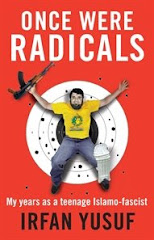
Irfan Yusuf is a Sydney lawyer and author of the forthcoming book Once Were Radicals. First published in The Canberra Times on 30 January 2009.

Delicious
Bookmark this on Delicious

Digg!

Get Flocked

Stumble Upon Toolbar

Thursday, December 11, 2008

OPINION: Muslim apathy & thick-Sheiks


Tanya Louise Smith, a young Australian woman who converted to Islam and eventually went to Yemen. She met up with some other Australians and started studying a more fringe form of Islam, which sometimes going by the name "salafi" or "wahhabi".

She married a Palestinian man, fell pregnant and went to Gaza to live with her in-laws. Her husband, who hoped to join her, was stuck outside thanks to the Israeli blockade and Egypt closing the border. You can read her story in The Australian here.

How did she and her Australian classmates end up pursuing studies in a more fringe form of Islam and in an apparently more radical institution?

No doubt some will say that it's logical that a person adopting Islam will become a danger to themselves and society. Since 9/11, it has become fashionable in some circles to equate the 14 centuries of evolving religious tradition known as Islam with just about all the ills of the world.

Hence, anyone who says anything even remotely positive about the "i" word is treated as if they've just screamed out the "f" word repeatedly on TV.

Still, let's not live in denial. There are a bunch of crazies out there happy to make a political point by blowing themselves up or flying jet aircraft into skyscrapers. They have their own peculiar ideology, and their message is essentially a political (as opposed to a religious) one. This explains why Osama bin Ladin's taped messages are always dominated by references to political grievances.

A major problem bin Ladin has is that he follows a sect of Islam that Smith adopted. This particular sect is the official religion of the Kingdom of Saudi Arabia, though apparently only a minority of Saudis actually follow it. In the non-Saudi world, it is regarded as quite heterodox.

Some Muslims (especially shia Muslims) regard it as downright heretical.

So bin Ladin is a wahhabi. He also was for many years (but not anymore) a Saudi citizen. However, that doesn't mean all Saudis and/or Wahhabis are sitting on the "friends" section of bin Ladin's Facebook page, even if some scribes think they are.

We have some Wahhabis in Australia but not a huge number. At least one of them says he meets with the boys and girls from ASIO fairly regularly to "talk about everything".

More extreme Wahhabis do recruit, though their efforts among first generation Muslim migrants haven't been too successful. Why? Because these migrants have been spiritually and ideologically inoculated against any extremist influence.

When you grow up in Pakistan or Turkey or Indonesia or other Muslim country, you develop a sense of what mainstream theology is.

But what happens to those who haven't gone through this mainstream religious osmosis? What happens to young kids brought up in Australia?

It's no secret that extremists target young people and converts. Sean O'Neill and Daniel McGrory, two British journalists working with The Times, wrote a book in 2006 entitled The Suicide Factory: Abu Hamza And The Finsbury Park Mosque.

The book tells the story of how radical preacher Abu Hamza recruited the children and grandchildren of Muslim migrants and a small band of converts. Some of his former students were among the London bombers.

Abu Hamza's group took advantage of the weak management of religious institutions. British Muslims are largely of South Asian extraction whose cultures regarded involvement in religious institutions as a rather lowly endeavour.

Mosque managers also saw their institutions as places where they could keep alive the culture they left behind in Pakistan or Bangladesh in the 1970s. Hence, mosques are stuck in a cultural time-warp, relics of religious and social attitudes that are rarely found even in modern South Asian countries.

Into this vacuum strode Abu Hamza and his cronies, many of whom had criminal records for violence and fraud offences. After being removed from one small mosque, Abu Hamza set his sights on the large Finsbury Park Mosque built with Saudi money and supported by Prince Charles.

Could someone like Abu Hamza just as easily operate in Sydney or Melbourne? The descriptions in The Suicide Factory given of the parlous state of British Muslim institutions – political intrigue, scarce resources wasted on litigation, cultural irrelevance to name just a few - are what I've seen in Australia for over two decades.

Of course, Muslim Poms and Aussies are as dissimilar as Catholic Brazilians and East Timorese. But what many mosques in both the UK and Australia share is disregard for the spirirtual needs of second and third generation Muslims and converts.

Further, Muslims are by and large a very secular lot most of whom will only be seen at the mosque on the two major feast days. You don't see prominent Muslims from BRW's top 100 list getting involved in managing religious institutions.

The good news is that young Muslims are taking control of their own spiritual destinies. Young Muslims are looking to Europe and the United States for sensible relevant voices like Hamza Yusuf Hanson and Tariq Ramadan.

The only opposition they face is from a coalition of radical thick-Sheiks who label them infidels and radical neo-conservative pundits for whom the only good Muslim is an ex-Muslim.

Young educated Muslims are now taking over religious institutions. The new face of the Lebanese Muslim Association in Lakemba is a surfing sheik who visits schools with a young rabbi. And you can watch the CEO of the Islamic Council of Victoria compering an SBS talkshow each Wednesday night, while a member of his executive is a stand-up comic who wants to run for Mayor in the Sydney's Camden.

An Australian Islam with a genuinely Aussie accent is a key element to ensuring the Abu Hamza's of this world don't gain a foothold in Australia, and that the Tanya Smith's can learn their faith without having to travel into a culturally unfamiliar environment.

First published in ABC Unleashed on 9 July 2008.

Words © 2008 Irfan Yusuf

Delicious
Bookmark this on Delicious

Digg!

Get Flocked

Stumble Upon Toolbar

Wednesday, July 02, 2008

COMMENT: Muslim Aid Australia and Interpal


Richard Kerbaj writes in The Australian today of an Australian aid agency which has allegedly breached Australia’s anti-terror laws. Muslim Aid Australia (MAA), in conjunction with Muslim Aid UK, has been raising funds for Palestinians in Gaza caught up in the Israeli-enforced blockade arising from Gaza’s takeover by HAMAS. That aid has been allegedly channelled through another UK-based charity called Interpal, a proscribed organisation under Australia’s anti-terror laws.

The current Consolidated List of proscribed terrorist organisations and individuals has over 1,000 persons and entities listed. It’s an offence to hold assets on behalf of anyone on the list or to make assets available to them. This is all part of the terrorist assets freezing regime, details of which can be found here.

Interpal, also known as the Palestinian Relief and Development Fund, is number 462 on the list. It was proscribed by former Foreign Minister Alexander Downer on 21 November 2003, well before the HAMAS takeover of Gaza in June 2007 and the Israeli-enforced blockade. Kerbaj claims that MAA has channelled funds to Gaza via Interpal, an organisation proscribed under US and Australian legislation but not proscribed under UK legislation. Interpal is known to work with mainstream organisations working on the ground in Gaza such as the United Nations Relief & Works Agency for Palestinian Refugees (UNWRA) that works with Palestinian refugees living in camps in the Occupied Territories, Lebanon and other places.

Kerbaj provides a list of MAA “principal directors”. Curiously, he mentions where each director was born. I’m not sure how this is relevant to the story, especially since all directors are known to be Australian citizens (or, at the very least, Australian permanent residents).

It’s unknown how many other Australian aid agencies have channelled funds and other forms of aid to Gaza through Interpal. However, the fact that UNWRA works with Interpal raises some interesting issues. Such as how any aid organisation is expected to deliver aid to Palestinians without involving Interpal in some way, shape or form.

The other problem is with the legislation itself, which relies on the executive adding an individual or organisation to the list. Interpal was listed in 2003, allegedly because it was linked to HAMAS. Yet the reality is that HAMAS has been running various health and welfare-related projects (such as clinics and schools) since even before the Palestinian authority was established. Indeed, Israel encouraged HAMAS in these activities in the hope that HAMAS would act as an effective counter to the Fatah-led Palestine Liberation Organisation which Israel regarded as its enemy.

Given that HAMAS is now ruling Gaza, how can any organisation deliver aid to Gaza Palestinians without in some way involving HAMAS or a HAMAS-related entity? The listing of Interpal by former Foreign Minister Downer on the Consolidated List now effectively means that Australian aid agencies cannot donate to help the people of Gaza at all. I doubt this is what Downer intended when he made the directive in relation to Interpal.

Further, Australia has chosen to follow the lead of the United States instead of the UK, which has twice found Interpal having little or no substantive link to HAMAS. The United States doesn’t exactly have a brilliant record in proscription of individuals and groups as terrorists. ABC reported that the US only recently removed former South African president Nelson Mandela from its terrorism watch list.

Words © 2007 Irfan Yusuf

Delicious
Bookmark this on Delicious

Digg!

Get Flocked

Stumble Upon Toolbar

Tuesday, May 20, 2008

EVENTS: Suffer the little children ...


Christ is reported to have once said ...

Suffer little children, and forbid them not, to come unto me: for of such is the kingdom of heaven.


Two thousand years later, the people of his town are suffering. Now the Sydney-based Friends of Bethlehem have put on a superb exhibition of children's art. It starts tomorrow, 21 May 2008. Don't miss it.

Words © 2008 Irfan Yusuf

Stumble Upon Toolbar