Showing posts with label Iraq. Show all posts

Monday, August 03, 2015

BOOK: Hilarious book by an Iraqi-Iranian-Australian artist


What’s it like to live on the fringes of society, to be an outsider. First, second and third generation Muslim of migrant heritage often complain of being marginalised. But what would it be like to be a marginal person in more than one home country?
Osamah Sami’s family knows exactly what this is like. His late father, a religious scholar and leader to a Shia congregation in northern Melbourne, grew up in Iraq as a young man keen on reading foreign newspapers. Tortured by the regime of Saddam Hussein, he fled to Iran.
Osamah was born a foreigner. Despite belonging to the same religious denomination as the Iranians around him, Osamah was an Arab, not a Persian. His mother made him wear a long robe, not jeans like his Iranian friends.
But worse still, Osamah’s family were Iraqis living in Abadan, a border town. He and his neighbours lived under the shadow of Iraqi bombs, mortars, missiles and gas raining down on the city during the 1980’s war between Iran and Iraq. They also suffered from the constant suspicion and prejudice from those deemed more Iranian, more Shia and more Muslim than those who spoke Arabic. The language of the Prophet and the language of the enemy were one and the same.
Things weren’t made easier by the fact that Osamah’s father and uncles were fighting in the Iranian army, possibly against their former Iraqi relatives and neighbours. Amongst the drama and tragedy, the author manages to insert much laugh-out-loud humour.
Indeed, tragicomedy is an appropriate description of the book. Osamah’s childhood reflections of the hypocrisies of Iranian theocracy make an excellent antidote to those who would make us believe that the solution to our woes necessarily lay in the Islamic state. All the religious police in the world could not stop Muslims from identifying more by their tribe or sect. Kurds did not cease being Kurds. Iraqi Shia Muslims were still deemed Iraqis and potential enemies of the state. All this during the age of jihad against thee Great Satan and its cronies.
There were no long term prospects for Osamah’s family. The family moved from Abadan to the university city of Qom, where his father pursued studies to become a religious scholar. Later he was invited to Melbourne to officiate for religious ceremonies. Eventually, the family applied to migrate as refugees.
Much of the book is structured around a visit the adult Osamah made to Iran with his father. They arrived at the city of Mashhad in 2013, enjoyed a traditional falafel roll together and returned to their hotel. Osamah went for a walk while his father quietly moved onto the afterlife. Whilst dealing with his own grief, Osamah also had to deal with Iranian bureaucracy. “Policy is policy,” he would be told whilst forced to leave his Australian passport in the hands of anonymous officials in Mashhad before travelling some 900 km across a huge desert to Tehran.
Good Muslim Boy is a superbly hilarious read that will make you realise that even the most religious place can be filled with testosterone and even an imam’s son can get upto no good while maintaining his father’s affections. Terrific.
This review was first published in the Australasian Muslim Times on 31 July 2015.

Stumble Upon Toolbar

Thursday, May 07, 2009

VIDEO: The brutal practice of daughter exchange ...

Normally we should take for granted that people will mix religion and culture. The idea that religious practice can only exist in a cultural vacuum is absurd. But what happens when those cultural influence leads to the exploitation of women?

The following video from Al-Jazeera English shows the tragic results of certain cultural practices being enforced by religious leaders among Kurdish Muslims in Iraq. The text accompanying the video is as follows:

In the tribal areas of Kurdistan in northern Iraq, arranged marriages have been a way of life for centuries.

But society is changing. Families who engaged their daughters when they were still children are now renegotiating old contracts.

Nicole Johnston reports from Rania district, where some girls are choosing death over an arranged marriage.


Words © 2009 Irfan Yusuf


Delicious
Bookmark this on Delicious

Digg!

Get Flocked

Stumble Upon Toolbar

Saturday, April 04, 2009

VIDEO/IRAQ: Zahra weeps for her husband ...

Iraq under Saddam Hussein was a nasty place. There was little political freedom. Opposition figures were murdered, as were any persons deemed by the regime to belong to the opposition.

At the same time, there was security for ordinary Iraqis. It was a time when Iraqis lived side by side, when even the most devout intermarried across sectarian lines. Then the Americans and Brits came and toppled the dictator Saddam Hussein. The vacuum was filled by various forces - Al-Qaeda, Iranian Revolutionary Guards, sectarian militias and criminal gangs.

Sectarian strife is new to Iraq and has split apart families including the family featured in the following documentary entitled City of Widows, shown on the AlJazeera English documentary show Witness. Here is a short summary of the videos.

Filmmaker Rashad Radwan follows Zahra, a Shia in Iraq, as day after day, she visits police stations, hospitals and morgues in a desperate search for her kidnapped husband, and in the face of disapproval from a society where widows are still expected to be invisible.
The documentary is in two parts.

Words © 2009 Irfan Yusuf


Delicious
Bookmark this on Delicious

Digg!

Get Flocked

Stumble Upon Toolbar

Friday, January 30, 2009

OPINION: No such thing as a monolithic Muslim state of mind ...


Politics and foreign policy can be so confusing. Let's look at Iraq, for example. The conventional wisdom is that we went to war against Saddam Hussein in 2003 and overthrew his government for a variety of reasons, including that Iraq was a crucial battleground in the so-called war on terror. The former Iraqi dictator is said to have had direct links with an Islamist terrorist organisation, al-Qaeda. We were at war with al-Qaeda. Hence we had to make war on Saddam.

Now let's move to the present and another conflict. Israel claimed to be fighting a war on terror of its own recently in its bombardment on Gaza. Israeli spin doctors told us that their war wasn't against the people of Gaza but against Hamas, an Islamist terrorist organisation dedicated to Israel's destruction through firing thousands of rockets and sending suicide bombers into Israel.

See the connection? The war on terror is always a war on political Islamists. It isn't a war on Muslims as such, nor is it a war on the Islamic religion or on nominally Muslim countries. The battle we wage is against political Islam, an ideology that seeks to establish an Islamic state.

That's the rhetoric. But what is the reality?

Before the outbreak of the first Palestinian intifada in 1987, what we now know as the virulently anti-Israel militia Hamas was created from an Israeli-backed network of social welfare projects (including clinics, schools, libraries and other facilities) operated under the auspices of the Muslim Brotherhood, an Islamist movement founded in Egypt by one Hasan al-Banna. At the time, Israel and the Tunis-based PLO had not signed the Oslo Agreements. Israel's line was that it would not negotiate with Yasser Arafat's PLO because it was a terrorist organisation. Israel also knew that the Brotherhood' s reputation for scrupulous honesty would make it an excellent alternative to the PLO.

So when it suited Israel's desire to drive a wedge between Palestinians living in the Occupied Territories and the Palestinian diaspora-based PLO that Israel then labelled a terrorist organisation, Israel was quite happy to deal with another organisation it now labels terrorists.

The Muslim Brotherhood's Islamist credentials and ideology weren't seen as an obstacle to its establishing a host of institutions in the West Bank and Gaza.

But don't take my word for it. A report from United Press International on June 18, 2002 cites documents obtained from the Israeli-based Institute for Counter Terrorism to the effect that Hamas was legally registered in Israel in 1978 by Sheik Ahmed Yassin, the movement's spiritual leader, as an Islamic association by the name of Al-Mujamma al-Islami, which widened its base of supporters and sympathisers by religious propaganda and social work.

The report also cites US administration officials saying funds for the movement came from the oil-producing states and, directly and indirectly, from Israel.

Back to present-day Iraq. Thousands of US and British soldiers have lost their lives defending a democratically elected Iraqi Government. After the 2003 invasion and the toppling of its Ba'athist regime, an Iraqi Governing Council was set up and an interim constitution drawn up, which became the basis for Iraq's current constitution. Among the experts assisting in the drafting of this document was Noah Feldman, Rhodes scholar and Harvard University professor of law and Islamic studies.

Feldman is hardly what some might describe as an apologist for political Islam. He has intimate first-hand knowledge of Iraqi governance and law. Feldman openly says Iraq's constitution establishes an Islamic state. Coalition troops are putting their lives on the line to defend the very political agenda the war on terror was supposedly designed to fight.

In other words, all this hysteria about political Islam is little more than a rhetorical cover for what are really just the usual political manoeuvrings one expects in relations between states.

This isn't so much about defending our freedoms against those who allegedly hate our way of life though in the case of anarcho-Islamist syndicates like al-Qaeda and Jemaah Islamiah the rhetoric largely reflects reality.

What we need to understand is that political Islam isn't in itself the enemy. If it were, American and British troops wouldn't be in Iraq today. And if, as President Barack Obama has promised, US troops are withdrawn, it will not be because the US has abandoned Iraq's democratically elected Islamist Government. Indeed, President Obama has indicated that US troops from Iraq will more than likely be deployed in Afghanistan to fight combined Taliban and al-Qaeda forces and the odd insurgency movement. Even in Afghanistan, our allies, led by President Hamid Karzai, are (at least on paper in the Afghan constitution) committed to maintaining Afghanistan as an Islamic republic, albeit a democratic one. The Afghan Government consists of the remnants of old Afghan jihadi factions which once waged war on the Soviet Union, again with support from the West.

In his 2008 book The Fall and Rise of the Islamic State, Professor Feldman argues that the struggle is not between secularism and theocracy. Religion and government are not necessarily seen in many Muslim-majority states as polar opposites. Instead, in the primary battlegrounds of Afghanistan and Iraq, democratic political Islam is allied with the West against what are in essence forces of anarchy.

Being moderate isn't the same as separating mosque from state. Saudi Arabia is classed as a moderate ally of the West but could hardly be described as secular. Muslim-majority states such as Indonesia, Turkey and Kosovo are fiercely secular, even if religion plays a significant role.

With George W.Bush back at the ranch and his neo-conservative advisers and their array of think-tanks and mercenary commentators (including pundits who during the US presidential campaign were obsessed with the Democratic candidate's middle name) largely discredited, now is a good time to adopt a more nuanced approach to our relations with Muslim countries, among them our closest neighbour, Indonesia, which also happens to be the world's most populous Muslim nation.

As President Obama said in his inauguration speech, we in the West must seek a new way forward, based on mutual interest and mutual respect.

That can be achieved only when we seek to understand the interests of Muslim electorates and to respect their political aspirations, whether these have more secular or religious outcomes.

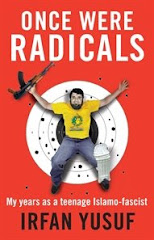
Irfan Yusuf is a Sydney lawyer and author of the forthcoming book Once Were Radicals. First published in The Canberra Times on 30 January 2009.

Delicious
Bookmark this on Delicious

Digg!

Get Flocked

Stumble Upon Toolbar

Saturday, January 26, 2008

COMMENT: Ordinary Australians, extraordinary stories ...

One of the great things about Melbourne is its newspaper, The Age. And this Australia Day edition is no exception. Under the heading “Looking at the bigger picture”, a number of Age writers profile ordinary Australians with extraordinary stories.

They include a farmer, an AFL player, an activist for seniors and a surf lifesaver. But also rating a mention is my good pal Constable Maha Sukkar, whose name apparently means “very sweet” in Indonesian. I doubt some of those she arrests would agree.

Also profiled are a probationary constable Nadia Hammoud, youth worker Nadia Mohamed and SIEV-X survivor Faris Shohani.

About Faris, The Age writes ...

Mr Shohani’s life as a non-citizen began when, at the age of 13, his family was deported to Iran from Iraq. He is a survivor of the SIEV-X tragedy of October 2001, when 354 asylum seekers perished when their overcrowded boat sank en route to Australia. Among those who drowned were his wife, Leyla, and daughter, Zahra.

Other members of his family, including his mother, Fadilha, and son, Ali, had been on another boat and were in the Woomera detention centre when they were told of the tragedy.

While most of the 45 survivors were swiftly offered permanent protection in other countries, those such as Shohani with relatives in Australia had to wait almost nine months in Jakarta before he was reunited with his mother and son and afforded just temporary protection.

When The Age first met him in October 2002, his depression was palpable. Compounding the grief, and the conviction that the truth about the tragedy had not been told, was his temporary status.

"I have no hope, no future," he said. "I belong nowhere."
Well now, Mr Shohani, you belong to the big family of Australians. We’re sorry you had to go through that kind of suffering to reach this far And we as a nation are very fortunate to have you among us.

Words © 2008 Irfan Yusuf

Stumble Upon Toolbar

Wednesday, January 16, 2008

BOOK REVIEW: Diversity the destination for journey into Islam

On The Road To Kandahar: Travels Through Conflict In The Islamic World
by Jason Burke
Penguin
320pp

____________________

It is one thing to be a cultural warrior, to speak boldly about an allegedly monolithic enemy and to instil in readers fear of people they (and, indeed, the author) have never met.

It's another to actually visit this enemy on their home turf and discover that, deep down we all really share the same dreams and hopes and aspirations. And to discover that your enemy isn't a monolith after all but is really a reflection of the complexities of your own society.

In other words, to discover that we don't have to be enemies after all.

Jason Burke, chief reporter for the British newspaper The Observer, falls well into the latter category. His most recent book, On the Road to Kandahar: Travels through Conflict in the Islamic World, is one people of all faiths (including, or rather, especially Muslims) can learn much from.

This is Burke's second book on the politics of the nominally Muslim world. It follows on well from his first, which tells the story of radical Islam as being more than just a single group labelled by pundits and politicians as al-Qaeda.

What makes his second book so important is that his focus is not just on political and religious leaders in war zones. He isn't content to fly in for a day or two to Baghdad or Southern Thailand, arrange a few appointments, chase after stringers and repeat the usual analyses. He doesn't just want to tell us what we want to hear or our supposed enemies want us to hear.

Instead, Burke insists on spending (pardon the cliche) quality time with a broad range of people.

Classical Islamic scholars teach that Islam cannot be learned just from books. Rather, one needs to engage in sohbet, to spend time in the environment of those who know and practise Islam and to absorb Islam through a kind of spiritual osmosis.

Burke insists on learning about Muslims through a similar process. So, when visiting Iraq during the time of Saddam, Burke doesn't talk just to whomsoever Saddam's Information Ministry allows him to. He keenly observes and patiently absorbs the general environment, letting the words and behaviour of even the most ''menial'' people (including an 11-year-old-child named Bilawal at a primary school) give readers some idea of the broader environment in which he reports.

Notwithstanding the somewhat left-of-centre reputation of his newspaper, Burke is not stereotypically critical of the role of the United States in Muslim countries. He doesn't, for instance, buy the argument that the Americans were only in Iraq to protect their oil interests. He also recognises the enormous risks taken by well- meaning soldiers and civilians from coalition forces in Iraq, many of whom want to make a real difference to the lives of ordinary Iraqis.

Burke uses the Algerian experience to show why Islamists can gain support at a grassroots level when existing secular administrations are too short-sighted and corrupt. Here he discovers the importance of

... the middle ground, the mass of moderate opinion, the huge weight of the population who just wanted a decent life for themselves and their friends and family.

That middle ground can exist in any country, Muslim or otherwise.

After all his time in various zones of conflict in the nominally Islamic world, Burke realises the enormous variety of Islams (as opposed to a single Islam) that exists. This is a lesson anyone who has travelled and spent time in more than one Muslim-majority state will take for granted. It is also a lesson that self-serving Muslim spokespersons in Western countries should learn.

Surely the easiest way to demonise a group is to portray them in a monolithic fashion. Muslim leaders in Australia who pretend, in their own communal and political interests, that there is just one Muslim community (which they conveniently represent) are not only doing Muslims a disservice. Their claims reflect either complete ignorance or total dishonesty.

Burke concludes with some reflections on the London bombings, to whose victims he dedicates his book.

And if the London bombings had taught me anything it was that to gather people together, whether hundreds of millions of people across huge swathes of the planet or fifty people in a tube carriage, and demarcate and label them and designate them simply as one thing or another, as enemies or friends, as Westerner or Eastern, as Muslims or non-Muslims, as believers or non-believers, is something no one should ever do.

In short, the things that divide us within communities are, in truth, the things that truly unite us as human beings.

Irfan Yusuf is associate editor of AltMuslim.com and winner of the 2007 Allen & Unwin Iremonger award for writing on public issues. This review was first published in The Canberra Times on Saturday 12 January 2006

© Irfan Yusuf 2008

Stumble Upon Toolbar

Sunday, October 28, 2007

COMMENT: Baghdad - once a city for all faiths ...

The October 7 2007 edition of the New York Times magazine includes a profile of Iraqi-American author Kanan Makiya, who wrote (under the pen-name of Samir al-Khalil) one of the most influential biographies of Saddam Hussein.

There's plenty in the profile to blog about. Despite spending much of his undergraduate years a supporter of the Palestinian cause, Makiya wasn't exactly fond of fellow Columbia University Professor Edward Said. Makiya promised George W Bush on the eve of the Iraq invasion that Iraqis would greet US forces with "sweets and flowers".

What particularly struck me was the description of historical Baghdad. The profile speaks of perhaps Makiya's most important achievement - the documentation of Saddam Hussein's atrocities under the auspices of the Iraq Memory Foundation.


Since 2003, Makiya and his small staff have scoured Baath party offices and dungeons, adding to a collection that would reach more than 11 million pages of records. And they began filming interviews with the regime’s victims. 

Makiya’s dream was to build a museum for the archives on the site of the Victory Arch, the memorial commissioned by Hussein to commemorate Iraq’s so-called triumph in the Iran-Iraq War ... Among the foundation’s most vivid achievements are the 190 videotaped testimonies from Hussein’s victims. They include Sunnis, Shiites, Kurds and even Jews.

One of these testimonies takes us back to a time when Baghdad was a centre of Jewish cultural life. Thanks to the infiltration of Ba'athist ideology, the tolerance of devout Iraqi Muslims was undermined. Suddenly, anyone deemed non-Arab became a target. And supporting Palestinian rights became a cover for some of the most virulent and despicable acts of anti-Semitism.


In December 2003, at the age of 98, Shao’ul Sasson, for example, described his arrest and torture at the hands of the Baath Party police. Sasson, who died in 2005, was an Iraqi Jew. As late as the mid-1930s, Baghdad was one of the world capitals of Jewish life, with Jews making up a third of its population. Most of Iraq’s Jews either fled to Israel or were expelled beginning in the late 1940s; most of the rest were harassed or killed. In January 1969, in one of the Baath Party’s first displays of public brutality, 13 Iraqi Jews and 4 other men were hanged in a public ceremony in Baghdad before a crowd of about a half million people. Iraqis were bussed in from around the country to witness the event.
“I was born in Baghdad,” Sasson says on the videotape. “My father was the chief rabbi. He sent me to a Jewish school to learn Hebrew, but I can’t remember much of it.
“I was working for Mohammed al-Damarchi. My salary had been stopped because I was Jewish, and there was a warrant out for my arrest. They knocked on the door and asked for Shao’ul. 

“My wife said, ‘Let him take his clothes or put something on,’ but they said there was no need, as I would be brought back soon. They blindfolded me and took me away. I could tell we were going to the notorious Al-Nihaya Palace prison, because I lived in the same area. . . . They asked me to confess to everything, but I told them I didn’t have anything to confess to. And yet they insisted I must. They brought a metal bar and hit me on my legs. I fell into the wall and broke two teeth. Again, they told me to confess and hit me on the legs. Again, I fell and broke a few teeth. I lost 9 or 10 teeth that day.
“I saw Abdul Rahman al-Bazzaz (the former prime minister). They had hung him up and burned his tongue with matches. . . . My worst experience was the day I saw all the prisoners hanging up on either side of the corridor. 

“They put me in a cell where the floor was covered in urine and feces. I couldn’t bear to stay in it, so I would bang my head hard against the wall in an attempt to kill myself.”


The Prophet Muhammad is reported to have said: "Those who so much as lay one finger on the dhimmi (non-Muslim citizen of an Islamic state) will have me witnessing against them on the Day of Judgment."

Sadly, so many Muslim politicians like to flex their political muscle at the expenses of non-Muslim minorities. Those of us fortunate enough to live as Muslim minorities in non-Muslim countries should be at the forefront of campaigning for non-Muslim minorities in Muslim countries.

© Irfan Yusuf 2007

Stumble Upon Toolbar

Thursday, April 05, 2007

CRIKEY: In search of consistency: How Kevin Andrews applies his ministerial discretion ...


Immigration Minister Kevin Andrews has a residual discretion to refuse a visa to anyone, an authority he describes succinctly as follows:

It's unrelated to religion, it's related to whether there is a risk to our national security, whether there is a risk to vilification of segments of the Australian community, inciting discord, these are the sorts of criteria which are looked at under these provisions.


But for the discretion to make any sense, it must be exercised consistently. The Government looks a little stupid banning Wahhabi speaker Bilal Phillips as a security threat whilst allowing in Alex Vella, the head of a violent bikie gang with a criminal record.

And why has Andrews (or his predecessor) not banned speakers who engage in "vilification of a segment of the Australian community"? Or does Andrews think it's OK for Mark Steyn and Raphael Israeli to generate hatred toward 360,000 Australians of a certain faith? Does Andrews believe that some Australians are more deserving of vilification than others? Is this really unrelated to religion?

I'm no fan of the theology of a fringe Muslim sect founded in the Arabian peninsular by one Muhammad bin Abdul Wahhab, or of its promoters like Dr Bilal Phillips. Bilal Phillips featured prominently on the UK Channel 4 documentary Undercover Mosque. He's visited Australia before on at least one previous occasion. But is he a national security threat?

The Hun got its Muslim sects confused, claiming yesterday that Phillips "holds to a radical form of the religion", unlike another invited scholar (Sheik Jafar Idris) who "espouses the radical form of Islam known as Wahhabism". Nonsense. They're both Wahhabis.

The tabloid further claims Phillips promotes certain criminal sanctions on Fridays. But is defending elements of Saudi criminal law the same as calling for its implementation in Australia?

Phillips isn't the first Wahhabist scholar to be banned. Abdur-Raheem Greene, a UK-born Wahhabist, copped a similar ban in August 2005, despite delivering a number of speeches across the Tasman.

DIAC-heads last year delayed issuing a visa to Malek Triki, Al-Jazeera's London correspondent, who was keynote speaker at a conference organised by UTS and Macquarie University. On that occasion, it's believed DIAC-heads thought Triki looked and sounded a little too much like Saddam Hussein's surname of Tikriti.

Yep, those Muslims certainly are a triki bunch!

First published in the Crikey daily alert for 5 April 2007.

© Irfan Yusuf 2007


Stumble Upon Toolbar

Sunday, May 15, 2005

COMMENT: Now Is Not The Time ...

Imagine your brother or son working as an engineer in Iraq has been kidnapped by insurgents. Imagine you have been told by your elected officials that they will not negotiate with his captors.

Then imagine if you know that an Australian Muslim leader may be able to help. What will you do? Will you refuse to take a chance because of anti-Semitic remarks he made about Jewish people over a decade ago? Will you not approach him because of recent remarks he made in Lebanon during some Friday sermons?

Of course not. You would do anything to save your loved one.

The Howard government sent thousands of young Australian servicemen and women to Iraq. Many of these young Australians are still there, risking their lives to keep (or rather, create) the peace. Yet the Howard government has said that it will not negotiate with those holding an Australian citizen captive.

I am sure Ministers will be wishing there was some way they could save Mr Wood without giving terrorists the legitimacy that they simply do not deserve. And revelations in the Sun-Herald on May 15 of a gentleman’s agreement between Mr Ruddock, Keysar Trad and Imam Hilaly are proof that the Government is trying to do what it can.

Yet two issues arising from this whole affair are of particular concern.

Firstly, the attitude of neo-Conservative pro-Government commentators is cause for concern. At least 3 major columnists have made vicious attacks on Imam Hilaly, raising decade-old allegations of anti-Semitic remarks. These commentators express their distaste with Imam Hilaly being used as a go-between and a negotiator. Some have virtually accused him of using the Wood family’s grief to gain publicity for himself.

I am not the world’s biggest fan of Imam Hilaly. I have criticised him publicly in various Muslim and wider community forums (online and otherwise). But on this occasion, I simply cannot find fault with what he is doing.

Hilaly is an old man with a serious heart condition. His personal life is not the best, and his office is in turmoil after his translator and adviser of many years was removed. Hilaly is caught in the cross-fire of 3 feuding Islamic councils vying for hegemony over the affairs of the Muslims of NSW.

Yet at the drop of a turban, the Imam has rushed to a war-zone, risking his life to save the life of a fellow-Australian. Whatever Hilaly may have said about Jews over 16 years ago, I am sure Australians of Jewish faith (and indeed of all other faiths and no faith) will be hoping and wishing that Imam Hilaly’s mission is successful.

Now is not the time for allegedly conservative columnists to attack the Shaykh. Let him do his job. Iraqis (including the terrorists) will not take the Shaykh’s mission seriously if they go to the web and read respected columnists in major Australian media outlets attacking the Shaykh. Criticising the Shaykh at this time, apart from causing enormous distress to the Wood family, will effectively undermine efforts to free Douglas Wood.

But apart from the irresponsible comments made by commentators (tabloid and otherwise), there is a matter of greater concern. It seems that our foreign affairs apparatchiks in Canberra may not have the extensive knowledge and contacts in the Arab world needed to deal with such situation should it arise in the future.

That a country with such a large, diverse and educated Arabic-speaking community does not have more such people in our intelligence and foreign affairs agencies is cause for concern. How can we fight ‘Islamist terror’ when we do not have the people who can speak the language and understand the culture of many terrorist groups?

One important lesson our government can learn is that it cannot afford to ignore the potential for Arab and Muslim Australians to contribute to our national security and our diplomatic efforts. Muslims are not just good for securing IOC delegates’ votes for the 2000 Sydney Games, or for opening up export markets in halal meat.

If major Australian financial institutions, telecommunications companies and large commercial law firms are happy to involve persons of Arab and/or Muslim backgrounds in sensitive leadership roles, why can’t our government, intelligence and diplomatic agencies?

I am not suggesting that our government agencies activeky discourage the involvement of persons of a particular background. Nor do they discriminate. And nor am i suggesting that private sector personalities positively discriminate. And I certainly am not suggesting that positive discrimination on the basis of ethnicity or religion is the solution.

What I am saying is that, in the current environment, even the most Aussie of Mossies are not exactly the social flavour of the month. Years of bad press, especially since September 11, are taking their toll. And as the Wood saga shows, it is not just Aussie Mossies who are suffering as a result.

But it works both ways. Muslim Australians need to come out of the closet. They cannot allow the Islamophobic tendencies of ignorant shock jocks and infantile columnists to dictate the extent of their contribution to this wonderful country we all call our home. It is their duty to God that they show their service to Australia with greater gusto.

Australians need and deserve to be reassured. Aussie Muslims need to find voices that communicate in a language all Australians can understand and appreciate. Even if some claiming greater loyalty to Australia oppose them.

Stumble Upon Toolbar

Tuesday, March 22, 2005

BOOKS: The More Regimes Change, The More They Stay The Same

Revolution Day – The Human Story of the Battle for Iraq
By Rageh Omaar
Viking, 2004
250pp


This is not your average account of the Iraq War and its aftermath, a process often labelled “regime change”. Most reporting and writing on Iraq has focussed on the sayings and actions of world leaders, defence and foreign ministers, military commanders, weapons inspectors and UN officials.

As the main correspondent covering the war for BBC television, Omaar will have been tempted to stick to the same formula. Thankfully he resisted the temptation. The end result is a book genuinely attempting to see the war and its aftermath through the eyes of ordinary Iraqis.

Omaar’s own parents were refugees from the civil war in Somalia. Despite having spent most of his life in the UK, Omaar speaks fluent Arabic.

One of the main themes of the book is how the Coalition forces failed to save Iraqi infrastructure and institutions from looting and arson. Thousands of priceless ancient Mesopotamian relics were stolen from the National Museum, and key ministries were ransacked. The building blocks of any future government were largely destroyed. Even Iraq’s Reserve Bank was looted and millions of US dollars stolen.

None of this seemed to phase the Coalition troops, who watched Iraq’s culture and wealth being looted whilst guarding the Iraqi Oil Ministry.

Omaar also witnesses many Iraqis welcoming the invasion thinking it would bring them liberty, peace and security. They were soon disillusioned as their sons, husbands and other male relatives were carted off. Many have not resurfaced. Others are only seen in photographs taken in the Abu Ghraib Prison.

Saddam Hussein, the man who built Abu Ghraib, ruled Iraq using terror and torture. His regime humiliated ordinary Iraqis and forced them to face the brunt of sanctions that killed hundreds of thousands of children. Many highly educated Iraqis were forced to sell their valuables to UN officials and foreign journalists at secret auctions. Meanwhile, Saddam and his cronies continued to live the good life in huge palaces.

With the fall of the Baathist government, the United States installed another Baathist, Iyad Allawi. And if the Americans refuse to accept the results of the Iraqi election, they might just have to have another round of “regime change” to install yet another Saddam to do their bidding.

Read Omaar’s book and share his disgust at how the resources and wealth and culture and health and human capital of ordinary Iraqis is being plundered yet again. To think more of our own troops are being sent into this sickening process.

(This review first appeared in the Sydney-based Australia FAIR newspaper.)

Words © 2005 Irfan Yusuf

Delicious
Bookmark this on Delicious

Digg!

Get Flocked

Stumble Upon Toolbar