Showing posts with label religion. Show all posts

Saturday, September 24, 2011

COMMENT: There are frauds and then ...


A colleague who spent many years practising law in a set of Pacific Islands recently told me about a lawyer who arrived from the US to represent Fijian strongman George Speight in his treason trial. The lawyer tried to seek admission in Fiji. He claimed to be admitted in at least one American state, to have university qualifications in law, etc. After some investigations, it turned out the bloke was telling porky pies. Yep, this Navin Naidu chap was a complete fraud.

Which brings me to an upcoming interfaith event in Auckland organised by a group started in honour of a barrister whose qualifications are beyond question, indeed who was held in the highest regard by his profession and his nation.

The event involves 3 people. One is Douglas Pratt from the University of Waikato. You can read about Professor Pratt here. There is more here. This gentleman knows his stuff.

Another person to take part in this symposium is a chap known as Imam Afroz Ali.

This isn't the first time these two gentlemen have spoken on the same platform. In late June 2005, they held a symposium in Auckland. The promotional material described them as ...

Two eminent scholars on religion ...

Afroz Ali? A scholar of religion? But wait. There's more.

The other speaker, attending from Australia, is Mr. Afroz Ali of Sydney, also well versed in inter-religious matters, holding degrees in Islamic Studies and Shari'ah from Islamic University, Madina, Saudi Arabia ...

The man has not one but TWO degrees from the Islamic University of Madina. He holds ONE DEGREE in ISLAMIC STUDIES and ONE DEGREE in SHARIA.

Awesome. Now here's the thing. When Afroz Ali first started calling himself an "imam" and "religious scholar", a smart cookie I know from Melbourne used his contacts with the Islamic University of Madina admissions office. The result?

Yep. There is no record of an alumnus of that identity.

Indeed, I wonder whether Professor Pratt was aware of the fraudulent nature of Mr Ali's claims back in June 2005. Or whether he is aware now.

And I wonder if Afroz Ali has ever tried getting admitted to the Fiji Bar ...

Words © 2011 Irfan Yusuf

Stumble Upon Toolbar

Sunday, January 02, 2011

REFLECTION: Why Christmas is an Islamic Time of Year ...

From the Aussie Mossie blog first published 05 December 2005.

Christmas is hardly a fortnight away, and already some people feel affronted. What puzzles me is that some of these people claim to feel this way because of their Muslim faith.

Yet anyone who understands what Christmas is about will see nothing in it offensive to Muslim sensibilities.

Muslims believe the Jesus Christ is the Messiah. They believe his birth occurred by immaculate conception to the Virgin Mary, an miraculous act of direct Divine intervention. Muslims do not dispute that Jesus was born in Bethlehem, presently a Palestinian town in the West Bank.

You cannot be regarded as a Muslim if you do not believe in these key events of Christmas. The nativity scene is as much part of the Qur’an (the Muslim scripture) as it is of the New Testament.

I have the benefit of being exposed to both Christian and Muslim religious traditions. I attended Sydney’s only Anglican Cathedral School. I studied the New Testament in Divinity classes and attended weekly chapel services. My Indian Muslim parents insisted I be part of all Christian activities of the school.

At the same time, as a child, I grew up with the Qur’an. I learnt about the chapter of the Qur’an named after Mary which describes the nativity scene in great detail. In that chapter, it states that Mary chosen above the women of all nations and ages for the sacred task of giving birth to God’s Messiah.

Today, Bethlehem is a city where Muslims and Christians celebrate Christ’s birth together. It is not uncommon to see Muslims seated in the pews of the Church of the Nativity. During the most recent Israeli incursion into Bethlehem, both Muslims and Christians sought refuge in the Church.

Both ancient and modern realities of Bethlehem bring the two communities of Christ together. It makes no sense for Muslims to oppose the celebration of Christmas. In this regard, comments attributed to the Forum of Australia’s Islamic Relations (FAIR) in the Sunday Mail on 4 December are cause for concern.

In a press release dated 5 September 2005, FAIR director Kuranda Seyit denied suggesting that Christmas should be phased out of Australian life. The comments attributed to FAIR are certainly not echoed by Muslim leaders in other parts of Australia.

Of course, some will argue against Christmas being used to sell products. Even some Christians feel that Christmas is becoming too commercial, with more emphasis being placed on storewide sales than church services.

I personally feel that the sales themselves are a reflection of a broader Christmas spirit. Christmas is about celebrating Christ’s mass, the birth of Christ. It is a time when God showed His divine generosity by sending His Messiah to spread a message of love and compassion.

The New Testament Christ is a man who made time for the most marginalised members of society – tax collectors, sex workers and lepers. The Christ of the Qur’an was a man who brought the message of God’s mercy and love. Both versions involve celebrating a man whose life was itself a celebration of human kindness and generosity.

It therefore makes sense that people exchange gifts during this time. Retailers who choose to cash in on people’s generosity by offering incentives and sales for people are hardly doing society a disservice.

Islamic teachings state that money should continue to circulate through the economy. Money grows when it is in motion. Like still water stagnates, hoarded wealth is a source of many diseases of the heart. The cure for such diseases is generosity.

So this year, as in every other year, I will be sending Christmas cards to all my clients, Muslim and non-Muslim. I will also be sending a package to a close Muslim female friend for Christmas consisting of books of poems by the Muslim mystic Rumi.

The message of the Muslim saint Rumi, like that of the Muslim Messiah Jesus, was one of Divine love. I hope my fellow Aussie Muslims show traces of that love to their fellow countrymen and women of all faiths and of no faith in particular.
Words © 2005-11 Irfan Yusuf


DeliciousBookmark this on Delicious
Digg!Get Flocked

Stumble Upon Toolbar

Wednesday, August 19, 2009

REFLECTION: What Aussie Muslims must do for Christian minorities ...

The following post was published on the Aussie Mossie blog on Tuesday September 19 2006.

In today's Daily Telegraph and Canberra Times, I challenged the tiny but loud minority of infantile Muslim protesters to siddown and shuddup or find another religion. Today, I’d like to make some suggestions to the more mature Muslims living on either side of the Tasman.

In January, the Australia-Indonesia Institute sent me with a group of 4 other Aussie Muslims to Indonesia. That trip included a visit to a private Protestant university in Yogyakarta, that gorgeous Javanese town recently rocked by earthquakes and living in the shadow of a rather nasty volcano.

The students and staff at this university were all members of a religious minority in the world’s largest Muslim country. I couldn’t help but notice these Indonesians expressing virtually the same concerns Muslims express in Australia and New Zealand.

If Muslims aren’t concerned about the plight of Christian minorities in nominally Muslim countries like Indonesia, they shouldn’t expect anyone to care about their problems in Australia. Further, Muslims have strong theological reasons to act in this case. The Prophet Muhammad promised that on the Day of Judgment he would personally testify against any Muslim who caused the slightest injury to a non-Muslim citizen of a Muslim state.

With that in mind, here are some practical suggestions for Muslims:

a. Imams and Presidents of all local mosques contact and offer support to their local Catholic clergy.

b. All peak Muslim bodies and the PM’s Muslim Reference Group should write letters to embassies of all member-states of the Organisation of Islamic Conference (OIC) demanding their governments take all necessary steps to protect Christian churches and other property and to bring to justice anyone who so much as threatens Christian civilians and property.

c. The Boards of Imams of each State and territory should write to their equivalent boards in each province or state of each OIC state and (unless Phillip Ruddock deems this in some cases to breach anti-terror laws) to each Islamic party and remind them of their religious and legal responsibilities toward Christian minorities.

d. Prominent and wealthy Australian Muslims should sponsor full-page advertisements in as many English-language dailies published in OIC states as possible. These advertisements should remind Muslim readers of the extensive religious and legal duties Muslims have toward their Christian brethren.

These are just some of the things that come to mind.

Christian minorities have played productive roles in Muslim communities across the world. Christians like Dr Hanan Ashrawi and Amin Maalouf (author of The Crusades Through Arab Eyes) have defended Muslim perspectives in historical and political matters.

In Pakistan, the late Justice AR Cornelius, Chief Justice of the Pakistan Supreme Court from 1960 to 68, defended the rights of Pakistanis to implement Muslim religious law.

In Australia, the Catholic Church is at the forefront of not only defending the rights of (mainly Muslim) asylum seekers but also providing them with essential welfare services. Indeed, Christian churches have been far more active than Muslim organizations, a matter of enormous shame for Australian Muslims.

Indeed, the Pope himself has been at the forefront of supporting peace efforts in the Middle East. He has been a staunch critic of the Israeli incursions into Lebanon and Gaza, and expressed his concerns on these issues just days before his address in Germany.


Words © 2006-9 Irfan Yusuf

Delicious
Bookmark this on Delicious

Digg!

Get Flocked

Stumble Upon Toolbar

Friday, May 22, 2009

ADDRESS: A Common Word ...


Before I start, I’d like to pay my respects to the indigenous owners, the Gadigal people of the Eora nation, of this land.

Thank you for inviting me to join with you to celebrate the document entitled “A Common Word” (ACW). The document was prepared by some 138 Muslim scholars and intellectuals across the world and from every denomination, and was addressed to Christians of every denomination. The document sought a basis for discussion and cooperation between Christians and Muslims, whose combined population made up well over half the world’s population.

“Without peace and justice between these two religious communities,” reads the Summary and Abridgement, “there can be no meaningful peace in the world”. The document further stated that the “basis for this peace and understanding already exists ... [in] … the very foundational principles of both faiths: love of the One God, and love of the neighbour”.

The document then provides in detail the textual evidence for both these foundational principles in the Old and New Testaments as well as in the Qur’an and Ahadith literature.


Educating Theology

It’s all wonderfully esoteric and theological, but as many of you know, I am no theologian. Religious texts matter to me to the extent that I see them acted out by those around me.

We are very close to the grounds of a school managed by the Melkite Catholic Church. Each of the children attending that school will learn about their Christian faith and heritage from their teachers and school elders. They will learn this from studying the Bible and other religious works. But more importantly, they will learn this from their exposure to their Christian teachers and elders and community leaders and (hopefully) from their own families acting out the teachings of the Bible. They will learn how to be what Jesus Christ (p.b.u.h.) described as “the salt of the earth”. They will not only learn the words of the Ten Commandments, the Lords Prayer, the Sermon of the Mount and of Paul’s wonderful description of love and charity in I Corinthians 13.

Up the road from here is a Muslim independent school. Each child attending that school will learn about their Islamic faith and heritage from their teachers and elders. They will study the Qur’an, the Ahadith and other religious works. But more importantly, they will learn from their exposure to their Muslim teachers and elders and community leaders and (hopefully) from their own families acting out the teachings of the Qur’an and the Sunna. They will learn how to be what Muhammad (p.b.u.h.) described as people of “ihsan” who “worship God as if they see Him, and if not then they are at least conscious that He is seeing them”. They will learn the words of the Ayat al-Kursi, Surat al-Fatiha and the Prophet’s extraordinary communion with God after being pushed out of the city of Taif.

But like most Muslim kids brought up in Australia, I never attended a Muslim independent school. Instead, mine was a rather confusing and confused upbringing, a mish-mash of Urdu linguistic fascism, ecumenical north Indian Bollywood culture and very spicy food. So what I wanted to share with you today is how I learned my lessons in loving God and loving my neighbour. I learned these lessons from my parents, my (largely Christian) teachers at my Christian school and the few decent imams I was exposed to during my youth.


Common Values

For my middle class North Indian parents, the idea of a “Common Word” seemed almost superfluous. They took it for granted that Christianity and Islam taught the same values. But then, so did Hinduism, Sikhism, Judaism, Buddhism and other major religions. Mum taught me that the best people were generally the most religious, and that all religions taught you to be good to people.

At primary school, Thursday afternoon was devoted to what was called “scripture”. Volunteers were sent by various churches to take children whose families belonged to their denominations. Mum left it to me to attend whichever denomination I wished, and I’d flirt between Catholic and Anglican. Much of our time was spent studying Bible stories, and my favourite was the dramatic story of Joseph. It was a full-scale Biblical blockbuster in which the good guy came out on top in the end and showed extraordinary magnanimity to his foes who ironically were his own brothers.

I also enjoyed the nativity plays we’d perform during Christmas time. For some reason, I was always assigned the role of one of the three wise men from a strange country called “The East”. The other two wise men were a boy from New Guinea and Chinese girl dressed up as a boy. The baby Jesus was played by a white skinned doll, while our teacher insisted that Mary and Joseph be played by blond-headed children. Perhaps she thought Bethlehem was somewhere north of Scandinavia and that Mary and Joseph lived next door to Santa.

Later my parents wanted to extend my religious and secular education. Like many migrant parents, they wanted their children to have the best education money could buy, even if they could barely afford this amount of money. They ended up sending me to St Andrews Cathedral School, a very Protestant low church Anglican.School located in Sydney’s CBD. It was here that Christianity was less about culture and skin colour and more about values. My first school captain was the son of a Pakistani Anglican priest. I repeatedly learned, almost memorised, the beautiful words of Paul in 1 Corinthians 13 about the primacy of love.

Christianity was less about culture and more about values. It was about God loving us so much that he was even prepared to sacrifice a part of Himself, and about how we must show love to those around us. But the Islam I learned was in a strictly Indo-Pakistani cultural zone which I never quite understood. We didn’t have many Islamic books in English, and mum would read to me from books in Urdu.


Culture and Tribalism

When we associate religion and religiosity with culture, we turn it into a closed chop, into a club. We tribalise religion. The kids at my primary school could perhaps never imagine the existence of a Pakistani Anglican priest, let alone elect his son as school captain. But then, many Pakistani Muslims I grew up with also probably couldn’t imagine a Pakistani Anglican priest.

When people use religion and religious identity to serve tribal causes, the results are not only deadly but also highly irrational and involve a complete misreading of theology, history and reality – not just that of the “other” but also of our own. For instance, Christianity (or the so-called “Judeo-Christian” tradition) is often cited in support of prejudice against persons from the Middle East, forgetting that Christ himself wasn’t exactly Caucasian.

Conclusion

ACW reminds both Christians and Muslims that they can only find commonality by becoming (in a sense) fundamentalists, by returning to the fundamental themes of their faith. Tribalised religion is about turning people away, while Islam and Christianity are missionary faiths that seek to attract people.

The basic principles of loving God and loving one’s neighbour negate religious tribalism. Or as my mother taught me as a child, the best people are those most true to their religion.

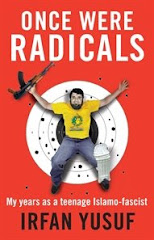
(Irfan Yusuf is a Sydney-based lawyer, author and columnist. His first book Once Were Radicals: My years as a teenage Islamo-fascist has just been published by Allen & Unwin. The above address was delivered to a conference on the Common Word document organised by the Australian Muslim-Christin Friendship Society and the Melkite Welfare Association on Friday 15 May 2009.)

Words © 2009 Irfan Yusuf

Delicious
Bookmark this on Delicious

Digg!

Get Flocked

Stumble Upon Toolbar

Wednesday, April 22, 2009

COMMENT: The Camden fracas continues ...

It would be improper for me to comment on the legal merit of submissions made by Camden Council’s barrister at a hearing of the NSW Land & Environment Court yesterday afternoon. Excerpts from that letter have been reported in the Camden Advertiser, the Daily Telegraph and the Sydney Morning Herald, not to mention some 11 regional papers.

Camden Council’s submission apparently included a letter signed by four local church leaders. Significantly, the Catholic and Uniting Churches are not signatories. I’m not sure if that letter made reference to issues of traffic, infrastructure and other planning considerations. It did, however, make reference to the school following a religion ...

... driven by a powerful political agenda, ... an ideology with a plan for world domination.

Apparently establishing such faith-based schools was ...
... typical of a regularly repeated pattern to form a beachhead in an area for the development of a sub-culture which, for the most part, regards its own legal system as superior to the current Australian law.

Furthermore, Camden Muslims would seek to dominate public space in Camden ...
... as we have seen in Auburn, Bankstown, Lakemba and more recently Liverpool.

It all sounds like something out of the pages of some fictional Protocols of the Learned Mullahs of Auburn, Bankstown, Lakemba & Liverpool (and soon Camden). Soon these nasty Muslim theocrats will be forcing locals to speak Islamic.

Directors of the Qur’anic Society behind the school proposal have some affiliation with the Tabligh Jamaat (TJ, translated as “preaching group”), a Sufi evangelical group founded in India last century. I have my reservations about the TJ, but these are more to do with some of their preaching methods which I think were best left in the last century.

"Yes Irfan,” some of you will say, “but tell us what these people really believe. What is their real agenda?” I guess the best way to sum up this nefarious group’s revolutionary agenda of world domination is to reproduce their 6 basic teachings:

*Strong faith in God;

*Observing the 5 daily prayers;

*Seeking knowledge while remaining humble through remembering God;

*Showing good manners to fellow believers;

*Sincerity in good deeds; and

*Spreading the message of the 5 abovementioned points.


You can find an expanded version of their terrorist extremist fundamentalist chauvinist Islamo-fascist Auburnist Bankstownist Lakembist agenda here. You’d sooner find Ahmedinejad supporting Zionism than the TJ plotting world domination.

Words © 2009 Irfan Yusuf

Delicious
Bookmark this on Delicious

Digg!

Get Flocked

Stumble Upon Toolbar

Saturday, December 20, 2008

VIDEO: Besieged by the Basij?

This short documentary concerns a special part of Iran's Revolutionary Guards which is allegedly growing in influence and power. The Basij see themselves as the guardians of Iranian Muslim culture and its fierce sense if undependence.

The documentary is the work of Kouross Esmaeli, a 38 year old film maker and journalist from New York. Esmaeli talks about the making of this documentary and the workings of al-Jazeerah in Iran.


You can read his superb story about racial profiling at airports in the United States here. You can also read about how the nuclear issue is helping Ahmedinejad rather popular in Iran here.

Esmaeli has tourned his journalism and documentary-making into activism on a range of issues. He has documented the negative consequences of America's disastrous war in Iraq.


Words © 2008 Irfan Yusuf

Delicious
Bookmark this on Delicious

Digg!

Get Flocked

Stumble Upon Toolbar

Sunday, November 30, 2008

REFLECTION: Syed Zauqi Shah and India's religious secularism ...

In India, secularism is a deeply religious affair. So religious that people of all faiths are involved. It's common to see devotees of one faith showing their devotion at the shrine associated with another faith.

At Sufi shrines, you will see Hindus and Sikhs and Catholics and followers of other indigenous Indian faiths (yes, Catholicism is an indigenous faith!) sshowing their respects to the buried saint in much the same manner as their Muslim countrymen and women. After collecting their faiz (blessing), devotees feel moved to share this blessing with the line of beggars that often sit in a long line at the entrance. Hence all share in the blessing.

During a visit to Pakistan in the early 1990's, I picked up a copy of Mazamin-e-Zauqi, a collection of articles and correspondence in English by an Indian Sufi named Syed Muhammad Zauqi Shah. The book was published in 1948, hardly 12 months after Partition. Many of the articles were published in a Pakistani newspaper called People's Voice which started publication in December 1941 and barely lasted a few months. All in all, the book is 96 pages. I must have started reading it decades ago, and there is a book mark placed between pages 72 and 73.

The correspondence includes letters to Muhammad Marmaduke Pickthall, a British Muslim who translated the Qur'an. Syed Zauqi uses firm but polite language, objecting to some of Pickthall's renderings of the Qur'anic text. There is also a critical commentary on an essay written by Saeed Halim Pasha and entitled Reform of Muslim Society. Saeed Pasha served as Vizier-i-Azam (Prime Minister) of the Ottoman Empire during the period 1913-16 and was assassinated in December 1921.

Syed Zauqi Shah may have been a pan-Muslim nationalist, but his spiritual heritage was from the more ecumenical traditions of Indian tasawwuf. Hopefully when I finish the book (which hopefully will be in less time than a few decades!!), I'll be able to re-visit Syed Zauqi's work.

Syed Zauqi lived in a time when some Indian Muslims were enjoying the benefits of having their own homeland, whilst others were struggling to make their mark in what was left of India. Many Muslim nations had still not achieved independence, and Ottomans like Saeed Pasha were preaching a message of turning one's back on the West.

Words © 2008 Irfan Yusuf

Delicious
Bookmark this on Delicious

Digg!

Get Flocked

Stumble Upon Toolbar

Sunday, November 23, 2008

CRIKEY: Israeli torn between ''Islamists'' and ''the Muslim thugs'' ...


Visiting Israeli Professor Raphael Israeli presents different faces for different audiences. Sometimes he says his target is only “Islamists”, ie, those Muslims who want to impose a political version of Islam on secular democracies.

Certainly this is what he said in a letter to The Australian. Here's an excerpt from The Oz report on February 19 2007 ...

A VISITING Israeli academic has blasted Australia's Jewish leaders for disowning him after he raised concerns about the level of Muslim immigration in Europe and the consequences of a similar approach here.

Raphael Israeli, Professor of Islamic, Middle East and Chinese History at the Hebrew University in Jerusalem, wrote to The Australian yesterday to complain about his treatment after a story in the Australian Jewish News which claimed he favoured a cap on Muslim immigration.

The story, which Professor Israeli said didn't accurately reflect his views, led to criticism from Muslim and Jewish leaders without further checks with him, he said. The Australia/Israel and Jewish Affairs Council, co-sponsoring his lecture tour, decided to sever ties with him.

"Instead of standing by their guest, and supporting free debate in this country, Jewish leaders have elected to shamefully disown me in their statements that were geared to placate Muslims," Professor Israeli wrote.

"I come from a country dipped in solidarity and that never abandons its fighters in the battlefield. Here I feel abandoned, forlorn, betrayed by people who lack courage and stamina to stand up for principles."

Professor Israeli's attributed comments in the Jewish press last week in part suggested there would be demographic pressure for Indonesian Muslims to resettle. The article quoted him as saying "one of the big possibilities is Australia, so they will continue to come legally, or illegally, and settle here, and when they get to the rate of the 10per cent, like in France, then you will see life will become untenable".
Yet he wrote an almost identical, though more virulent (and need I say honest) letter to the far-Right polemical JihadWatch website. In that letter, he made it clear he was talking about “the Muslim thugs”, without differentiation. In other words, his attitudes are directed to all Australians who happen to tick the “Muslim” box on their census forms. Here's how The Age reported Israeli's remarks ...

A VISITING Jewish professor has lashed out at Australian Jewish leaders for their "shameful submission to Muslim thugs", saying his comments were less harsh than some by the Prime Minister and federal Treasurer.

Hebrew University professor Raphael Israeli, dropped from a proposed lecture tour after comments last week, said political correctness did not allow his remarks to be said, though, privately, all supported them.

He said Prime Minister John Howard and Treasurer Peter Costello had said harsher things after "Muslim riots", but "someone elected to seize upon this opportunity now and sweep Australia into a storm in a teacup".

Professor Israeli, who will teach his six-week Islamic history course at the University of NSW, posted his version of the stoush on a website.

On the Dhimmi Watch section of www.jihadwatch.org, he wrote: "The dhimmi-like Jewish leadership cancelled all activities, in a shameful submission to the Muslim thugs and under the false claims of a 'multicultural society' in Australia, which they know is not true."
Regardless of where he stands, we’d be living in denial if we insisted Israeli’s attitudes to that nebulous Arab/Muslim/Islamist/Middle Eastern “them” aren’t gaining some hold.

Why is this so? Who is responsible? And what is being done about it?

Journalism professor and veteran reporter Peter Manning believes that skewed reporting is largely to blame. His research of metropolitan Sydney newspaper reporting pre and post-September 11 shows that the prejudices have pre-dated the emergence of al-Qaeda.

Experts like Dr James Jupp of the Australian National University argue cogently against Israeli’s central thesis on limiting immigration for a particular religious group. Here's how ninemsn reported Jupp's remarks on February 16 2007.

A local immigration expert has dismissed suggestions by a visiting Israeli academic that Islamic migration to Australia should be capped.

... immigration expert Dr James Jupp from the Australian National University said talk of limiting immigration for Muslims was the kind of idea "put forward by crackpots" — even though there is no legal barrier to doing so.

He said banning immigrants on religious grounds is possible as all migrant applications are done in other countries which are not subject to our racial vilification laws.

“You [immigrants] have no legal rights to Australian law if you are outside Australia,” Dr Jupp said.

Proving religious discrimination “would be extremely difficult” as immigrants cannot access our legal system before they arrive in Australia.

”I don’t think you’d have a leg to stand on, you couldn’t prove it,” Dr Jupp said.

He added that officials could easily hide religious discrimination behind the various other requirements immigrants must meet to enter this country ...

... Dr Jupp said that would not occur here as European countries gave full citizenship to emigrants from ex-colonial nations — many of which are Muslim countries.

As Australia has no colonial ties with Muslim countries like Algeria, it was unlikely that Muslims would come to this country in such large numbers as they do in Europe.
I think much responsibility rests with Muslims themselves, especially with religious and organisational leaders who are largely first generation migrants who regard Islam as a relic of their lives “back home” and are generally disinterested in communicating Islamic theology to the broader community.

The ethno-religious nature of the Muslim religious establishment is the biggest reason why Israeli’s claims simply don’t apply to Muslims here (if they apply anywhere else).

On Radio National Israeli said that
... in Islam, secular Islam, or secular Muslims, is a contradiction in terms.
He also said that there is only one Islam, and that Muslims either adopt it or they don’t.

This is the weakest link in Israeli’s argument. Australian Muslims come from over 60 different countries. Australian Islam is more ethno-cultural than religious a phenomenon, reflected in Muslim community leadership drawn from ethnic-based mosques.

To say there is one Islam means there is one Muslim community. But the fact is that Muslims cannot even agree on holding festival days. Israeli says that a growing monolithic Muslim community in Australia is a threat. This Muslim community doesn’t exist down under.

An edited version of this piece was first published in Crikey on 23 February 2007.

Words © 2008 Irfan Yusuf

Delicious
Bookmark this on Delicious

Digg!

Get Flocked

Stumble Upon Toolbar

Saturday, November 15, 2008

COMMENT: The Voice of Port Elizabethan Islam


Around 20 years ago, I wrote some questions to the a group of South African Islamic (as opposed to Muslim) scholars calling themselves the Mujlisul Ulama (council of scholars).

Why do I describe them as “Islamic” as opposed to “Muslim”. I guess because I can’t get out of my head the habit of differentiating between something/one who is Islamic and something/one Muslim.

Maududi always used to differentiate between a Muslim state and an Islamic state. A Muslim state was a state with a nominally Muslim majority and whose leaders were nominally-Muslim. You were nominally Muslim if you regarded yourself as being Muslim. Whether you understood what it meant to be Muslim didn’t really matter. It also didn’t matter if you understood why you were Muslim, or whether you aspired to act consistently with the teachings and requirements of Islam. Nominal Muslims were often people who belonged to a tribe or ethnic group that regarded itself as Muslim. You could be an atheist or agnostic – you could still be a Muslim.

On the other hand, being Islamic meant that you strove to follow the ideals of Islam (or rather, what you thought or were taught was Islam). In this sense, the Mujlisul Ulama were Islamic scholars and not just Muslim scholars. Their scholarship was about Islam and they actually believed what they were studying and researching was something coming from God (Allah).

In this sense, the MU were different from those nasty people called “Orientalists” whose task it was to research for the purposes of mere intellectual or academic research and teaching or, worse still, to spread misinformation about Islam with a view to furthering the goals of international colonialism, the CIA, Zionists, freemasons or any other force deemed capable of mounting an international conspiracy against whichever kind of Islam MU happened to subscribe to.

Anyway, so around 2 decades ago, I wrote to the MU seeking a fatwa about whether Mum was wrong to stop me from marrying some gori (i.e. white woman). This particular gori was different though – she was Bosnian and her ancestors had probably been Muslim for much longer than mine (and hence Mum’s).

Within a few months, I received a reply. It was a typewritten aerogram, the author of which wasn’t quite a mujlis. Unless one includes a mujlis of one. Anyway, I was very happy with the response I received from the mujlis, and wrote back asking him to put me on his mailing list.

Since then, I’ve regularly received a copy of the Mujlisul Ulama’s newspaper which is entitled The Majlis – “Voice of Islam”. It’s a fascinating newspaper providing hours of reading entertainment. The cover stories are always well-worth a read. They usually involve condemnation of some Muslim group which doesn’t quite fit the MU’s definition of Islam.

Past editions of The Majlis have included articles on the errors of Western medicine, especially vaccination. I wish their fatwa (religious ruling) was available years ago when I was at primary school and had to undergo painful vaccination injections. Alas, relief arrived a few decades too late!

My most recent edition of The Majlis (Vol 18 No 07) includes these awesome headlines:"THE INTERFAITH MENACE”, “ULAMA OF PAKISTAN DECLARE ALL ‘ISLAMIC’ BANKS AND ALL TV CHANNELS HARAAM” and “THE CORRUPTION OF ‘SHARIAH’ BOARDS”.

The “Question and Answer” sections, which take up the bulk of the paper, are always gems of wisdom. Usually the most misogynistic and offensive question and answer is highlighted and turned into a separate article. In the most recent edition, under the headline “WOMEN & EID SALAAT”, someone asks this impartial question:


Q: A crank women’s group which advocates that women should come into the streets to perform Eid Salaat, justifies their call of enticing women out from their homes ...
The Majlis’ response includes references to “the women’s lib miscreants” and “women who emerge from their homes to prowl in the streets and to wonder in male-dominating terrain”. With such masculinity in their responses, who needs Viagra?

In all seriousness, The Majlis does have some really interesting articles as well as excerpts from the inspiring sayings of some Indian and Pakistani scholars of the deobandi tradition (which also happens to be the tradition I feel closest to, though the deobandi scholars I know tend to use more diplomatic language and are less averse to the real world). These include gems of wisdom from the orthodox sufi tradition.

Anyway, I’d better stop writing. The last thing I need is to receive the negative dua’s of the Mujlisul Aalim. Or should that be Mujlisul Ulama? Who knows?

UPDATE I: I just discovered you can also read The Majlis online. There's also some kind of archive which can be found here. Though it doesn't feel the same as holding the newspaper in your hand!

Words © 2008 Irfan Yusuf

Delicious
Bookmark this on Delicious

Digg!

Get Flocked

Stumble Upon Toolbar

Friday, November 14, 2008

EVENT: Faith and Climate Change ...


The Centre for Policy Developmenmt is organising a Common Ground seminar on climate change. Among the guests is self-styled "Imam" Afroz Ali, who represents a group called Australian Religious Response to Climate Change. You can book for the seminar here.

You can find out about othet ARCC management committee members here. I certainly hope the good "Imam" has been somewhat more upfront with these august persons about exactly what makes him adopt this title. Certainly he doesn't provide the same list of impressive credentials as he has claimed elsewhere.

One needn't be an imam to become involved in this issue. And in 21st century Australia, one needn't have any serious religious qualifications to be an Imam!

Words © 2008 Irfan Yusuf

Delicious
Bookmark this on Delicious

Digg!

Get Flocked

Stumble Upon Toolbar

Saturday, November 08, 2008

VIDEO: Islam and Christianity in 21st century Britain

I don't agree with both sides of this argument. The Muslims misunderstand secularism. The Christians use a very narrow definition of Christianity. The Muslims don't define Islam. The use of historical precedents by both sides is selective and at time dishonest.

Still, that's my conclusion, having watched 30 mins. I'm glad that it's a much more sensible and sensitive discussion. Plus the moderator is quite fair.


Words © 2008 Irfan Yusuf

Delicious
Bookmark this on Delicious

Digg!

Get Flocked

Stumble Upon Toolbar

Thursday, October 23, 2008

VIDEO: Why God (but not Allah, Buddha or even Hindu) is a Republican (??)

I'm not sure exactly which party God is voting for in the upcoming US Presidential election. I'm also not sure which way Allah, Buddha or even "Hindu" will vote. But this Republican paator, delivering a prayer at a Republican Party convention certainly does.

Thanx to Gazza for the tip-off.


Words © 2008 Irfan Yusuf

Delicious
Bookmark this on Delicious

Digg!

Get Flocked

Stumble Upon Toolbar

Wednesday, October 22, 2008

OPINION: Something rotten in the states of Islam ...

Those wonderful people from the Eureka Street ezine have just published an essay I sent them as part of the Inaugural Readers' Feast/Eureka Street Award for a human rights essay.

The headline put on the essay is Something rotten in Islam. This is a deliberately provocative headline designed to get people to read the article. But will Muslims read it? Or will they be turned off it?

Before reproducing the article, I've reproduced a brief exchange of e-mails between myself and the editor. I think these e-mails will provide readers with a better understanding of the editorial process.

Eureka Street is not and has never been a racist or Islamophobic publication. Another colleague of mine, Saeed Saeed, also writes for the publication.

________________________

When one submits an article for publication, it is the sub-editor/editor's job to write the headline. It isn't for the contributor to select a headline. The editor also chooses a graphic if appropriate. It isn't my role to tell you what headline to place on this article.

With that in mind, I should tell you that this article was addressed to all men but in particular men of Muslim faith/heritage/background/ancestry. The headline is good in that it will attract and perhaps even shock people to read the article.

On the other hand, many Muslims will find it offensive. This in itself isn't a bad thing, though it might turn out to be counterproductive.

Many will argue that the graphic is the sort of graphic fit for the Daily Telegraph. I myself have hacked into the Tele for using such graphics. Still, when the Tele uses them, it is often on issues unrelated (or tenuously related) to Muslim women.

I cannot say for certain as I doubt any research has been done on the topic, but my own experience is that the vast majority of Muslim women don't wear a face-veil. Further, many do not associate the face-veil with physical or sexual violence against women.

In this sense, some Muslims will argue that the graphic does little more than entrench stereotypes. Hence Muslim women may find the graphic offense.

Perhaps a better graphic may be a photo of one of the victims. Perhaps a better headline could be "Something rotten in states of Islam". That way a distinction is made between Islam as theology/law/texts and Islam as modern post-colonial political orders.

However, this is only my view. It isn't for me to be telling Eureka Street how to edit an article in their own publication.

People should be free to say what they like about any faith tradition. My own personal practice is not to criticise faith traditions but rather to criticise people whilst praising traditions. Hence my last piece attacked Hindutva as a political movement but pointed out that Hinduism itself was above all this.

Just some feedback.

Regards
Irfan Yusuf

___________________________

Hi Irfan,

Thanks for feedback. Our title was, as you acknowledge, designed to pique people's interest and get them to click through and read the essay. It is lifted almost directly from the essay itself: the subtitle 'Something is rotten' is followed by the sentence 'Something is rotten in the state of Islam', adapted for the title to 'Something rotten in Islam'. But I take on board your comments regarding sensitivity.

Your point about image selection is also fair. I confess it crossed my mind that I was running the risk of 'entrenching stereotypes' by using that image. Ultimately my intention was to use something that would be immediately recognisable to the general public as a 'Muslim woman'. Perhaps that is just another way of saying the same thing! I'm sorry if you feel the image reflects badly upon your essay.

In any case, you are most welcome (and I would encourage you) to post your feedback at the base of the article, as it adds to the dialogue about Islam and makes valid points about the editorial process.

Thanks again Irfan.

Cheers.

__________________________


EUREKA STREET/ READER'S FEAST AWARD
Something rotten in Islam
Irfan Yusuf October 22, 2008

A Muslim proverb says that a child's first university is her or his mother's lap. Young children at this age are like soft clay and can be moulded into more or less a permanent shape that will prove difficult to change in later years. It's a process that might be called education by osmosis.

I graduated from the university of my Indian mother's lap with a fear of the prayers of others, especially those I have wronged. The word for oppression in both Arabic and Urdu (my mother's North Indian dialect) is zulm. An oppressor is zaalim and the oppressed is muzloom. Mum's Urdu formula was fairly straight forward.

Zulm na karo. Kiyun kar Allah Ta'ala muzloom ka dua hamesha soontahey, chahe muzloom kaafir ho aur zaalim musalman.

Literally this means: 'Do not oppress. Because God Almighty always hears and responds to the prayers of the oppressed, even where the oppressed refuse to acknowledge Him and the oppressor believes in Him.'

Collective oppression

What happens when the oppression is collective? What happens when communities oppress themselves? And do so in the name of establishing God's law?

I could apply mum's proverb to many Muslim communities and come up with an explanation as to why so many are politically, economically and socially backward. At least 51 per cent of Muslims are women. And whether Muslim men accept it or not, many are the subject of the collective negative prayers of their mothers, sisters, daughters and wives.

So often I hear Muslim imams, preachers and apologists reminding me that Islam gave women certain rights at least a thousand years before Europe did, that the rules of Islamic sacred law (also known as the sharia) cannot be legitimately applied in a manner which causes injustice to women, and that Muslim women have equal (if not always the same) rights as men.

That might be the case in textbooks of theology and sacred law. But what is the current reality on the ground?

Something is rotten

Something is rotten in the state of Islam. Perhaps not in the sacred texts nor even in the vast legal tradition. Muslims can debate among themselves whether the source of the problem lies in the religion itself. But the reality is beyond debate.

Something certainly is rotten in many of the 58 states that make up the organisation of Islamic Conference. A cruel sickness of absurd and oppressive gender-based practices and attitudes is poisoning the lives of men and women in Muslim societies.

Such practices and attitudes aren't limited to ignorant villagers, nor are they random acts of murder committed by strangers. It wasn't an unlettered stranger who murdered 17-year-old student Rand Abdel-Qader in Basra on 16 March this year. She was murdered by her father, a government employee who worked in Iraq's Health Department.

Rand's mother tried to save her from this barbarism but to no effect. The Observer reported on 11 May:

Though her horrified mother, Leila Hussein, called Rand's two brothers, Hassan, 23, and Haydar, 21, to restrain Abdel-Qader as he choked her with his foot on her throat, they joined in. Her shrouded corpse was then tossed into a makeshift grave without ceremony as her uncles spat on it in disgust.


What was her crime? This young student at Basra University had worked as a volunteer with displaced Iraqi families. Over a period of some four months, and after a few short conversations, the young woman had become infatuated with a 22-year-old British soldier.

That's it. She had feelings. Her father came to know of this. He saw her talking to the British soldier in public. He dug a makeshift grave. He murdered his own daughter. His sons joined in, spilling the blood of their own sister, their own flesh and blood.

Why? Apparently this act has become known as an 'honour killing'. It seems that for some men, the only way to restore the honour of their family is to kill family members.

Concentric circles of oppression?

Some have argued that this incident was a symptom of the wider oppression of Iraqis, of the foreign occupation which hasn't brought the promised peace and order promised by the self-styled Coalition of the Willing.

It is true that the brutality of occupation can lead to other forms of brutality. Tortured, humiliated and oppressed men need some kind of outlet. All too often, such men end up torturing, humiliating and oppressing their wives, sisters and even mothers.

But such incidents also happen where there are no brutal occupiers present. In April 2006, hacked pieces of 20 year old Bahnaz Mahmod Agha's body were found in a suitcase in London. In June 2007, a London court had convicted Bahnaz's father and uncle of her murder.

Bahnaz had entered a marriage arranged by her Kurdish-Iraqi father when she was just 17. Her husband had repeatedly raped and abused her, even knocking out one of her front teeth after she called him by his first name in public. In late 2005, by which time she was 20, Bahnaz had left this abusive relationship and fallen in love with another Kurdish man from a different tribe.

Bahnaz's uncle convened a family council during which it was decided that the family's honour could only be restored by killing her. Bahnaz's mother alerted her to the plot, but police didn't believe the story. With her family against her and the police refusing to assist, to whom could this young woman turn?

Again, concentric circles of oppression operated. Again, Muslim religious and community leaders had more important things on their mind, such as the pressure of the post-7/7 environment, the increased public scrutiny, the struggle against oppressive anti-terror laws.

The ultimate victims of these concentric circles of oppression are the 51 per cent of Muslims that happen to be female. So what is the solution?

It's true that these practises are not religiously sanctioned (though theological justification is often found by misogynistic religious authorities), are not limited to Muslims and are found in non-Muslim communities in South Asia, the Middle East and Africa also. But Muslim men can not afford to live in denial about their prevalence.

The double standard

Muslim faith communities suffer from multiple personality disorder, applying one standard to the male and another to our female side. And we impose our double standards under the garb of tradition or sharia.

We speak of reviving the age of Muslim glory, when Muslims were the most civilised nation on earth. But what characterised that civilisation?

There is the story of one Muslim woman who was kidnapped by the Byzantine empire. The Caliph in Baghdad wrote a letter threatening to send an army whose length stretched from Baghdad to Constantinople.

Today, Muslim Presidents and Kings and Generals do nothing to help women being mistreated and held in captivity in their own countries. Without international pressure, one wonders whether Pakistan's General Musharraf would have allowed Mukhtar Mai liberty within her own homeland.

Perhaps the most obvious example of our double standards is in our domestic relations. Many Muslim men regularly beat their wives. Unlike their non-Muslim brothers, Muslim men don't require excessive alcohol or narcotics in their system to beat their wives.

There are few laws in Muslim countries protecting women from domestic violence. Worse still, those responsible for enforcing the law — police and the judiciary — are open to bribery by the usually wealthier male perpetrators. What makes the problem worse is that imams rarely mention the problem to their (mostly male) congregation.

Muslim and ethnic language newspapers commonly read by Muslims rarely mention the issue. It is as if we are pretending the problem just doesn't exist. Or worse still, it's as if it isn't even a problem.

Raising voices

Some years back, a group of men in Canada decided that they would take a stand on violence against women. The result was UNIFEM White Ribbon Day. Each year, men where white ribbons to take a stand, to show that they regard violence against women as an abomination.

I'm not suggesting that the solution is Muslim men merely wearing white ribbons. But the philosophy of WRD is one worth promoting — that violence against women is a men's issue and that the situation won't change until men speak out against it.

Because if we stay silent, we might as well be lending a hand to the perpetrators of violence. Today it may be a stranger. Tomorrow, it could be our mother, our sister, our daughter. Paradise can be found under the feat of mothers. Yet millions of Muslim mothers and sisters and daughters are living in hell on this earth.

I wish more Muslim men stopped justifying theology or pointing to historical precedents and address current gender realities in Muslim communities. I wish more influential men in nominally Muslim communities and countries raised their voices against the continued exploitation of at least half of their community.

With that in mind, I'll start by raising my voice.

First published in Eureka Street on Wednesday 22 October 2008.

UPDATE I: Some discussion on the piece can be found here.

Words © 2008 Irfan Yusuf


Stumble Upon Toolbar

Friday, October 10, 2008

COMMENT: Accommodating mainstream Muslims is no danger ...

Why must I keep repeating this? Surely this should be self-evident. Anyway, here goes ...

Some people suggest that by accommodating mainstream Muslim religious traditions, America and other Western countries are somehow opening themselves up for further terrorist attacks. Many Muslims respond by arguing that the terrorists and the mainstream Muslims are two entirely different groups of people.

The Quran says what it says, but that has no bearing on the fact that mainstream Muslims and their religious traditions pose no threat to the West whatsoever.

So what if the Quran does say Muslims should convert or kill non-believers? So what if the Old Testament says the same? How many mainstream Muslims have killed or wounded non-Muslim Americans or Australians because they weren't Muslim? It just doesn't happen.

Maybe those violent passages in the Quran and/or Old Testament can help us understand more where the terrorists are coming from, but none of that is relevant to mainstream Muslims carrying on with their own peace-loving interpretation of those texts.

We have enough external enemies without creating new ones from a group of people who would like to think of themselves not only as allies but fellow citizens.

I've adapted this from a comment appearing in an online discussion on an American newspaper called the Morris Daily Herald.

Words © 2008 Irfan Yusuf

Stumble Upon Toolbar

VIDEO: The common threads of South Asian faiths ...


Stumble Upon Toolbar

Wednesday, September 03, 2008

COMMENT: On religious conservatives and artistic erection?


Well, it seems that the Prophet Muhammad is once again in the news. And what has he done this time? Read this ...

Representatives for a gallery in Gateshead appeared in court yesterday charged with outraging public decency, after featuring a statue of Jesus with an erection ...

Lawyers for Emily Mapfuwa, a 40-year-old Christian who was offended by the artwork, launched a private prosecution against the gallery for outraging public decency and causing harassment, alarm and distress to the public. Mapfuwa, of Brentwood, Essex, argues the Baltic would not have dared depict the prophet Muhammad in such a way.


Perhaps not. After all, the art gallery isn't a Danish newspaper, an American pastor or an American cable news network. These days, you can pretty much say whatever you like about the Prophet Muhammad or his followers.

Ms Mapfuwa could easily have gotten Muslims on her side. After all, why wouldn't devout Muslims be equally as offended as she by an artist depicting God's Messiah in this way? Instead, she has turned an opportunity to defend shared Christian and Muslim sentiments into yet another example of far-Right fringe pseudo-religiosity claiming the mantle of victimhood.

Words © 2008 Irfan Yusuf
Delicious
Bookmark this on Delicious

Digg!

Get Flocked

Stumble Upon Toolbar

Sunday, August 17, 2008

COMMENT/VIDEO: On faith and dishonesty ...


I watched this video on the Dutch-Somali neo-Conservative activist Ayaan Hirsi Magaan/Ali. The video provides a thought-provoking discussion on the background to her memoir Infidel. The main issue of the review is whether Hirsi Magaan/Ali should be the subject of negative judgments because she was not truthful to Dutch immigration authorities.

I can't help but wonder whether Hirsi Magaan/Ali would agree with the reviewer's assessment if he were talking about another asylum seeker. Hirsi Magaan/Ali's term in the Dutch Parliament was characterised by what could only be described as extreme disdain for asylum seekers. She supported the expulsion of a Bosnian asylum seeker who had been less than truthful in her application.

But there's more to this story than meets the eye. There are many more incredible stories of Muslim women who faced horrific cultural experiences and who overcame amazing odds to secure freedom. However, these women chose not to attack their religious beliefs or the religious beliefs of others. However, their books haven't been promoted so heavily by rightwing thinktanks with religious scores to settle.

Hirsi Magaan/Ali's lies about her migration status may be forgiveable. But when she lies about the beliefs of 1.3 billion Muslims, pretending that her experience is necessarily reflective of the experiences of others, and when she uses those lies to incite hatred against ordinary people with some link to Islam, her lies become unforgiveable.

People should ask themselves this simple question: If Hirsi Ali/Magaan had chosen to expose the evils of the cultural practices she grew up in WITHOUT inciting virulent hatred against other Muslims, would she have been taken so seriously?

We don't see far-Right thinktanks promoting Shirin Ebadi or Irene Khan or Mukhtar Mai. We don't even see them promoting Waris Dirie, a Somali woman with a similar story. I certainly won't be holding my breath waiting for the Centre for Independent Studies inviting Shirin Ebadi or Waris Dirie to speak about Islam or the enlightenment or women's rights.

Why is this so? Think about it.

Words © 2008 Irfan Yusuf

Delicious
Bookmark this on Delicious

Digg!

Get Flocked

Stumble Upon Toolbar