Showing posts with label al-Qaida. Show all posts

Wednesday, September 25, 2013

POLITICS: Jihadi kids


[01] In recent days, the Harakat al-Shabaab al-Mujahideen (or Movement of Stiving Youth) have made international headlines by holding up a shopping centre in Nairobi, killing shoppers and staff, and taking hostages. These antics are seen by the group as the preferred method of championing an ideology that is somewhere between warped Islam and crazed Somali nationalism.

[02] Somali communities living in Kenya, the US, UK, Australia and New Zealand will come under increasing surveillance after claims that a number of the Shabaab fighters involved in the attack are from the large Somali diaspora communities including US and UK. 

[03] Many readers will be unfamiliar with the history, geography and ideological forces involved in Somalia as well as the involvement of its neighbouring countries in this failed state. Somali diaspora communities often do not intermingle with other ethnic Muslim groups and vice versa. Hence many Muslims have little understanding if exactly what is going on.

[04] Kenya's Interior Minister Joseph Ole Lenku described the attackers as a "multicultural collection from all over the world". Kenya's military head General Julius Karangi spoke of "foreigners from so many nations" involved in the attack.Tweets from al-Shabaab said that fighters included persons from the US, UK, Canada, Sweden, Syria, Finland, Russia, Dagestan and Kenya as well as Somalia.

[05] Hostages were freed if they could prove they were Muslim to the kiddies. Apparently they were asked questions such as who the Prophet's wife was. Clearly the terrorists must have failed the most elementary test in aqida (creed).

[06] Young children were made to which as their mothers were slaughtered. What kind of sick mind could commit such atrocities?

[07] The risk is that the barbarism of the Shabaab monsters will lead to further disastrous foreign intervention in Somalia. It might also lead to crackdowns on Somali diaspora communities who will suffer bother from attempts by Shabaab to recruit as well as from the heavy-handedness of security forces. 

[08] Here is an excerpt from what Ian Birrell wrote in The Independent:

Somalia is seen as the ultimate failed state, an ungovernable hellhole plagued with poverty, conflict and hatred. Curiously, it is one of only two African nations sharing a single language, religion and culture; the other is Botswana, one of the continent’s biggest success stories. Yet it is riven with historic rivalries between hundreds of nomadic clans and sub-clans. The last person to rule with any real authority was a military dictator, Siad Barre, whose overthrow in 1991 sparked the chaos that still engulfs the country.  
One million Somalis have been killed since then, twice that number displaced and much of the country reduced to rubble. Half a million Somali exiles now live in Kenya, where even before this vicious attack they faced growing hostility. But while many of the country’s problems were self-induced, with feuding warlords growing rich as they ripped apart their own country, Somalia’s problems were worsened by bungled interventions from outside. 
Go back eight years, and a semblance of normality had returned to the country. Western-backed warlords had been defeated and the Union of Islamic Courts, a coalition of Islamic conservatives, enforced the rule of law. There was security in Mogadishu, with families knowing a son or daughter would return from a trip to the shops rather than end up bleeding in the streets; unsurprisingly, the courts were popular, despite often intolerant rulings. The possibility of genuine peace hovered on the horizon. 
But a united, stable and Islamic country was the last thing Ethiopia wanted on its doorstep. So it invaded in the name of driving out fundamentalism, persuading Britain and the United States to back their key ally in the region. The incursion was disastrous, with Somalia spiralling back out of control, while grotesque human rights abuses boosted the militant cause. The biggest beneficiary was the security wing of the courts movement, al-Shabaab, which soon had control of much of Mogadishu and great swathes of the country.
[09] A July 2011 report on Al Shabaab by Ron Wise of the Centre for Strategic & International Studies states that the movement started out as the youth wing of a mainstream Muslim political party that rose to power in Somalia in early 2006. Ethiopia invaded in December 2006, after which Shabaab became a popular militia with nationalist aspirations of removing Ethiopian forces from Somalia. It was only in 2008 that Shabaab has slowly and gradually made the transition into a group having linkages with al-Qaeda.


[10] Wise suggests that Ethiopia can take major responsibility for radicalising Shabaab. The Ethiopians drove out the more moderate Islamic Courts Union (ICU) administration from Somalia. The ICU kept a check on Shabaab going down a more radical path.

[11] After ICU were driven out, Shabaab took control of large tracts of land in Somalia. In a lawless land, these areas provided citizens with some rule of law and stability, which made Shabaab even more popular and assisted with its recruitment drive.

[12] Wise says that Somalia's started with the overthrow of military dictator Mohammed Siad Barre in 1991. Since that time, competing warlords have committed atrocities against civilians, leading to some 1 million being forced to flee Somalia. Hundreds of thousands have died from starvation, famine and violence.

[13] The ICU was a federation of 11 courts formed in mid 2004. By June 2006, the ICU, with the help of its militia Shabaab, had crushed the warlords. Wise claims that Shabaab was a remnant of the most radical remnant of ICU, its members influenced by Saudi-style wahhabi Islam which was contrary to the traditional sufi Islam followed by most Somalis.

[14] Dr Kisiangani Emmanuel of the Institute for Security Studies based in Pretoria South Africa has written an excellent paper comparing the Shabaab and the Lords Resistance Army. Emmanuel claims the two groups emerged out of comparable contexts and were motivated by genuine grievances. Emmanuel says that these groups can only be fought properly when they are understood and when their often grievances are addressed. This way the hearts and minds of the local population can be won over, this removing the incentive for locals to support the extremists.

Stumble Upon Toolbar

Thursday, February 12, 2009

COMMENT: Hassan Butt turns out to be a Claytons jihadi ...


Many years ago, a famous Australian actor (I think it was Jack Thompson) appeared in an advertisement for a drink called Claytons. I'm not sure if it was a non-alcoholic drink, but the slogan of the advertisement was "Claytons - the drink you're having when you're not having a drink".

Since then, Australians have been referring to half-baked or fraudulent things using the adjective "Claytons". In this sense, if recent media reports are correct, it seems that Hassan Butt, darling of the UK tabloid media and ex-jihadi pinup boy, has turned out to be a complete fraud, a Claytons jihadi.

The Guardian and Reuters report that Hassan Butt was all along speaking out of his backside to various media outlets and journos about his alleged exploits in al-Qaeda. Here's what the Guardian says:

Hassan Butt received significant media attention for his claims to have helped send scores of Britons to terrorist training camps overseas and to have met Mohammad Sidique Khan, the ringleader of the 7 July 2005 attacks on London.

Butt was the former spokesman for the extremist group al-Muhajiroun and was invited to meet a government minister to discuss ways to combat terrorism, as well as featuring heavily in BBC News, national newspaper and US television reports on al-Qaida.

However at a trial of another man accused of terrorist offences, Butt said he had told journalists stories "the media wanted to hear", admitting that he was "a professional liar". He also admitted faking his own injuries to make it appear that he had been attacked by extremist Muslims.

Butt was arrested in 2008 over his planned autobiography Leaving Al Qaeda: Inside The Life And Mind of a British Jihadist, in which he was planning to claim involvement in the US consulate attack in Karachi, Pakistan, in June 2002, which killed 12 people.

The book was being co-authored by freelance journalist Shiv Malik, who became a media cause celebre after counter terrorism officers demanded he hand over his notes.

But in court Butt agreed he had taken Malik for a "right patsy"

Here is how Reuters reported it:
He made the confession in December during the trial of a former friend, Habib Ahmed, who was subsequently convicted of belonging to al Qaeda. Restrictions on the reporting of the case have only now been lifted following the conclusion of another trial involving Butt's wife.

"At no point have I ever been training, have I ever been a jihadi," Butt told the court, according to a transcript of the proceedings.

Questioning Butt about his past, prosecutor Andrew Edis asked: "So, you were a professional liar then?"

Butt replied: "I would make money, yes." He had, he said, told stories that "the media wanted to hear".

The confession will come as a surprise to many as Butt was for years regarded as a leading Islamist who had subsequently turned himself into a proponent for "de-radicalising" young men in order to combat extremism.

He has been widely profiled in newspapers, magazines and in television documentaries, and even met members of the government to discuss his plans for combating radicalism.

What a bullsh*t artist this guy is. Seriously. God knows just how many people have been arrested or detained or subject to various restraining or control orders thanks to his evidence.

I wonder who will be caught out spinning crap next. Will the UK government now investigate some of the crazy claims of other alleged ex-jihadis and ex-"Islamists"? Will Ed Husain cut the nonsense and admit that so many of his claims about his HT involvement are about as real as Santa Claus or the Tooth Fairy?

Hassan Butt ran this imbecilic line that all jihadis had the same "Islamic theology" which inspired them all to commit acts of terror. Butt, speaking out of his surname-sake, told Muslim-phobic tabloid morons exactly what they wanted to hear - that the problem wasn't with violence or terror but with religion itself. But with Butt's cover blown, fruitloops like Robert Spencer and Mad Mel Phillips won't have many native informants to assist in their misinformation campaigns.

Writing in the Daily Mail under the headline I was a fanatic...I know their thinking, says former radical Islamist, Butt writes:
The attempts to cause mass destruction in London and Glasgow are so reminiscent of other recent British Islamic extremist plots that they are likely to have been carried out by my former peers.

Which peers were they, Mr Butt? Were these the non-existent peers you told 60 Minutes about in 2007?

Butt's nonsense has been published by an impressive list of media outlets including Commentary Magazine based in the United States, The Times of London, NPR and BBC. Check out this interesting summary of Hassan Butt's butt-headed nonsense and his numerous supporters here. For more blog commentary, check out UmmahPulse and Indigo Jo.

I feel rather strange now. I've just finished the manuscript of my own memoir of my own teenage and young adult flirtation with Jamaat-i-Islami and Iranian literature during the years of the Afghan jihad of the 1980's. After finishing it, I wondered whether anyone would find it slightly entertaining or enlightening given the more exciting memoirs of people like Hassan Butt and Ed Husain. Well, all I can say now is that my memoir might be a little less dramatic, but at least it is honest.

Words © 2009 Irfan Yusuf

Delicious
Bookmark this on Delicious

Digg!

Get Flocked

Stumble Upon Toolbar

Friday, January 30, 2009

OPINION: No such thing as a monolithic Muslim state of mind ...


Politics and foreign policy can be so confusing. Let's look at Iraq, for example. The conventional wisdom is that we went to war against Saddam Hussein in 2003 and overthrew his government for a variety of reasons, including that Iraq was a crucial battleground in the so-called war on terror. The former Iraqi dictator is said to have had direct links with an Islamist terrorist organisation, al-Qaeda. We were at war with al-Qaeda. Hence we had to make war on Saddam.

Now let's move to the present and another conflict. Israel claimed to be fighting a war on terror of its own recently in its bombardment on Gaza. Israeli spin doctors told us that their war wasn't against the people of Gaza but against Hamas, an Islamist terrorist organisation dedicated to Israel's destruction through firing thousands of rockets and sending suicide bombers into Israel.

See the connection? The war on terror is always a war on political Islamists. It isn't a war on Muslims as such, nor is it a war on the Islamic religion or on nominally Muslim countries. The battle we wage is against political Islam, an ideology that seeks to establish an Islamic state.

That's the rhetoric. But what is the reality?

Before the outbreak of the first Palestinian intifada in 1987, what we now know as the virulently anti-Israel militia Hamas was created from an Israeli-backed network of social welfare projects (including clinics, schools, libraries and other facilities) operated under the auspices of the Muslim Brotherhood, an Islamist movement founded in Egypt by one Hasan al-Banna. At the time, Israel and the Tunis-based PLO had not signed the Oslo Agreements. Israel's line was that it would not negotiate with Yasser Arafat's PLO because it was a terrorist organisation. Israel also knew that the Brotherhood' s reputation for scrupulous honesty would make it an excellent alternative to the PLO.

So when it suited Israel's desire to drive a wedge between Palestinians living in the Occupied Territories and the Palestinian diaspora-based PLO that Israel then labelled a terrorist organisation, Israel was quite happy to deal with another organisation it now labels terrorists.

The Muslim Brotherhood's Islamist credentials and ideology weren't seen as an obstacle to its establishing a host of institutions in the West Bank and Gaza.

But don't take my word for it. A report from United Press International on June 18, 2002 cites documents obtained from the Israeli-based Institute for Counter Terrorism to the effect that Hamas was legally registered in Israel in 1978 by Sheik Ahmed Yassin, the movement's spiritual leader, as an Islamic association by the name of Al-Mujamma al-Islami, which widened its base of supporters and sympathisers by religious propaganda and social work.

The report also cites US administration officials saying funds for the movement came from the oil-producing states and, directly and indirectly, from Israel.

Back to present-day Iraq. Thousands of US and British soldiers have lost their lives defending a democratically elected Iraqi Government. After the 2003 invasion and the toppling of its Ba'athist regime, an Iraqi Governing Council was set up and an interim constitution drawn up, which became the basis for Iraq's current constitution. Among the experts assisting in the drafting of this document was Noah Feldman, Rhodes scholar and Harvard University professor of law and Islamic studies.

Feldman is hardly what some might describe as an apologist for political Islam. He has intimate first-hand knowledge of Iraqi governance and law. Feldman openly says Iraq's constitution establishes an Islamic state. Coalition troops are putting their lives on the line to defend the very political agenda the war on terror was supposedly designed to fight.

In other words, all this hysteria about political Islam is little more than a rhetorical cover for what are really just the usual political manoeuvrings one expects in relations between states.

This isn't so much about defending our freedoms against those who allegedly hate our way of life though in the case of anarcho-Islamist syndicates like al-Qaeda and Jemaah Islamiah the rhetoric largely reflects reality.

What we need to understand is that political Islam isn't in itself the enemy. If it were, American and British troops wouldn't be in Iraq today. And if, as President Barack Obama has promised, US troops are withdrawn, it will not be because the US has abandoned Iraq's democratically elected Islamist Government. Indeed, President Obama has indicated that US troops from Iraq will more than likely be deployed in Afghanistan to fight combined Taliban and al-Qaeda forces and the odd insurgency movement. Even in Afghanistan, our allies, led by President Hamid Karzai, are (at least on paper in the Afghan constitution) committed to maintaining Afghanistan as an Islamic republic, albeit a democratic one. The Afghan Government consists of the remnants of old Afghan jihadi factions which once waged war on the Soviet Union, again with support from the West.

In his 2008 book The Fall and Rise of the Islamic State, Professor Feldman argues that the struggle is not between secularism and theocracy. Religion and government are not necessarily seen in many Muslim-majority states as polar opposites. Instead, in the primary battlegrounds of Afghanistan and Iraq, democratic political Islam is allied with the West against what are in essence forces of anarchy.

Being moderate isn't the same as separating mosque from state. Saudi Arabia is classed as a moderate ally of the West but could hardly be described as secular. Muslim-majority states such as Indonesia, Turkey and Kosovo are fiercely secular, even if religion plays a significant role.

With George W.Bush back at the ranch and his neo-conservative advisers and their array of think-tanks and mercenary commentators (including pundits who during the US presidential campaign were obsessed with the Democratic candidate's middle name) largely discredited, now is a good time to adopt a more nuanced approach to our relations with Muslim countries, among them our closest neighbour, Indonesia, which also happens to be the world's most populous Muslim nation.

As President Obama said in his inauguration speech, we in the West must seek a new way forward, based on mutual interest and mutual respect.

That can be achieved only when we seek to understand the interests of Muslim electorates and to respect their political aspirations, whether these have more secular or religious outcomes.

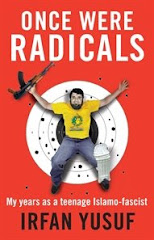
Irfan Yusuf is a Sydney lawyer and author of the forthcoming book Once Were Radicals. First published in The Canberra Times on 30 January 2009.

Delicious
Bookmark this on Delicious

Digg!

Get Flocked

Stumble Upon Toolbar

Monday, December 03, 2007

COMMENT: Bobby Sands joins al-Qaida while every other prison gang joins the Hayek Appreciation Society ...

I am very concerned. In fact, I’m very alarmed. I know al-Qaida are a nasty bunch of people. They kill more Muslims than non-Muslims. They are prepared to undertake all kinds of deadly attacks, including suicide bombings. They really don’t care about the strictures of the Islamic sacred law, and claim that flouting its basic provisions (such as the blanket prohibition of suicide) is necessary to wage their wacko pseudo-jihad.

Now I read reports of al-Qaida infiltrating prisons. Apparently, prisoners are studying the al-Qaida training manual. And the evidence? Muslim inmates are engaging in behaviour which is unique to al-Qaida. No other group ever engages in such behaviour. It can only be found in prisons infiltrated by this international terrorist outfit.

So what is this behaviour? According to a report in the Sun-Herald, the behaviour consists of … wait for it …

... hunger strikes, group protests and claims of mistreatment.

The behaviour also includes

... an internal organisational structure to maintain morale, resist interrogation and recruit members.

Clearly ethnic gangs and drug smuggling rackets in prison never develop organisational structures, preferring to follow the teachings of Friedrich von Hayek who claimed that the most durable social structures are those which emerge spontaneously.

And since when have prisoners been known to engage in hunger strikes or claimed of mistreatment? Clearly al-Qaida is at work here. Only Islamic extremists like Sheik Bobby Sands go on hunger strikes.

The report quotes the NSW Attorney General referring to the “insidious nature of these activities”. Apparently “international prison authorities had alerted Australian authorities to the existence of the manual three months ago”, despite the fact that the manual is freely available on the internet and has been known to the CIA since 1996!

The Sun-Herald has been pursuing this story rigorously. Back in April, they claimed that NSW Corrective Services Commissioner Woodham was of the view that there was a contradiction between being Aboriginal and being Muslim.

With this kind of incompetent reporting and/or administration, once again we have good reason to be alert and alarmed.

Words © 2007 Irfan Yusuf

Delicious
Bookmark this on Delicious

Digg!

Get Flocked

Stumble Upon Toolbar

Sunday, November 13, 2005

COMMENT: Moustapha al-Akkad - Sharing the Prophet in name and in film

Every life lost to terror is precious. Whether it be Sydney footballers or an anonymous London travellers, terror always claims innocent victims. But one recent terrorist incident should have really shaken the few Muslim left who only reluctantly condemn the terrorists.

Moustapha al-Akkad was no small fish in Hollywood. He was executive producer of the successful Halloween series of movies, from which he made millions. Halloween was released in 1978, and has regularly featured in lists of all-time great horror movies. The film had 7 sequels, the most recent of which was released in 2002.

Akkad was an American national. He had decided to move to Lebanon, taking advantage of the Mediterranean surrounds and the relative peace following decades of civil war and occupation. He was in Amman with his family to attend a wedding.

Akkad was born in the city of Aleppo in Syria, a Muslim town which provided shelter to thousands of Armenian refugees fleeing persecution during the last days of the Ottoman Empire. He moved to the United States at 18 years, and is said to have had only $200 and a Qur’an in his pocket when he arrived in Los Angeles.

Akkad studied film at UCLA, graduating in 1958. He completed his Masters from the University of Southern California where he focussed his attention on documentary making. Akkad went onto make documentaries for CBS across the world.

Despite being held captive to the American dream, Akkad never forgot his roots to his Syrian homeland or his Islamic faith. He used his directing skills to produce two movies regarded as classics across the Muslim World.

In 1976, Akkad produced and directed “The Message”, a film about the life of the Prophet Muhammad. He gathered actors of the calibre of Anthony Quinn, who played the Prophet’s uncle Hamza. Quinn also played the lead role in Akkad’s 1981 film “Lion of the Desert”, which portrayed the life and death of Libyan anti-colonial fighter Omar al-Mukhtar.

In a 1977 interview about “The Message”, Akkad described his reasons for making the film and his vision of his Islamic faith.

I did the film because it is a personal thing for me. Besides its production values as a film, it has its story, its intrigue, its drama. Beside all this I think there was something personal; being a Muslim myself who lived in the West, I felt that it was my obligation, my duty to tell the truth about Islam. It is a religion that has a 700 million following, yet it's so little known about, which surprised me. I thought I should tell the story that will bring this bridge, this gap to the West.
Akkad’s vision of Islam was as a faith which built bridges between hearts and civilisations. Like most Muslims, Akkad wanted to use his faith to be a source of peace, not conflict. The only terror (if one could call it that) Akkad wanted people to experience was from his horror movies.

Akkad was attending a wedding in Amman, Jordan when terrorists struck. He was standing outside the hotel where the wedding was being held. His 34 year old daughter, Rima Akkad Monla, was inside the hotel and was amongst those instantly killed in the blast. Akkad was severely injured and died in hospital on Friday.

Across the Arab world and the United States, tributes have been pouring in on this proud son of Aleppo. The Daily Star of Beirut, Akkad’s adopted city, writes:

Remembered by his friends and family here as a humble man whose words spoke volumes, he lived life to the fullest always loving the art of filmmaking and never stopped in his pursuit of bringing a true and peaceful image of Islam to the West. It is the most tragic of ironies that he died a victim of fellow Muslims claiming to fight in the name of the religion he so loved.
Akkad was planning to produce a movie on medieval Kurdish general Salahuddin (known in the West as Saladin) who defeated the Crusaders and drove them out of Jerusalem. Firas al-Atraqchi from al-Jazeera writes on 13 November 2005:

It was only two years ago that I sat across from him and his son Malek as he discussed the challenges he was facing in arranging financing for his new epic project – Salahuddin. Sitting comfortably in a leather chair in the lobby of the Grand Hyatt in Cairo, Egypt, with a pipe in his hand, Akkad described his Salahuddin troubles as nearly synonymous to the challenges he faced when trying to put together a script for The Message – a film about the rise of Islam and the teachings of the Prophet Muhammad.
Atraqchi goes onto describe the problems Akkad faced in trying to convince the fringe Wahhabi religious establishment of Saudi Arabia to approve the making of a film about the Prophet Muhammad. The sunni scholars of al-Azhar and shia authorities of Southern Lebanon had given their approval. Only the wahhabi's were holding back.

The same ideology held back Akkad from completing his Salahuddin project. The al-Qaida terrorist network, an offshoot of the wahhabi cult, took responsibility for the Amman blasts which killed Akkad, his daughter and over 50 others.

In his book The Great Theft – Wrestling Islam from the Extremists, UCLA Law Professor Khaled Abou el-Fadl laments how contemporary attention on Islam focuses on the actions of fringe groups such as wahhabi's and al-Qaida. The result, argues el-Fadl, is that “the most emphatic moral values taught by Islam … mercy, compassion, and peace” are readily ignored.

This struggle between the violent fringe and the moderate mainstream continues. It continues to claim victims of all faiths and no faith in particular. It has now claimed Moustapha al-Akkad, a man who devoted much of his creative talent and wealth to building bridges between Muslims and the rest of humanity. Muslims in Australia , New Zealand and across the Western world owe it to humanity to continue his legacy.

Words © 2005 Irfan Yusuf

Delicious
Bookmark this on Delicious

Digg!

Get Flocked

Stumble Upon Toolbar