Showing posts with label Melbourne. Show all posts

Sunday, December 25, 2016

COMMENT: The significance of Melbourne's Anglican cathedral

I haven't posted on this blog for ages and ages. This post will be spontaneous and not have a huge amount of organisation or direction. Sorry.

It's Christmas eve and I should be enjoying my holidays in Tokyo. It's winter here and Christmas is little more than a retailing gimmick. Christians are a minority in this largely Buddhist/Shinto nation. Churches are about as common as mosques. 
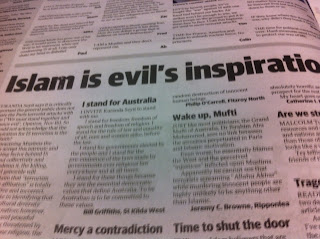
In this part of the world, no one seems to have the same hangups that Australians do about security and terrorism and all that stuff. The biggest security threats are China and North Korea. Muslims are more known as expat workers or tourists, just as Christians (and Jews) are.


While I've been here, my friends in Australia have had to content with a large terror-related raid in Melbourne. The alleged plot was to attack St Paul's Cathedral in the heart of the city.

I'm not sure how many Muslims:

a) understand the significance of St Paul's Cathedral

b) appreciate the timing of an attack on Midnight Mass or a late night service

c) are aware of the kinds of people who attend such services

I attended an Anglican Cathedral school in Sydney. A cathedral is the main church in a region or city. It is almost always the largest church in size and capacity, and is usually built and designed in the most ornate fashion. Australian Christianity is just over 200 years old, but our cathedrals are modeled on European structures much older.


An attack on St Paul's Cathedral i Melbourne would be the equivalent of an attack by Christian or Hindu extremists in Indonesia on Masjid Istiqlal. Or an attack in Lahore on Badshahi Masjid. Or an attack in Sarajevo on the Gazi Husrev Beg Cami. 

Stand opposite St Paul's Cathedral on Flinders Street and you will see a large placard that reads "Refugees Welcome Here". Refugees from all across the globe. Largely Muslim refugees. This Anglican institution opens its doors to the most vulnerable Muslims.

Speaking of Anglicanism and the Anglican Church, I spent a afew monthss working as a solicitor for Anglicare in a poor town in the La Trobe Valley. Anglicare offices provide services to people of all denominations including Muslims. Anglicare hires Muslim staff. I went to an Anglicare Christmas event for foster kids and their families. There were lots of women there in hijabs, all Angliicare clients.

Anyway, getting back to Midnight Mass, an event I've attended on plenty of occasions in Sydney (though admittedly at St Mary's Catholic Cathedral). The Anglican church (also known as the Church of England) remains the dominant church in Australia, though like other established churches it is facing stiff competition from charismatic churches such as Hillsong. 

But the Anglican church's fastest growth is not in Australia. Instead it is in Africa, in countries like Kenya and Nigeria and South Sudan. There are significant Anglican communions in Pakistan and India. When I started school, the school captain was a Pakistani Christian whose father was an Anglican priest.

Midnight mass would attract Anglicans from across the ethnic and linguistic spectrum of Melbourne Anglicanism. An attack on this congregation would not have merely affected "rich white people". It would have hit poorer families, including refugee families from South Sudan and immigrants from Pakistan and Indonesia.


I've often been stunned at the variety of costumes worn at Midnight Mass. Women decked out in saris and shalwar kameez and other cultural dress from Kenya and Vietnam. 

Imagine if an attack had gone ahead. The casualties would have been enormous. People from across Australia's multicultural spectrum would have been hurt. And all on Christmas, a time of celebration and worship and families and goodwill and peace on earth.

But as we all know, ISIL love attacking big targets, whether a large crowd in Istanbul or Karachi or Iraq or Syria or Tunisia. Whether Eid or Ramadan or Ashura, ISIL have no respect for holidays or sacred days or worshippers or mosques or shrines. Why would they care about our church services and congregations?

Stumble Upon Toolbar

Monday, August 03, 2015

BOOK: Hilarious book by an Iraqi-Iranian-Australian artist


What’s it like to live on the fringes of society, to be an outsider. First, second and third generation Muslim of migrant heritage often complain of being marginalised. But what would it be like to be a marginal person in more than one home country?
Osamah Sami’s family knows exactly what this is like. His late father, a religious scholar and leader to a Shia congregation in northern Melbourne, grew up in Iraq as a young man keen on reading foreign newspapers. Tortured by the regime of Saddam Hussein, he fled to Iran.
Osamah was born a foreigner. Despite belonging to the same religious denomination as the Iranians around him, Osamah was an Arab, not a Persian. His mother made him wear a long robe, not jeans like his Iranian friends.
But worse still, Osamah’s family were Iraqis living in Abadan, a border town. He and his neighbours lived under the shadow of Iraqi bombs, mortars, missiles and gas raining down on the city during the 1980’s war between Iran and Iraq. They also suffered from the constant suspicion and prejudice from those deemed more Iranian, more Shia and more Muslim than those who spoke Arabic. The language of the Prophet and the language of the enemy were one and the same.
Things weren’t made easier by the fact that Osamah’s father and uncles were fighting in the Iranian army, possibly against their former Iraqi relatives and neighbours. Amongst the drama and tragedy, the author manages to insert much laugh-out-loud humour.
Indeed, tragicomedy is an appropriate description of the book. Osamah’s childhood reflections of the hypocrisies of Iranian theocracy make an excellent antidote to those who would make us believe that the solution to our woes necessarily lay in the Islamic state. All the religious police in the world could not stop Muslims from identifying more by their tribe or sect. Kurds did not cease being Kurds. Iraqi Shia Muslims were still deemed Iraqis and potential enemies of the state. All this during the age of jihad against thee Great Satan and its cronies.
There were no long term prospects for Osamah’s family. The family moved from Abadan to the university city of Qom, where his father pursued studies to become a religious scholar. Later he was invited to Melbourne to officiate for religious ceremonies. Eventually, the family applied to migrate as refugees.
Much of the book is structured around a visit the adult Osamah made to Iran with his father. They arrived at the city of Mashhad in 2013, enjoyed a traditional falafel roll together and returned to their hotel. Osamah went for a walk while his father quietly moved onto the afterlife. Whilst dealing with his own grief, Osamah also had to deal with Iranian bureaucracy. “Policy is policy,” he would be told whilst forced to leave his Australian passport in the hands of anonymous officials in Mashhad before travelling some 900 km across a huge desert to Tehran.
Good Muslim Boy is a superbly hilarious read that will make you realise that even the most religious place can be filled with testosterone and even an imam’s son can get upto no good while maintaining his father’s affections. Terrific.
This review was first published in the Australasian Muslim Times on 31 July 2015.

Stumble Upon Toolbar

Monday, January 19, 2015

NOTES: Tim Winter in Melbourne


In late 2011, Tim Winter (also known as Abdal Hakim Murad) toured Sydney and Melbourne. His tour was hosted by Islamic Realm, a private educational foundation. I was fortunate enough to attend his Melbourne classes which were held in the Melbourne suburb of Box Hill. I recently found my hand-written notes for these some of these talks.

[01] Humans need stillness, meaning and rootedness. The modern world, including the virtual world, cannot provide these. Modernity knows how to sell but these commodities cannot be sold. All modernity can provide is entertainment to help us forget just how meaningless our lives are.

[02] One of the signs of the end of times is that distances are folded. Globalisation.

[03] How do mind, body and spirit draw us together to make us “centred”?

[04] The oldest thing in creation is insan, the imperfect, negligent human. We are a riddle. Our lives are like a bumpy progression from one strange experience to another.

[05] Post-modernity says that generalisation is impossible. What counts is one's self-perception. It's all about finding irony.

[06] Historically Muslims have had respectful interactions with other civilisations.

[07] There is evidence of human habitation in Cape York (northern Queensland) dating back 40,000 years.

[08] Islamic civilisation had a capacity to hybridise with indigenous civilisations. There is plenty of historical precedent for this. Wherever Ilam went, indigenous civilisation was invigorated. But what about with the historic singularity of post-modernism? We are in a post Judeo-Christian (Ahl al-Kitab) world that has turned its back on itself, its values etc. Its core “truths”, its values, its legislation etc is no longer touched by the Unseen.

[09] Modernism was about the clash between science and religion, between reason and mythology. But the narrative of modernism as collapsed and been replaced by an equality of all stories and narratives. The prevailing intellectual currents are about deconstruction of religious iseals, indeed all ideals.

[10] Most surrogate religions of the past 2 centuries (fascism, marxism etc) have been complete nightmares.

[11] Islam is not mmerely a series of rearguard actions, of defensiveness, even of despair and depression. Islam is not merely a way of staying afloat but rather a healing. We don't need a siege mentality or an attitude of insisting on difference as many migrants use as a survival mechanism. We are walking through the ruins of post-modernity.

[12] Beauty was left behind 100 years. The new Freudian human is just a bubbling of desires and ugliness. These days people look not to beauty or ugliness but to tolerance and intolerance.

[13] Reactive religion never reacts successfully. It must be true to itself. We don't need the outraged pride or the khutbah (sermon) screamed out like some kind of ego-based jahili rant.

[14] Modern spirituality has become commercialised egotistical stuff, the work of false gurus and televangelists.


[15] The diagnosis of the current human condition is dire. It is a complete dislocation of mind, body and spirit. Ethics and philosophy have collapsed. According to the World Health Organisation (WHO), the main reason for people's shortening of life will be depression.  

Stumble Upon Toolbar

Sunday, November 21, 2010

COMMENT: al-Ahbash to speak at Melbourne University??

No, my Lebanese Moslems Association friends, don't get over-excited. It's just a post-graduate research conference that juist happens to be hosted by a university department. It's quite normal for university departments to allow all kinds of people to submit abstracts and speak at conferences.

Indeed at least one sufi (or so he once claimed) deviant fitna-mongering former Liberal Party member has spoken at a conference organised by the Centre for Excellence in Islamic Studies.

And it would not be fair to suggest that Mustapha Kara-Ali, an engineering graduate and a PhD student at the International Islamic University of Malaysia has only one layer of identity - being an admirer of one religious leader in Lebanon known as Abdullah Hareri al-Habashi and allegedly belonging to a group known as "al-Ahbash".

This same group was strongly favoured by a former Australian government for assisting with deradicalising (whatever that means) Muslim youth. The result of over $150,000 in Australian taxpayer funded largesse was one manual.

That manual was produced under the auspices of an independent school founded and managed by followers of the said religious scholar in Lebanon. In his bio for the conference, Kara-Ali refers to that manual:

In 2007, he proposed and led a Government-Community-Partnership named the Building Identity and Resisting Radicalisation (BIRR) Initiative. He was also the lead-author of its publication The Way Forward - an Islamic Mentoring Guide for Building Identity and Resisting Radicalisation (2008), which was academically endorsed.


I'm not sure who "academically endorsed" the book, or indeed how something can be "academically endorsed". Did they send it to a university academic who said some relatively nice things about the layout? Did they sit on some steering committees and provide some general direction? Or did it go through a peer review process? Is it being published in an academic journal? Or just being excerpted in Quadrant Magazine?

I was amused by this entry:

In 2007, Mustapha was selected by DFAT to join a delegation to Malaysia to strengthen people-to-people relations ...


I wonder how DFAT staff on that trip found him to work with. What was his response to a presentation on the rights of religious minorities in Malaysia by the Malaysia Chinese Association (MCA)? I really cannot say. I'd have to ask others who went with him. I wasn't in that delegation. I went in 2006 instead. But I don't mention it in a bio for an academic conference.

One thing I would shove in a bio (if I had the chance) was hanging out with the wonderful Imam Feisal Abdul Rauf of New York. Imam Feisal has had a few issues of late with imbecilic fruitloops. Many who happily endorsed Imam Feisal are now having second thoughts due to political and social pressures arising from the so-called "Ground Zero Mosque" project.

When Kara-Ali attended a conference organised by Imam Feisal's American Sufi Muslim Association entitled Muslim Leaders of Tomorrow, he had this stunning bio:

Mustapha Kara-Ali is a 29-year-old representative on the Prime Minister's Muslim Community Reference Group (MCRG). He represents second generation Australian Muslims. The Bulletin Magazine recently profiled him as "an active mentor and educator within the Australian Muslim youth community since 1995", and last month he was introduced on the ABC's Religion Report as "an agent for change". Kara-Ali has been an outspoken critic of some ethnic leaders in the community for what he says is their failure to address the concerns of an emerging community of homegrown Muslim youth in Australia. He believes that sections of the Muslim community can be too defensive and fail to articulate issues in which they believe strongly.

Mr. Kara-Ali has a Masters degree in Engineering from UNSW and has worked as a consultant for Sydney University and CSC. He is a NAATI accredited translator in Arabic, and has a graduate diploma in media studies. Mustapha has appeared on the Channel 9 Sunday Program, Channel 7 Today Tonight, SBS Insight, ABC Religion Report and other media fronts. He has authored opinion pieces in metropolitan newspapers on Muslim issues such as Muslim integration in the West, identity struggles and immigrant marginalization. In talking politics, Mustapha's approach is informed by the conviction that Muslims in the west are part of the solution, not the problem.


For some reason, Kara-Ali's attendance at such a prestigious international forum isn't mentioned in his conference bio. Is he also now embarrassed to be associated with Imam Feisal?

UPDATE I: It will be interesting to see if Mr Kara-Ali's BIRR makes a bid for the latest round of government-sponsored deradicalisation dosh. According to a recent report in The Australian:

INDIVIDUALS believed to be at risk of falling prey to the lure of violent extremism are to be targeted in a series of community-based programs under the federal government's $9.7 million counter-radicalisation strategy.

Attorney-General Robert McClelland is inviting community groups to apply for federal funding to run grassroots projects to steer young people away from extremist ideology.

Grants of between $5000 and $200,000 are to be allocated to organisations in Victoria and NSW as part of the new Youth Mentoring Grants Program, to be launched by Mr McClelland today.

"The program will support activities that directly assist young people to disengage from intolerant and radical ideologies and encourage positive and constructive participation in the community," Mr McClelland said yesterday.


Words © 2010 Irfan Yusuf

DeliciousBookmark this on Delicious
Digg!Get Flocked

Stumble Upon Toolbar

Tuesday, October 12, 2010

EVENT: Launch of "Islam Dreaming: Indigenous Muslims in Australia"


Peta Stephenson is a scholar who has written on aspects of Australian history most of us never learned about at high school. I've learned a fair bit from her first book, which I've written elsewhere:

Genuine conservatives show genuine respect and reverence to our 40,000 year indigenous cultural status quo at least as much as they will to our 220-odd year European status quo. That involves recognising the sophistication of indigenous communities. In her 2007 book The Outsiders Within: Telling Australia's Indigenous-Asian Story Peta Stephenson tells just some of the stories of trade and cultural interaction (and indeed intermarriage) between indigenous tribes and Makassar trepang fishermen from Sulawesi (going back at least a century before Captain Phillip landed in Botany Bay) and Chinese indentured labourers.

Stephenson shows that these interactions were suppressed by colonial and Australian authorities, with members of culturally mixed families torn apart. Her book should convince even the most hardened monoculturalist the Indigenous Australia wasn't some isolated monolithic horde of noble savages waiting for the Poms to civilise them. Before and after Europeans settled and plundered, non-European peoples interacted with indigenous peoples on more equal terms, respecting their laws and customs.

We've all heard of Cathy Freeman's indigenous heritage. But how many of us are aware that Freeman is also part-Chinese? Her great-great grandfather moved from China in the late 19th century to work on sugarcane farms in northern Queensland. Stephenson writes that Freeman actively supported Beijing's bid to host the 2008 Olympics, and Chinese-language newspapers openly celebrate her Chinese heritage even if mainstream newspapers ignore it.

And who could forget the 1988 bicentennial celebrations, including the re-enactment of the Endeavour landing in Sydney? Our Territorian cousins up north had their own celebration, with the landing of the Hati Marege (meaning "Heart of Arnhem Land" in Indonesian) on the Arnhem Land coast. Stephenson provides evidence of Makassar fisherman from Sulawesi making annual voyages to fish for trepang (sea cucumbers) and to trade with the local Yolngu people since as early as the 17th century. This mutually beneficial trading relationship was banned by the South Australian government in 1906-07, ensuring the local Aboriginal people became isolated and insular. Mixed Makassan and indigenous families were torn apart, some only reunited recently after 80 years.


Dr Stephenson is now launching her second book, entitled Islam Dreaming: Indigenous Muslims in Australia. You can find out more about the book here.

The launch of the book is coming up in Melbourne. Details of the launch are as follows:

Friday 5 November 2010
6:30 for 7pm
Institute for Postcolonial Studies
78-80 Curzon Street
North Melbourne
RSVP by October 29 p.stephenson@unimelb.edu.au


Come along!

Words © 2010 Irfan Yusuf

DeliciousBookmark this on Delicious
Digg!Get Flocked

Stumble Upon Toolbar

Friday, September 04, 2009

COMMENT: Reasonable and unanswered questions ...


Recently I received an e-mail via a Melbourne Muslim yahoogroup. The e-mail was from a young chap who currently represents the AlGhazali Centre, and promoted a series of lectures to be delivered by "sheikh" Afroz Ali. Here is an excerpt of that e-mail:

Imam Afroz Ali is the Founder and President of Al-Ghazzali Centre for Islamic Sciences & Human Development, based in Sydney, Australia. He is a qualified Imam in the Islamic Tradition, having studied under Traditional Islam and received licence to teach in various Islamic Sciences. His studies have taken him from university-based Islamic University- Madina, Saudi Arabia then moving towards Traditional Scholarship in Yemen, United States and Mauritania, where he has spent considerable time to learn from the most esteemed Rightly Guided Islamic Scholars of our time. He has also travelled to Cairo, Egypt for further studies in Islamic Jurisprudence with Scholars at al-Azhar University and is on the Board of Advisors at Markaz Aleem in Cairo, Egypt.

He has presented lectures, workshops and training programs worldwide, including Australia, New Zealand, Malaysia, United States, The Emirates, Egypt, China, Japan and Denmark. He lectures around the world on Islamic Jurisprudence, Spirituality, Ecological Wellbeing, Ethical Rights and Responsibilities, and Personal and Corporate Citizenship.

He has initiated philanthropic as well as sustainable environment projects in Australia and abroad, and continues to advocate peace, acceptance, justice and interpersonal rights. Imam Afroz is a founding and executive member of the Australian Religious Response to Climate Change. He is also the recipient of the International Ambassador for Peace award.


I wrote to the brother in the following terms:

Dear Taymour,

In the bio of Mr Ali, it states:

"He is also the recipient of the International Ambassador for Peace award."

Can you please advise:

1. Who granted this award?

2. What was the award granted for?

3. When was it granted?

In relation to his studies at Madina University, can you please advise:

a. When did he study there?

b. How long did he study there?

c. Which courses, if any, did he complete?

d. Who were his teachers?

e. Did he complete any qualifications?

Looking forward to your response.

Ma salameh


These questions are, in my opinion, perfectly reasonable. And I expect that they will also remain perfectly unanswered.

I will keep readers informed of any response I receive. I don't expect any clarification at any stage before 2052 Olympics.

Words © 2009 Irfan Yusuf

Delicious
Bookmark this on Delicious

Digg!

Get Flocked

Stumble Upon Toolbar

Monday, November 03, 2008

EVENT: NCIES Conference

The National Centre for Excellence in Islamic Studies is holding its conference in Melbourne commencing Wednesday 19 November 2008. For reasons beyond my understanding, they've accepted a rather controversial paper proposal from me. It is a proposal that might get up the noses of some people ...

Imams as expert witnesses

This paper explores the use of imams as expert witnesses in court proceedings where matters relating to Islamic sacred law or Islamic theology in general become an issue. The paper will introduce the role of expert witnesses in the context of the law of evidence in Australia, focussing on how expert witnesses are qualified and why their opinions are treated as potentially authoritative evidence. Imams pose a particular difficulty in this regard as there is no set system for accrediting imams. In the case of imams’ boards (including the Australian National Imams Council), the accreditation system is unknown, unpublished and/or inconsistently applied. Further, there are very few imams with substantial working knowledge of areas where Islamic sacred law and Australian law might intersect (e.g. family law, estate matters and employment law). Hence, Australian imams can only be of limited use in court proceedings as expert witnesses. This became particularly clear in the religious vilification litigation between the Islamic Council of Victoria and Catch The Fire Ministries, where not a single imam was called by the ICV as an expert witness.
Words © 2008 Irfan Yusuf

Delicious
Bookmark this on Delicious

Digg!

Get Flocked

Stumble Upon Toolbar

Thursday, May 08, 2008

CRIKEY: Media rant - SBS declares Dave Hughes mufti of Australia!


SBS broke the news last night that Australia’s 360,000-odd Muslims now have a new Mufti.

Last night’s premiere episode of Salam Café saw Dave Hughes dressed up in ceremonial robes and a turban and declared mufti by compere Ahmed Imam (whose dad, coincidentally, is current mufti Fehmi el-Imam). Sheik Hughsy left the live Melbourne audience in hysterics.

SBS picked up this community-based show from Channel 31, where the show picked up a bunch of Antenna Awards in 2006 including Best Program on Community TV. The show features a panel of talented young Victorians including a couple of brilliant young stand-up comics, three charming hostesses, an author and that son-of-a-mufti I mentioned earlier.

The show was filmed before a live Melbourne audience, though rumour has it they’re filming some shows in Sydney.

One panel member is no stranger to mainstream TV. As a university student, ophthalmologist Dr Ahmed Hassan raised eyebrows among conservative community leaders by appearing on and (if my memory serves me correctly) winning a “Red Faces” segment on an episode of that Channel 9 classic Hey Hey! It’s Saturday. Back then, the idea of using popular culture to break down stereotypes was a little too cutting-edge for the middle-aged men that ran Australia’s mosques.

But times have changed. At least they have in Victoria. A fair few stars of this show hold senior positions on the Islamic Council of Victoria. And with Sheik Hughsy as their spiritual leader, it looks like mufti day has just hit the big time!

First published in the Crikey daily alert for Thursday 8 May 2008.


Words © 2008 Irfan Yusuf

Stumble Upon Toolbar

Thursday, March 27, 2008

EVENT: Aspire2Inspire Conference in Melbourne ...

Another excellent initiative by the ICV and partners. I'd go except that I'm too old! Click on the poster below for more info ...

Stumble Upon Toolbar

Sunday, February 03, 2008

EVENT: Maz hits Mexico!!!!!!


Attention All Melbournians!! You seriously cannot afford to miss Maz Jobrani. This dude is one of the funniest Americans to perform this side of the equator. Not bad for an Iranian!

You can read more about Maz here. His Sydney show on Saturday night 2 February 2008 was an absolute hoot. Yes, there was a large Iranian/Persian element in the audience, but they certainly were not the majority. Maz attracted people from across the ethnic and religious spectrum with his simple message of culturally “mixing it up”. If only John and Janette Howard could have been there. They might have actually learned something!

So stop what you’re doing, siddown, shuddup, grab your laptop and purchase a ticket online for tonight, Sunday 3 February 2008 before they all sell out. It’s his only performance in Melbourne and the last gig of his current Australian tour. Don’t miss out!!

© Irfan Yusuf 2008


Stumble Upon Toolbar