Showing posts with label ABC. Show all posts

Wednesday, December 22, 2010

COMMENT: Wingnut wishes ...


Some comments on a recent piece of mine published on ABC's The Drum challenged me to write something really cynical about the Prophet Muhammad and Muslim countries. Apparently the piece should involve the Prophet Muhammad leaving his blessed tomb in Madina and hitting the road to see what he'd find.

I'm supposed to be expecting a fatwa followed by an international madding crowd by writing that ... wait for it ... shock horror!!! ... Muslim countries don't exactly reflect Muhammadan ethics and expectations.

So I might as well start drafting these wingnut wishes on this blog. Here goes.

[01] In Saudi Arabia, female-only sports have led to a government investigation. I'm not sure if there was an investigation into the running races the Prophet Muhammad had with his wife Aisha. Imagine the Mother of the Believers being taken into custody by Saudi Arabia's morality police.


DeliciousBookmark this on Delicious

Digg!Get Flocked

Stumble Upon Toolbar

Saturday, December 26, 2009

COMMENT/MEDIA: On Afroz Ali, Saudi qualifications & the ABC Compass Progam cont ...

Readers may recall this post regarding "imam" Afroz Ali's appearance on the Compass program on ABCTV in 2007.

Yours trully contacted the Compass program and there was some exchange of correspondence which I will reproduce here. The initial contact was as follows:

2 December 2007

G'day,

I occasionally write for various places (including NewMatilda.com). I noticed that in a recent edition of the Compass program, the following was said ...

Imam Afroz Ali is founding president of the Al-Ghazzali Centre for Islamic Sciences and Human Development in Sydney’s south-west. Imam Ali has qualifications from Saudi Arabia and he’s studied in other significant centres of Islamic learning. At the Al Ghazzali Centre he teaches Islamic sciences, jurisprudence, ethics and corporate citizenship.

Can you please advise as to where you obtained this information from. Was it provided to you by Mr Ali and/or someone from the Al Ghazzali Centre? Did Mr Ali advise you of which qualifications he completed in Saudi Arabia?

Regards
Irfan Yusuf


I have received a response from Sharon Connolly, the Story Editor, as follows:

6 December 2007

Dear Irfan,

Many thanks for your inquiry about the Compass program One Vote, Which Values.

Information about Imam Ali and his qualifications was provided firstly by Imam Ali himself in an interview with Compass producer Peter Kirkwood published in Tomorrow’s Islam, G.Doogue & P. Kirkwood, ABC Books, 2005, and from information provided on the Al Ghazzali Centre website last August (unfortunately the site seems to be under reconstruction at present).

My understanding is that Imam Ali has studied in a number of centres, including Saudi Arabia, the US, Yemen, Mauritania and, most recently, at Al-Azhar University in Egypt.

Whilst I am not aware of which of his qualifications come from Saudi Arabia , I understand that Imam Ali is qualified to teach in various Islamic Sciences.

Please let me know if I can be of further assistance,

Sharon Connolly
Story Editor


I responded to Ms Connolly as follows:

5 December 2007

Dear Sharon,

Thank you for your response.

Did Mr Ali state that he had obtained a university degree from Saudi Arabia? Did he mention any specific university from which he graduated? Did he provide the year of graduation and the specific degree he obtained? Did he advise if the degree was an undergraduate or postgraduate qualification?

Regards
Irfan Yusuf


Ms Connolly responded as follows:

6 December 2007

Dear Irfan,

I am afraid that both you and Imam Ali have now alerted me to an inaccuracy in the narration for One Vote, Which Values.

In response to your email yesterday I was about to revisit the research files for the program this morning when I received an email from Imam Ali. He is currently in Cairo and though I have sent him a DVD copy of the program he has not yet received it. However as you’ll see in his message (the relevant passage of which I have copied below), Imam Ali has read the transcript of the program on the Compass website.

Imam Ali’s clarification is as follows:

Also, just as a quick note for your records, in the intro part of the transcript i was introduces as holding "qualifications" from Saudi Arabia . I just want to clarify that whilst i have studied in Islamic University, Madina, I did not complete my studies (due to a Wahhabist leaning of the teaching when I was there), nor do I reallu rely on that knowledge base. My qualifications as an Imam comes from Traditional source of one-on-one with Scholars. Just for future reference, if you need me for an interview again!!!!

I regret that there appears to have been a misunderstanding on my part, and hope that the above information clarifies the position.

Yours sincerely,
Sharon Connolly
Story Editor,
Compass


What a strange coincidence. Anyway, more questions were put to Ms Connolly.

6 December 2007

Dear Sharon,

Thank you for that. I would still be interested to know if at any stage Mr Ali did represent to you or anyone else that he had completed a degree or other qualification.

It is a representation that has been made in the past. For instance, in 2005 in New Zealand ...http://www.scoop.co.nz/stories/PO0506/S00251.htm

... Mr. Afroz Ali of Sydney, also well versed in inter-religious matters, holding degrees in Islamic Studies and Shari'ah from Islamic University, Madina, Saudi Arabia, thereafter continuing through traditional Islamic learning styles under scholars such as Shaykh Hamza Yusuf of the United States, Shaykh Salik bin Siddina and Shaykh Murabtal Hajj of Mauritania.

... and at the University of Western Sydney in 2004 ...

Mr Ali graduated in Islamic Studies - Sharia after studying in Islamic University, Madina Saudi Arabia ...

This shows the problems arising from the absence of a proper system of accreditation of imams. Perhaps an idea for a future episode?

Regards
Irfan Yusuf


Ms Connolly responded:

6 December 2007

Dear Irfan,

I haven’t myself seen a description of Imam Ali’s qualifications like those that you quote. I think my ideas about his qualifications came from the program researcher’s notes which say that he is a “qualified Imam” and that he “received licence to teach in various Islamic Sciences.” Those notes contain no more specifics about the qualifications, simply a list of countries (not universities) in which he studied.

I have been unable to contact the researcher concerned as she is no longer working with the ABC. However I understand that her information came from the sources I mentioned to you in an earlier email; basically the Al Ghazzali centre website, Tomorrow’s Islam and from discussion with Imam Ali.

There is however nothing in the material I have revisited to suggest that Imam Ali has misrepresented the case; rather I have erred (as his email points out) in suggesting that he has qualifications from Saudi Arabia. As I said earlier, I think this is a case of misunderstanding on my part.

I agree with you that - to the uninitiated at least - the system for conferring qualifications upon Imams is not perhaps as clear as for some other denominations, and have mentioned your program idea to the Compass Executive Producer.

Regards,
Sharon Connolly
Story Editor,
Compass

Perhaps the contents of these e-mails can be discussed separately.


Delicious
Bookmark this on Delicious

Digg!

Get Flocked

Stumble Upon Toolbar

Monday, November 09, 2009

COMMENT: Rachael Kohn on imam con-artistry ...


According to ABC Radio National religion presenter Dr Rachaael Kohn, it is the responsibility of Muslims in Australia to expose some wacky Iranian self-proclaimed Ayatollah they probably have never heard of except through the news.

In the many media conferences and interfaith meetings I've attended, Muslims have regularly complained that the media cast them in a poor light.

However valid that complaint may be, it loses all credibility when they don't go after the radicals in their community.

If they don't, the media will do it for them.

Indeed. And when the media does it, it's likely that it will be the first time even the most well-connected Muslims will learn about the person in question. But what if Muslim religious leaders go further and actually request law enforcement agencies to do something about it? As Kohn herself notes:

Almost two years ago, Richard Kerbaj [The Australian, Jan 28 2008] reported that the Melbourne based Shia Muslim leader, Kamal Mousselmani, urged the Australian Federal Police to investigate Sheik Haron, whom Mousselmani claimed was not a genuine religious leader.


Did you read that, Rachael? Almost two years ago. Perhaps you should be directing your inquiries to AFP.

Still, Rachael does have one point:

But one issue remains outstanding: just who is a genuine religious leader in the Muslim community and who is monitoring their output to young Australians?

I've been making that precise point in the matter of Afroz Ali. But then, Afroz doesn't exactly go around preaching suicide bombing. I don't think someone who promotes feeding the homeless and getting involved in climate change activism could be described as a threat to our national security even if he isn't as qualified to teach religion as he claims to be.

You'd think a religious reporter from Radio National would be able to make such distinctions and address such issues. Still, you don't need to know much about Islam or Muslims to get a job in the Religion department there. Indeed even Afroz Ali wouldn't be silly enough to object (as Kohn once did) to using the term "unitarian Islam" (or something similar) to describe wahhabism. A bit like objecting using "lawyer" to describe a legal practitioner.

Read this paragraph and wonder:

Yet it would seem that with the rapid growth of storefront prayer halls, it is time to ensure that all the independent sheiks who garner a following be known and when necessary reined-in by a body that represents the interests of Australian Muslims.

It's hard not to be flippant about Kohn's claims. Yes, these shopfront prayer hall sheiks are breeding like rabbits, popping up all over the place. And as we all know, Muslim youth are so damned vulnerable that they can be brainwashed into doing just about anything. I mean, we've all heard of those genetic deficiencies, haven't we?

Seriously, Rachael, if you want to hold me and 359,999 other Australians who tick the "Muslim" box on their census forms responsible for the wacky remarks of some wacky dude we know bugger-all about just because our unelected self-appointed leaders do bugger-all about him, you might consider resigning from Radio National and move to 2GB where people holding such silly views do their broadcasting.

Words © 2009 Irfan Yusuf


Delicious
Bookmark this on Delicious

Digg!

Get Flocked

Stumble Upon Toolbar

Wednesday, August 12, 2009

EGYPT: A look at divided Cairo ...

Today I had a chat with ABC reporter Hagar Cohen. A migrant from Israel, she settled in Australia in 2003, studying journalism at UTS and now working as a producer for Radio National programs including Background Briefing. She spoke to me in relation to a story about the role of the mufti of Australia.

Ms Cohen told me about a recent trip to Egypt to film a story on the future of Cairo, Egypt's ancient city on the Nile. The program looks at some of the difficult issues facing the city, especially the increasing segregation of rich and poor residents. This includes the development of "gated communities" and suburbs seeking to replicate American suburbia.

I wonder how much of these problems is replicated in other cities in the Arab and nominally Muslim world.

UPDATE I: The episode of Background Briefing dealing with imams and young Muslims can be seen and heard here.

Words © 2009 Irfan Yusuf


Delicious
Bookmark this on Delicious

Digg!

Get Flocked

Stumble Upon Toolbar

Friday, December 12, 2008

OPINION: An Irreverent Guide to the Aussie Hajj ...


Recently one of my favourite editors announced he was packing his bags, partner and kids off to the Iberian peninsular. I was a little confused at first as to why he was going. I thought it might be some kind of pilgrimage.

I went to his farewell at his house in the inner-city of Sydney . Lots of wine and beer was flowing, none of it down my throat but plenty of its fumes up my nostrils. Once we were in a sufficient state of intoxication, I think I remember us having the following conversation:

HIM: So are you gonna visit me over there?

ME: Maaaate [in Tony Abbott style], I'll only go if you take me on pilgrimage on the road to Santiago de Compostella.

HIM: Mate [this time less like Tony Abbott], when are you taking me to Mecca ?

ME: You've got a point there. Still, they should let you in this time, now that you've grown a beard!.

I guess that's the problem many non-Muslims face. They simply can't get into Mecca even if they wanted to. I mean, I'm sure plenty of Aussies would absolutely relish the opportunity to spend a fortnight in a desert wilderness enjoying the 45-plus degrees celcius heat (without having an ice-cold VB as a consolation prize), the noise, the crowds, the pick-pockets, the rudeness of Saudi customs officials and police etc etc. What better way to spend Christmas?

An Aussie Hajj-a-holic's guide to the pilgrimage

For those of you who ever wondered what it was like to go on the Hajj - the Muslim pilgrimage to Mecca, now located in the modern (and I use that word in its broadest possible sense) Kingdom of Saudi Arabia - here is a step-by-step guide to the experience.

No, not my experience. I've never been. In fact, I'm not allowed to go until I've paid all my debts. Though my exceptionally South Asian mum has. In fact, she's already been there three times. And worse still, she wants to go again! I reckon it's because she wants to commune with God. Though I could be wrong.

I vaant to go a-ghen, to get aveh frum yoo and yoor faadhar. Olvez mek
me doo-ing iss-stoopid cooking!

(Trans: I'd go again just to get away from you and your father! When are
you two gonna learn to cook??)


Yep, she's a bit of a Hajj-a-holic.

The crowd

The first problem mum points out is with the crowds. If Byron Bay and Sunshine coast locals thought they had it bad with schoolies and toolies, they should spare a thought for the people of Mecca. Each year, over 5 million people visit this sacred Muslim city.

The biggest numbers are at the time of Hajj, the sacred pilgrimage all able-bodied Muslims who can afford it are expected to make at least once in their lifetime. This year, over 2.7 million people are expected to converge on this ancient city for this annual assembly of monotheism.

The pilgrims come from just about every part of the planet. Despite the enormous cultural, linguistic and sectarian differences amongst Muslims, there is a surprising degree of consensus when it comes to the rituals of the Hajj. These ancient rites date back 1,400 years and are based on an even older story.

The Hajj story

Some people in Australia talk about "Judeo-Christian" values, as if they haven't quite figured out that there are at least 3 monotheistic faiths that emerged from the Middle East. And that's not including all the other monotheistic faiths (such as Sikhism).

Really, what we should be talking about are "Abrahamic" values. The triplet faiths of Islam, Christianity and Judaism all respect and honour Abraham, an Iraqi chap regarded by all three traditions as the father of ethical monotheism.

According to Islamic tradition, Ibrahim (Abraham) married an Egyptian woman named Hajira (Hagar) who bore him a son named Ismail (Ishmael). He also took a second wife Sarah (pronounced slightly differently in Biblical English) who bore him a second son Ishaq (Isaac).

For some domestic reasons, Ibrahim feels the need to leave his first wife in a desert valley named Bakkah with the baby Ismail. Like all good mums, Hajira's primary concern is the survival of her toddler. But where will she find water in this wilderness?

The well and the cube

She heads for a hill, finds nothing and so heads in the opposite direction to another hill. She again finds nothing. In desperation, she runs back and forth around 7 times before setting eyes on her young boy kicking the ground to uncover a spring. Quickly she builds a make-shift well.

Within a short period, the well attracts the attention of other travellers through this area. Hajira watches her son become a grown man, and receives a visit from Ibrahim again. Ibrahim and Ismail are ordered to build a temple in honour of the one true invisible God. The temple was a simple cubic structure, in the direction of which people would pray.

The valley of Bakkah eventually became known as Mecca. The cubic temple is known as the Kaaba (an Arabic word which just means "Cube"), and is traditionally draped in a black embroidered cloth. The well kicked to the surface by the infant Ismail is known as the Well of Zam Zam.

The age of pilgrims

The elders teach that the reward for a successful Hajj is nothing less than forgiveness of all sins and paradise. In many Muslim cultures, this means people tend to leave performing Hajj to the end of their life. In the Indian sub-Continent, where my parents come from, people tend to perform Hajj after their kids have grown up, married and left home. Cynics (like my dad each time his wife books her Hajj package at the travel agent) recite an old Hindi/Urdu phrase which can be roughly translated as:
After eating several thousand mice, the fat cat finally decides to head off for Hajj!

In places closer to our shores, people tend to go much earlier. In Malaysia, it's common for young couples to treat the Hajj as a kind of spiritual honeymoon. According to the Prophet Muhammad, a person who married has completed half the faith. So if you're a boofy bloke like me and you are lucky enough to marry some gorgeous Malay (apologies for the tautology) princess, it's like a heavenly 2-for-1 deal. You've got guaranteed loss of your virginity, gain of half your faith and your sins forgiven in one go!

And for those who believes neo-Con fictions about Islam, the deal doesn't even include the fictitious 72 heavenly virgins!

Multicultural Aussie Hajj

Each year Australia sends a few hundred people to perform Hajj. When they come back, they're given the honorific title of "Hajji" or "al-Hajj". If their Hajj was successfully completed, they should come back with their sins are washed away and as pure as the day they were born.

(Anyone who has had to deal with Saudi officials at Jeddah airport will know why forgiveness of one's sins is furnished so readily.)

In Australia, the Hajj trip is performed by people of various ages. More young people accompany their elderly parents on this difficult journey.

Then there are the different nationalities and their interesting idiosyncrasies.

Hajj Hansonisms

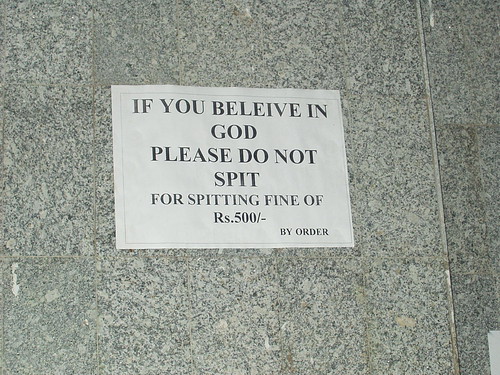
In Mecca, all street signs are in various languages. But there are certain signs you'll only find in Urdu, Bengali and Hindi. These signs simply state: "Spitting here is forbidden!". Or something like that.

Why? Across the Indian sub-Continent, people chew a special blend of nuts and paste wrapped in leaf known as paan which they chew and spit out into gutters or even against walls, leaving a nasty and distinct reddish-brown stain.

Turks travel in large groups and are extremely fussy about cleanliness. In one part of the Hajj, all pilgrims stay in tents on a plain called Mina for the night. The place becomes tent city for the night, with a range of facilities including toilets and kitchens. You know you're in the Turkish section because tents look shiny-new, the sand looks like someone has rubbed Mr Sheen into it, and the toilets are spotless to the extent you could make a sandwich on their floors.

Cronulla rioters will be pleased to learn that according to a reliable source (my mum), Lebanese pilgrims basically spend most of their Hajj sitting around cracking jokes and drinking coffee strong enough to keep you awake until the next Hajj.

Nigerians are tall and heavy-set. A major part of the pilgrimage is to circle the cubic temple seven times in an anti-clockwise direction, all the while shouting "Labayk! Allah humma Labbayk!" (roughly translated as "I'm here, Oh Lord, I'm here" though if you're on the receiving end of the rampage, you should read "My God! Here they come!!"). It's generally not advisable to slip if you find yourself in their path. When you see a group of them with arms clasped rushing toward you screaming the prayer, it's scarier than seeing 500 All-Blacks doing the Haka.

I have no idea what Kiwi pilgrims are like. I doubt they scream the Haka at any stage of the rituals. Plus people at Hajj tend to use sheep for slaughtering purposes.

And what the dinky-di Australian pilgrim do at Hajj? Maybe throw a halal shrimp on the bbq, have a game of sand cricket and sink down a few non-alcoholic VB's.

Hajj dress code

Despite the weird and wonderful characteristics of various cultural groups at Hajj, everyone dresses the same. Blokes wear a white-coloured two-piece towel thing, and ladies wear some additional stuff which is also white coloured. If you landed in Mecca at Hajj time and you didn't know where you were, you'd think it was a huge toga party. Except at this party, everyone is praying and no one gets pissed or stoned.

Despite this, Mecca does have some rather nasty features found in big secular cities. UK stand-up comic and columnist Shazia Mirza often talks about her Hajj during her routine. She was circling the Ka'aba when some dude pinched her behind. She turned around but couldn't recognise the culprit in a sea of sacred togas. She kept going when, within a moment or so, it happened again. She turned around, and again she couldn't locate the deviant.

Later, Shazia caught up with her sister, who also complained of being pinched. Shazia then relates to her audience: "We both concluded it was the Hand of God".

Boom boom!

(Don't panic. I didn't just let off a bomb.)

Meanwhile, back home...

Believe me, the party isn't just happening in Mecca. Across the world, Muslims celebrate their own party. In fact, it's the biggest feast of the year, and is known as Eid al-Adha (or Bayram for Turks, Hari Raya for Indonesians/Malays, Baqrah Eid for South Asians etc).

Thankfully, this year Eid and Christmas (or Hari Natal for all you Indonesians out there) are both happening around the same time. But for Aussie employers with Muslim employees, it's a huge pain in the butt. Here's why.

Aussie Lunar-tics

I'm sure all you (non-Orthodox) Christians find celebrating Christmas fairly straight forward. For a start, you at least know when it is. But spare a thought for us Muslims. The absence of any central priestly or scholarly authority in Aussie Islam means that we simply cannot agree on when the feast is to be celebrated.

Imagine being office manager in a medium-sized law firm in Sydney's CBD. It's Tuesday afternoon. Sekire (pronounced "Shakira"), a law clerk of Turkish ancestry, approaches you to confirm her leave on Wednesday to be at home helping mum with the cooking while her fiancé, brothers and dad go to the mosque for Bayram prayers. Her community's imams have settled religious festival dates until 2,987 A.D.

Then high-powered solicitor Suraina approaches you on Wednesday morning to take Thursday off for Hari Raya Haji. Her family and her metro-sexual husband (apparently the managing director of Petronas) are flying in from KL for the occasion. She only found out last night it was Hari Raya. She assures you a barrister had been briefed and will attend her hearing on Thursday.

Then on Friday morning, you get a call from the barrister's clerk. Thursday's hearing was adjourned to this morning, and the barrister Mr Yusuf can't make it as he heard last night that the Bakra Eid moon has been sighted.

But heck, don't blame us lay Muslims. Blame our lunar-tic mullahs, imams, sheiks, hojjahs, maulanas etc who can't seem to agree on how to calculate the beginning and end of lunar months!

The End

So that's the end of my slightly irreverent look at Hajj. For more information, go to your local mosque and convert. Then get on the first plane you can to Mecca, and you might arrive in time for the last rites.

First published in ABC Unleashed on 19 December 2007.

Words © 2007-8 Irfan Yusuf

Delicious
Bookmark this on Delicious
Digg!

Get Flocked

Stumble Upon Toolbar

Thursday, December 11, 2008

OPINION: Muslim apathy & thick-Sheiks


Tanya Louise Smith, a young Australian woman who converted to Islam and eventually went to Yemen. She met up with some other Australians and started studying a more fringe form of Islam, which sometimes going by the name "salafi" or "wahhabi".

She married a Palestinian man, fell pregnant and went to Gaza to live with her in-laws. Her husband, who hoped to join her, was stuck outside thanks to the Israeli blockade and Egypt closing the border. You can read her story in The Australian here.

How did she and her Australian classmates end up pursuing studies in a more fringe form of Islam and in an apparently more radical institution?

No doubt some will say that it's logical that a person adopting Islam will become a danger to themselves and society. Since 9/11, it has become fashionable in some circles to equate the 14 centuries of evolving religious tradition known as Islam with just about all the ills of the world.

Hence, anyone who says anything even remotely positive about the "i" word is treated as if they've just screamed out the "f" word repeatedly on TV.

Still, let's not live in denial. There are a bunch of crazies out there happy to make a political point by blowing themselves up or flying jet aircraft into skyscrapers. They have their own peculiar ideology, and their message is essentially a political (as opposed to a religious) one. This explains why Osama bin Ladin's taped messages are always dominated by references to political grievances.

A major problem bin Ladin has is that he follows a sect of Islam that Smith adopted. This particular sect is the official religion of the Kingdom of Saudi Arabia, though apparently only a minority of Saudis actually follow it. In the non-Saudi world, it is regarded as quite heterodox.

Some Muslims (especially shia Muslims) regard it as downright heretical.

So bin Ladin is a wahhabi. He also was for many years (but not anymore) a Saudi citizen. However, that doesn't mean all Saudis and/or Wahhabis are sitting on the "friends" section of bin Ladin's Facebook page, even if some scribes think they are.

We have some Wahhabis in Australia but not a huge number. At least one of them says he meets with the boys and girls from ASIO fairly regularly to "talk about everything".

More extreme Wahhabis do recruit, though their efforts among first generation Muslim migrants haven't been too successful. Why? Because these migrants have been spiritually and ideologically inoculated against any extremist influence.

When you grow up in Pakistan or Turkey or Indonesia or other Muslim country, you develop a sense of what mainstream theology is.

But what happens to those who haven't gone through this mainstream religious osmosis? What happens to young kids brought up in Australia?

It's no secret that extremists target young people and converts. Sean O'Neill and Daniel McGrory, two British journalists working with The Times, wrote a book in 2006 entitled The Suicide Factory: Abu Hamza And The Finsbury Park Mosque.

The book tells the story of how radical preacher Abu Hamza recruited the children and grandchildren of Muslim migrants and a small band of converts. Some of his former students were among the London bombers.

Abu Hamza's group took advantage of the weak management of religious institutions. British Muslims are largely of South Asian extraction whose cultures regarded involvement in religious institutions as a rather lowly endeavour.

Mosque managers also saw their institutions as places where they could keep alive the culture they left behind in Pakistan or Bangladesh in the 1970s. Hence, mosques are stuck in a cultural time-warp, relics of religious and social attitudes that are rarely found even in modern South Asian countries.

Into this vacuum strode Abu Hamza and his cronies, many of whom had criminal records for violence and fraud offences. After being removed from one small mosque, Abu Hamza set his sights on the large Finsbury Park Mosque built with Saudi money and supported by Prince Charles.

Could someone like Abu Hamza just as easily operate in Sydney or Melbourne? The descriptions in The Suicide Factory given of the parlous state of British Muslim institutions – political intrigue, scarce resources wasted on litigation, cultural irrelevance to name just a few - are what I've seen in Australia for over two decades.

Of course, Muslim Poms and Aussies are as dissimilar as Catholic Brazilians and East Timorese. But what many mosques in both the UK and Australia share is disregard for the spirirtual needs of second and third generation Muslims and converts.

Further, Muslims are by and large a very secular lot most of whom will only be seen at the mosque on the two major feast days. You don't see prominent Muslims from BRW's top 100 list getting involved in managing religious institutions.

The good news is that young Muslims are taking control of their own spiritual destinies. Young Muslims are looking to Europe and the United States for sensible relevant voices like Hamza Yusuf Hanson and Tariq Ramadan.

The only opposition they face is from a coalition of radical thick-Sheiks who label them infidels and radical neo-conservative pundits for whom the only good Muslim is an ex-Muslim.

Young educated Muslims are now taking over religious institutions. The new face of the Lebanese Muslim Association in Lakemba is a surfing sheik who visits schools with a young rabbi. And you can watch the CEO of the Islamic Council of Victoria compering an SBS talkshow each Wednesday night, while a member of his executive is a stand-up comic who wants to run for Mayor in the Sydney's Camden.

An Australian Islam with a genuinely Aussie accent is a key element to ensuring the Abu Hamza's of this world don't gain a foothold in Australia, and that the Tanya Smith's can learn their faith without having to travel into a culturally unfamiliar environment.

First published in ABC Unleashed on 9 July 2008.

Words © 2008 Irfan Yusuf

Delicious
Bookmark this on Delicious
Digg!

Get Flocked

Stumble Upon Toolbar

Sunday, November 23, 2008

CRIKEY: Israeli torn between ''Islamists'' and ''the Muslim thugs'' ...


Visiting Israeli Professor Raphael Israeli presents different faces for different audiences. Sometimes he says his target is only “Islamists”, ie, those Muslims who want to impose a political version of Islam on secular democracies.

Certainly this is what he said in a letter to The Australian. Here's an excerpt from The Oz report on February 19 2007 ...

A VISITING Israeli academic has blasted Australia's Jewish leaders for disowning him after he raised concerns about the level of Muslim immigration in Europe and the consequences of a similar approach here.

Raphael Israeli, Professor of Islamic, Middle East and Chinese History at the Hebrew University in Jerusalem, wrote to The Australian yesterday to complain about his treatment after a story in the Australian Jewish News which claimed he favoured a cap on Muslim immigration.

The story, which Professor Israeli said didn't accurately reflect his views, led to criticism from Muslim and Jewish leaders without further checks with him, he said. The Australia/Israel and Jewish Affairs Council, co-sponsoring his lecture tour, decided to sever ties with him.

"Instead of standing by their guest, and supporting free debate in this country, Jewish leaders have elected to shamefully disown me in their statements that were geared to placate Muslims," Professor Israeli wrote.

"I come from a country dipped in solidarity and that never abandons its fighters in the battlefield. Here I feel abandoned, forlorn, betrayed by people who lack courage and stamina to stand up for principles."

Professor Israeli's attributed comments in the Jewish press last week in part suggested there would be demographic pressure for Indonesian Muslims to resettle. The article quoted him as saying "one of the big possibilities is Australia, so they will continue to come legally, or illegally, and settle here, and when they get to the rate of the 10per cent, like in France, then you will see life will become untenable".
Yet he wrote an almost identical, though more virulent (and need I say honest) letter to the far-Right polemical JihadWatch website. In that letter, he made it clear he was talking about “the Muslim thugs”, without differentiation. In other words, his attitudes are directed to all Australians who happen to tick the “Muslim” box on their census forms. Here's how The Age reported Israeli's remarks ...

A VISITING Jewish professor has lashed out at Australian Jewish leaders for their "shameful submission to Muslim thugs", saying his comments were less harsh than some by the Prime Minister and federal Treasurer.

Hebrew University professor Raphael Israeli, dropped from a proposed lecture tour after comments last week, said political correctness did not allow his remarks to be said, though, privately, all supported them.

He said Prime Minister John Howard and Treasurer Peter Costello had said harsher things after "Muslim riots", but "someone elected to seize upon this opportunity now and sweep Australia into a storm in a teacup".

Professor Israeli, who will teach his six-week Islamic history course at the University of NSW, posted his version of the stoush on a website.

On the Dhimmi Watch section of www.jihadwatch.org, he wrote: "The dhimmi-like Jewish leadership cancelled all activities, in a shameful submission to the Muslim thugs and under the false claims of a 'multicultural society' in Australia, which they know is not true."
Regardless of where he stands, we’d be living in denial if we insisted Israeli’s attitudes to that nebulous Arab/Muslim/Islamist/Middle Eastern “them” aren’t gaining some hold.

Why is this so? Who is responsible? And what is being done about it?

Journalism professor and veteran reporter Peter Manning believes that skewed reporting is largely to blame. His research of metropolitan Sydney newspaper reporting pre and post-September 11 shows that the prejudices have pre-dated the emergence of al-Qaeda.

Experts like Dr James Jupp of the Australian National University argue cogently against Israeli’s central thesis on limiting immigration for a particular religious group. Here's how ninemsn reported Jupp's remarks on February 16 2007.

A local immigration expert has dismissed suggestions by a visiting Israeli academic that Islamic migration to Australia should be capped.

... immigration expert Dr James Jupp from the Australian National University said talk of limiting immigration for Muslims was the kind of idea "put forward by crackpots" — even though there is no legal barrier to doing so.

He said banning immigrants on religious grounds is possible as all migrant applications are done in other countries which are not subject to our racial vilification laws.

“You [immigrants] have no legal rights to Australian law if you are outside Australia,” Dr Jupp said.

Proving religious discrimination “would be extremely difficult” as immigrants cannot access our legal system before they arrive in Australia.

”I don’t think you’d have a leg to stand on, you couldn’t prove it,” Dr Jupp said.

He added that officials could easily hide religious discrimination behind the various other requirements immigrants must meet to enter this country ...

... Dr Jupp said that would not occur here as European countries gave full citizenship to emigrants from ex-colonial nations — many of which are Muslim countries.

As Australia has no colonial ties with Muslim countries like Algeria, it was unlikely that Muslims would come to this country in such large numbers as they do in Europe.
I think much responsibility rests with Muslims themselves, especially with religious and organisational leaders who are largely first generation migrants who regard Islam as a relic of their lives “back home” and are generally disinterested in communicating Islamic theology to the broader community.

The ethno-religious nature of the Muslim religious establishment is the biggest reason why Israeli’s claims simply don’t apply to Muslims here (if they apply anywhere else).

On Radio National Israeli said that
... in Islam, secular Islam, or secular Muslims, is a contradiction in terms.
He also said that there is only one Islam, and that Muslims either adopt it or they don’t.

This is the weakest link in Israeli’s argument. Australian Muslims come from over 60 different countries. Australian Islam is more ethno-cultural than religious a phenomenon, reflected in Muslim community leadership drawn from ethnic-based mosques.

To say there is one Islam means there is one Muslim community. But the fact is that Muslims cannot even agree on holding festival days. Israeli says that a growing monolithic Muslim community in Australia is a threat. This Muslim community doesn’t exist down under.

An edited version of this piece was first published in Crikey on 23 February 2007.

Words © 2008 Irfan Yusuf

Delicious
Bookmark this on Delicious

Digg!

Get Flocked

Stumble Upon Toolbar

Tuesday, September 09, 2008

MEDIA/COMMENT: On beards, robes and Salafis ...


I was recently doing some research on visits to Australia by Indonesian radical imam Abu Bakar Basyir when I came across an article by Sally Neighbour published on the ABC website. The article, from November 2006, dealth with Abu Bakar Basyir's ties with Sheik Mohammad Omran from Melbourne.

Neighbour makes this curious observation about the Salafi strains of Islam ...


But the two men and their followers shared a common world view. They were adherents of the Salafi school of Islam, which holds that the faith must be practised just as it was in the days of the Prophet Mohammed in the seventh century, hence their long robes and untrimmed beards.

Neighbour seems to suggest that Salafis represent a single school of Islam which is characterised by an insistence that Islam must be practised exactly as it was during the time of the Prophet Muhammad. One result of this is that men wear long robes and grow beards.

Neighbour is regarded as a senior reporter on national security issues. I hate to say this, but the statement quoted above is comparable to something you might read in a British tabloid or watch on FoxNews.

There are numerous Muslim groups who see the Islam practised during the Prophet Muhammad's time as an ideal and a goal to aspire to. This need not take the form of literalism, either in textual interpretation or application of the Islamic sacred law (also known as sharia). Having such an ideal could hardly be described as indicative of a person following the Salafi strains of Islam.

In recent times, there has been a debate in Muslim circles about moonsighting to determine the commencement of the month of Ramadan. One Sydney chap and various groups affiliated with him have argued that the moon should be sighted with the naked eye, just as happened 14 centuries ago. Yet even the staunchest critics of this chap (such as myself) could dare describe him as a Salafi.

Further, the wearing of long robes and men growing beards is also not exactly representative of Salafi strains of Islam. Anyone who has attended Sufi gatherings of teachers such as Sheik Nuh Ha Mim Keller or Sheik Na'eem Abdul Wali would know what I mean. Here are men wearing robes and sporting beards, yet are known to have published written works strongly critical of Salafi strains of Islam on a variety of issues.

Given the widespread ignorance of various strains of Islam (or indeed of the basics of Islam) in the broader community, it is often difficult for reporters to write in a manner that reflects the nuances of various theological groups and schools of thought. I hope senior reporters like Ms Neighbour are able to avoid such inaccuracies in their future reporting.

Words © 2008 Irfan Yusuf

Stumble Upon Toolbar

Wednesday, April 30, 2008

MEDIA: Crittenden attacks Georgetown inter-faith centre ...


ABC Religion Report presenter Stephen Crittenden today viciously attacked Georgetown University and one of its leading academics, Professor John Esposito. Professor Esposito is the author and editor of numerous books on Islam, Muslim societies and Islamist movements. He is also the author of a number of standard texts and authoritative reference works including:

* The Oxford History of Islam
* The Oxford Dictionary of Islam
* The Oxford Encyclopaedia of the Modern Islamic World (4 volumes)

Apart from these and many other works, Professor Esposito recently co-authored with Dalia Mogahed the book Who Speaks for Islam? What A Billion Muslims Really Think. That book is based on a Gallup World Poll - the largest study of its kind - conducted between 2001 and 2007, using a sample which represented

... residents young and old, educated and illiterate, female and male, and from urban and rural settings … representing more than 90% of the world’s 1.3 billion Muslims.


I'm not aware of Mr Crittenden conducting any similar surveys or fieldwork amongst Muslims or indeed followers of any other faith. Still, that doesn't stop Crittenden from describing Esposito in these terms ...

... Georgetown University in Washington DC- the Jesuit University there - where the big department that looks at interreligious dialogue between - I think it is called Muslim and Christian understanding - is run by John Esposito who is in fact, in the West, one of -I guess- the leading academics of that "It's all the fault of the West" approach. (emphasis mine)


It would be interesting to see Crittenden point out which parts of Esposito's works would fit this description. It's easy to make throw-away remarks that disclose one's underlying sectarian prejudices. But Crittenden is employed by the ABC, an organisation that prides itself on balance and fairness. Unfortunately on this, as on so many other occasions, Mr Crittenden doesn't seem to have lived upto the standards set by his employer.

Words © 2008 Irfan Yusuf

Delicious
Bookmark this on Delicious

Digg!

Get Flocked

Stumble Upon Toolbar

Tuesday, February 12, 2008

MEDIA: Stephen Crittenden's Religion report - some reflections ...

I get the feeling that Stephen Crittenden just cannot discuss anything to do with Muslims without sounding negative. Of course, he's not as prejudiced as, say, Andrew Bolt or Piersed Akumen or Tim Blair. He's also more nuanced than a certain female columnist who sits on the Board of his employer.

Yet for some reason, Crittenden always always makes sure his listeners are left with a sour taste on their tongues when discussing Islam.

Which is a real shame. The ABC prides itself on its relative neutrality, on allowing all sides of the argument to be heard. But it seems when it comes to Islam, objectivity at the Religion Report is more the exception than the rule.

I understand religion is a sensitive topic. People are entitled to their views when discussing it. And naturally, there will be times when followers of one faith will feel their most precious beliefs are being trampled on just because the broadcast does not treat their religious symbols with what they regard as a sufficient degree of reverence.

However, the Religion Report goes well beyond this. Some time back, at a conference on The Journalist and Islam, author and journalism guru Peter Manning delivered a paper on systemic bias in the ABC's religion department. The paper received very little coverage outside the conference. I guess it was the kind of bias shared by those who are always harping on about ABC bias.

Manning studied some of the interviewing techniques employed by Crittenden. He concluded that Crittenden's interviewing style bordered on sycophancy with even the most jaundiced interviewees on Islam. But when interviewing Muslims, Crittenden reverted in the other direction, almost verballing the interviewees.

I put Manning's allegations to Crittenden in a private exchange of e-mails. As it was a private exchange, it would be inappropriate for me to publish its details. Suffice it to say that Crittenden wasn't exactly a happy chappy.

He also wasn't happy when I claimed that the only time his program ever mentioned the persecution off Christians was when this was being allegedly carried out by Muslims. For instance, we never heard about the perilous situation facing Catholics and Catholic institutions in India at the hands of Hindu extremists. Nor do we ever hear about what Palestinian Christians are experiencing at the hands of the Israelis.

Now it seems that even when he has some spare space, Crittenden cannot help but make someone associated with Islam look bad. His episode of 6 February 2008 talks about Cat Stevens, and includes soundbites from an ABC documentary about Stevens. But Crittenden then decided to play what he described as:

... another side of Cat Stevens from the archives when ABC reporter Mark Tamhane spoke to him on AM in 1995.

What we heard was a tough interview that dealt with Stevens' remarks concerning Salman Rushdie. The interview concludes with this interesting exchange:

Mark Tamhane: You say that for every person who stands up and speaks there's a challenger. Is it fair to put a death sentence on that challenger?

Cat Stevens: Well I think you'll remember I wrote a song once called 'I'm going to get me a gun'. And now you know who that gun is for. It's for people like you who keep on asking provocative questions like that!
One might assume this was a light-hearted remark. Perhaps it was. Yet Stevens had already explained in the documentary what he actually said concerning Khomeini's outrageous fatwa against Rushdie. Why bring it up again?

In this week's episode, Crittenden deals with the recent speech by the Archbishop of Canterbury, Dr Rowan Williams. And who does he interview? The Archbishop himself? Another Anglican bishop? A Sydney Anglican? Nope. Crittenden chats with tablouid columnist and chronic Muslim-hater Melanie Phillips. No doubt he will be asking some grovelling questions.

© Irfan Yusuf 2008

Delicious
Bookmark this on Delicious

Digg!

Get Flocked

Stumble Upon Toolbar

Wednesday, November 28, 2007

COMMENT/MEDIA: On Afroz Ali, Saudi qualifications & the ABC Compass Progam

Shaykh ash-Shuyukh Fadilat ash-Shaykh Kiai Maulana Mullah Hujjat al-Islam Allamah Ayatullah Hoca Khwaja Moulay Sidi Imam Afroz Ali is described on the ABC Compass program as follows ...

Imam Afroz Ali is founding president of the Al-Ghazzali Centre for Islamic Sciences and Human Development in Sydney’s south-west. Imam Ali has qualifications from Saudi Arabia ...

Anyone reading or watching this would presume Afroz has completed more than one degree from Saudi Arabia.

How would ABC have gotten this information? Who told them about Afroz's Saudi degrees? And if it isn't true, did Afroz take steps to correct it? If not, why not?

This isn't the first time such false and exaggerated claima have been made by Afroz or about him in his presence. In 2003, the University of Sydney described him as an "Islamic scholar". Yet he refuses to come clean and provide evidence to back up his claims.

I therefore once again request Afroz to produce his Saudi qualifications. Surely it would't be hard for him to scan these and place them on his blog. Or even to tell us what these qualifications are, where he obtained them and in what years.

© Irfan Yusuf 2007

Stumble Upon Toolbar

Saturday, September 15, 2007

COMMENT: Campus Muslims ...

Stephen Crittenden’s Religion Report program on Radio National this week interviews a range of people who spoke at a recent conference on Muslim students held at the University of Western Sydney.

Among them is former UWS Muslim Students’ Association President Mona Darwiche. I’m not sure how much of Mona’s comments have been edited out. Perhaps what has been left in doesn’t reflect what she meant to say.

Still, what has been broadcast isn’t terribly helpful. Darwiche focuses on the “special needs” of Muslim students which she expects universities to meet. Among these are “[h]alal food, adequate prayer facilities, adequate ablution facilities, and segregation between men and women.”
In relation to halal food, perhaps Darwiche should consider that many Muslims regard it as perfectly permissible and halal to eat food prepared by non-Muslims which doesn’t contain pig meat and/or alcohol. Hence, the issue of halal really doesn’t arise. Further, why expect the university to deal with this? Wouldn’t it be more appropriate for Muslim students to approach food retailers on campus and suggest halal food as a commercial proposition? Why turn this into an issue of “special need”?

Darwiche has this to say about prayers:

It's important that the University provides adequate facilities for Muslim
students where students can observe prayers on campus, and I also mention the
time of prayers, because I know with myself, sometimes when it came time to
praying, I would be in a lecture, I would be sitting an exam, I would be giving
a presentation, so it's important for Muslims to pray at the designated times,
and so sometimes that could be a bit challenging for Muslim students to meet
their prayers on time when they have other commitments at Universities, such as
attending lectures, sitting exams, which sometimes go between two different
prayer times.

Darwiche seems to be getting two completely different issues confused – the alleged need for special facilities and the alleged need to account for prayer times.

Certainly it makes sense for universities to provide Muslim students with the same facilities as provided for students of other religious denominations. But how hard is it to take out a few minutes from your lecture or tutorial (or even exam) to say your prayers? And must you have special designated places all over campus for this purpose?

Further, in relation to segregation, what is the issue? If you want to live in a segregated environment, what are you doing at university in the first place? Darwiche comments:

Now I want to touch on a bit of a controversial topic. When I say the
segregation of men and women on campus, I say this with... segregation must be
considered in its context. There seems to be a lot of misconceptions about the
way in which Muslim men and women can interact with each other and also with
other non-Muslims.

Yes, and sadly many of the misconceptions are perpetuated by Muslims themselves. For instance, the whole idea that men and women can never shake hands. Or never even sit next to each other. When I went with a group of Aussie Muslims to Indonesia and Malaysia last year, our hosts wondered which planet us Aussies were from. This was because we always ensured we were seated in such a manner that no man sat next to a woman unless she was his wife. Yet in the world’s largest Muslim country, men and women sat next to each other all the time. They also weren’t afraid of shaking hands.

Darwiche continues:

And in regards to social interaction at university, whether it be lunch breaks
or otherwise, generally Muslim females and males do stay separate in terms of
social interaction. But in regards to fostering a relationship in terms of
university studies and working on particular tasks between males and females,
working as a team, achieving a core aim or objective towards a course, is
definitely allowable in Islam because you actually have a purpose behind your
interaction between interacting between males and females.

So unless they are studying together or organising some Muslim function, Muslim guys and gals always keep away from each other. Now this might be true for people from certain cultural backgrounds. But to make the blanket suggestion that all students of Muslim background and/or faith and/or heritage will all necessarily practise segregation requires an uncomfortable level of hubris.

It seems that Darwiche is confusing actual practice of Muslim students with what she regards as Islamic orthodoxy. It’s OK to express your opinion of what religion requires of you. It isn’t ok to insist that all Muslims agree with you and that therefore (largely non-Muslim) university administrators presume that they should make special allowances for this.

Sadly, once again, we see spokesmen and women for religious institutions pretending to speak for all people from their group who happen to be Muslim. Representing Islam and representing Muslims are not one and the same.

© Irfan Yusuf 2007

Stumble Upon Toolbar