Showing posts with label New Zealand. Show all posts

Thursday, November 10, 2011

COMMENT: Those nasty academics!!

The University of Auckland has just announced that it is setting up a specialist centre to teach Islamic Studies. Good on them.

I hope they advertise for teaching positions. I know of someone who would be perfect for the role. He also is very enthusiastic about the goals and motivations behind such centres.

You don't believe me? Here is his scholarly endorsement recently posted on facebook.


Try not to laugh too much.


Delicious Bookmark this on Delicious Digg! Get Flocked

Stumble Upon Toolbar

Wednesday, August 05, 2009

COMMENT: Further degrees of diasppearance ...

A funny thing has happened to "imam" Afroz Ali on the road to Massey University in New Zealand. An entire period of his life spent in the city of the Noble Prophet (upon whom be peace and blessings) somehow went missing. His lecture, scheduled for August 12 2009 and entitled "Debunking Islamic Myths", is now no longer being delivered by someone who studied at the Islamic University of Madinah in Saudi Arabia.

"imam" Afroz's hosts have not mentioned the Islamic University of Madina anywhere in his profile, part of which I reproduce from the relevant promotional Facebook page:


Mr. Ali, known for his inspiring talks and work in the Muslim community, is the Founder and President of Al-Ghazzali Centre for Islamic Sciences & Human Development, based in Sydney, Australia. He is a qualified Imam in the Islamic Tradition, having studied under Traditional Islam and received license to teach in various Islamic Sciences. Anyone who has had the privilege of attending his talks will tell you that this is something not to be missed.

It's as if all those years (or was it months? Or weeks? Or days? Or hours? Or minutes?) that "imam" Afroz spent studying at the Islamic University of Madinah are no longer worth promoting and no longer matter.

So while years ago, "imam" Afroz and his hosts in New Zealand boasted of him having more than one degree from that august institution, now it barely rates a mention.

But I shouldn't be so cynical. After all, "imam" Afroz has received "license to teach in various Islamic Sciences". Too bad he won't disclose any of the following details:

a. which "Islamic Sciences" he has licensed to teach in;

b. whether his license extends to the entire science or certain departments of that science or just certain books;

c. who provided him with these licenses; and

d. when he obtained these licenses.

But of course, we shouldn't be asking such questions. It is fitnah to ask such questions. Those claiming to be qualified imams should be accepted at their word.

But why stop at imams? We should be able to obtain legal advice from anyone. Who needs accreditation? Who needs a law degree and a practising certificate? And who needs a Fellowship from a College of Surgeons to perform surgery? Just put on a white gown and a white face mask, grab a knife and start cutting.

(Thanks to DB for pointing out a typo.)

Words © 2009 Irfan Yusuf

Delicious
Bookmark this on Delicious

Digg!

Get Flocked

Stumble Upon Toolbar

Sunday, February 01, 2009

COMMENT: How to become an "renowned international scholar" ...

Well, it looks like our Maulana Afroz Ali has moved up in the world. His Al-Ghazali Centre is organising a retreat in Christchurch, New Zealand which he describes as the "Inaugural International Deen Intensive".

That's right. This is the very first time in the world that anyone has ever organised a Deen Intensive. It is a world-first. No one has ever held a Deen Intensive before. Anyone who claims to have held a Deen Intensive in the United Kingdom or North America is just lying.

But it gets better. This Deen Intensive is not only the first to be held anywhere this side of the galaxy. It is also to include classes from ...

... two renowned international scholars ...

... among them ...
... Imam Afroz Ali from Al-Ghazzali Centre based in Sydney, Australia.


And who is the other renowned international scholar? Why none other than Usama Canon of the Zaytuna Institute. Indeed, the actual flyer lists the name of "Shaykh Afroz Ali" above that of "Shaykh Usama Canon".

So is this the first Deen Intensive to be held anywhere in the world? Well, not quite. But you have to read all the way down to the bottom of the page to realise this.
This program is the first of its kind for Australia-Pacific and should not be missed, and is part of a formal ongoing collaboration between Zaytuna Institute and Al-Ghazzali Centre.

Is this the same Zaytuna Institute where Ayatullah Afroz Ali claims is currently home to his numerous ijaza documents? The same Zaytuna Institute some of whose personnel inform yours truly that they do not keep ijaza documents for anyone, let alone Mufti Afroz Ali?

If you go to the Nawawi Center (sic.) of Christchurch website, you will find some carefully written and rather restrained biographical information for Usama Canon taken straight from the Zaytuna Institute website. There is also the updated biography of Fadhilat ash-Shaykh Afroz Ali, written in characteristically unrestrained language with plenty of clumsy hyperbole.

And what a glowing bio it is! You will see Professor Afroz Ali has become, amongst other things:
... a qualified Imam in the Islamic Tradition, having studied under Traditional Islam and received licence to teach in various Islamic Sciences.
So Hujjat al-Islam Afroz Ali has studied "under Traditional Islam". And what is this "Traditional Islam"? Is it the name of a teaching methodology? An institution? A university? Kiai Afroz Ali says he has received license to teach in various "Islamic Sciences". Which "Islamic Sciences" is Maulay Afroz permitted to teach? Is Molvi Afroz permitted to teach entire sciences? Or parts of sciences? Or certain books? Or parts of books? Will Shaykh al-Islam Afroz's teaching at the Deen Intensive be limited to these particular "Islamic Sciences"?

Mullah Afroz then repeats his mantra about how he studied at the Islamic University of Madina, leaving vague exactly what studies he did and/or what level of study he achieved. And so we read that Shaykh al-Hadith Afroz's ...
... studies have taken him from university-based Islamic University- Madina, Saudi Arabia ...

... before he moved on from his university studies onto ...
... Traditional Scholarship in Yemen, United States and Mauritania, where he has spent considerable time to learn from the most esteemed Rightly Guided Islamic Scholars of our time.

Considerable time? How long? Days? Months? Years? Did Dr Afroz spend time listening and learning in the presence of these scholars? Did the Reverend Dr Afroz download their lectures onto his iPod and listen to them whilst bushwalking? And who were these scholars? What did they teach Sayyidina Afroz? What made Khwajaji Afroz convinced that these were "Rightly Guided Islamic Scholars"? What makes a scholar "Rightly Guided"?

Still, it gets better.

He has also travelled to Cairo, Egypt for further studies in Islamic Jurisprudence with Scholars at al-Azhar University ...

In which areas of Islamic Jurisprudence? In which schools of Islamic law? For how long? When? What qualifications, if any, did Allama Afroz achieve?

The claims become even more hysterical ...
He has presented lectures, workshops and training programs worldwide, including Australia, New Zealand, Malaysia, United States, The Emirates, Egypt, China, Japan and Denmark.

Pfft. Did Rais al-Ulama Afroz send a video message? Was Chairman Afroz in China at the same time as Haji Noor Deen Mi Guang Jiang?

But wait, there's more ...
He lectures around the world on Islamic Jurisprudence, Spirituality, Ecological Wellbeing, Ethical Rights and Responsibilities, and Personal and Corporate Citizenship.
Around the world? Where around the world? Denmark and Japan and China? Indeed, can someone point out to us one place on the map below where Imam al-Azam Afroz has not taught?


Seriously, I am under-selling myself. I might have to update my biography. I've travelled to Malaysia and Indonesia on Muslim exchange programs funded by DFAT. There I met with various government officials, Muslim religious and social bodies, media, academics, NGO's as well as the odd Aussie diplomat. I had to make a few presentations here and there, including at universities in Yogyakarta, Jakarta and Bandung as well as at a pesantran just outside Jakarta. Perhaps I could say something like this in my biography:
Shaykh Irfan has delivered lectures and workshops at universities and institutes of Islamic learning across Indonesia. He has represented the Australian government in numerous sensitive diplomatic negotiations.


I have delivered two lectures at Macquarie University to students doing Masters in International Relations, not to mention a few bayaans when attending Tablighi Jamaat outings in Australia and Pakistan, including a bayaan in the presence of some scholars from Darul Uloom Karachi. I've also been in jamaats with prominent Indian scholars including the late Maulana Palanpuri. I was even asked to do a bayaan after fajr prayer in 1998 at the masjid in San Bernardo du Campo, a district of Sao Paolo in Brazil (though mainly because the usual bloke who did the bayaan was on holidays and the 3 or 4 people present wanted to brush up on their English). So now my bio can state:

Shaykh Irfan has lectured to scholarly audiences across Australia, Asia and the Americas. He has studied at the feet of some of the world's foremost scholars.


In 1998, I also made bay'ah to a Naqshbandi shaykh who also was authorised to teach in the Chishtiyya, Qadiriyya, Suhrawardiyya, Shadhiliyya, Kubrawiyya and Mawlawiyya traditions of Islamic spirituality. That shaykh (through one of his students, a respected Melbourne imam) also taught me how to perform a daily wird (set of furmulae for remembrance of God). I guess I can now say in my bio:
Shaykh Irfan is a master of seven sufi turuq [plural of tariqa, I think], having learned at the feet of masters of all these Islamic spiritual traditions.

You can find this updated extended stretched and exagerrated biography of Molvi Afroz Ali at the website of the Auckland-based Rasheed Memorial Trust here. Now doubt the trustees of that organisation (among them a young barrister) will have verified the information provided to them by Hujjat al-Islam Afroz, including his claim to have received from some unnamed organisation or body:
... the International Ambassador for Peace award.


Words © 2009 Irfan Yusuf

Delicious
Bookmark this on Delicious

Digg!

Get Flocked

Stumble Upon Toolbar

Friday, January 16, 2009

OPINION: Third Column in Crescent Times - Muslims in Australia have no rights!

I have some terrible news for you all. Muslims in Australia have no rights.

This is no joke. And as if to make matters worse, Christians also have no rights. Nor do Hindus, Buddhists, Jews, Sikhs or even atheists. In fact, no one in Australia, no Australian citizen or permanent resident, has any rights.

And no, I’m not writing this because I have gone stark-raving mad. I’m giving you free legal advice. I’m telling you this as a lawyer, so you can trust me on this one.

When I was in first year uni, my law lecturer told me that Australia’s legal system is based on the English Common Law tradition. There are a number of countries that follow this tradition, including many Muslim-majority states like Malaysia and Pakistan. Of course, it’s no mystery to many of us that Muslims living in many Muslim countries have few if any rights. Recent media reports suggest Malaysian Muslims don’t even have the right to engage in yoga.

Then again, I doubt that the Malaysian Common Law could improve some of the wackier declarations of Malaysian muftis. Returning to that first year law class, my lecturer told me that the Common Law tradition doesn’t grant rights. Instead, it grants citizens these interesting legal creatures called “liberties”.

Citizens can always decide to limit or even dispense with these liberties. How so? By electing members of Parliament to represent them who decide to legislate these liberties out of existence.

But why would citizens wish to deprive themselves of their own liberties? There could be any number of reasons. People might decide that there are internal or external threats that need to be dealt with. Before it was unceremoniously booted out of office, the Howard government kept telling us that it needed to implement a range of strategies to meet the apparently new threats of al-Qaeda terror. This included starting a war in Iraq that created enough chaos to enable al-Qaeda to establish a new front, to wreak havoc in yet another Muslim country. No doubt Osama bin Ladin was clapping his hands in glee when Messrs Howard and Downer joined Messrs Bush and Blair in that disastrous invasion.

The Howard government also kept reminding us that the terrorists hate us because of our values and our liberty. And what better way to protect that liberty than by legislating it almost out of existence?

The weird thing is that Australia claims to be a liberal democracy. Now liberalism is a political philosophy that places emphasis on the rights of individuals to be free of the coercive power of the state wherever possible. But the Common Law gives a sovereign parliament the right to limit the freedoms and liberties of individuals. MP’s can make laws that take away our liberties. But they can also make laws to create rights.

By now, some readers will be completely confused. So let me get to the point. We need a Charter of Rights. Or perhaps we need what citizens of the United States take for granted – a Bill of Rights. The US Bill of Rights hasn’t stopped the Bush administration from implementing draconian laws. But it has provided US citizens with a means to challenge and fight these laws in the courts.

Catharine Branson QC was a Federal Court Judge for 14 years. She is now president of the Australian Human Rights Commission. In a December 2007 speech, she made this startling remark:

... neither Australian lawmakers nor those who make decisions under Australian laws are sufficiently conscious of people’s rights. I have experienced lawmakers restricting freedom of speech. I have experienced public decision-makers making incorrect decisions with harmful consequences for people.

We’re fortunate to live in a country where we have at least some say over the decisions made by our governments. But having elections every 3 years isn’t enough to establish or protect human rights. It certainly hasn’t been enough to stop our government from locking up children in detention centres or deporting citizens. Victoria and the ACT both have a Charter of Rights. The United Kingdom has implemented a Charter of Rights, as has Canada and New Zealand. In fact, the Commonwealth of Australia is one of the few English-speaking democracies without such a charter.

The risk in having a Charter is that it gives unelected judges the power to disrupt the law making processes of our elected representatives. In any event, this is a debate in which Muslim Australians have much at stake. Unfortunately Muslims are frequently used as political and legislative footballs. We often feel our rights are trampled on. The national consultation and debate over a possible Commonwealth Charter of Rights is one process we need to become involved in.

First published in the January 2009 edition of the Crescent Times.

Delicious
Bookmark this on Delicious

Digg!

Get Flocked

Stumble Upon Toolbar

Friday, December 12, 2008

OPINION: An Irreverent Guide to the Aussie Hajj ...


Recently one of my favourite editors announced he was packing his bags, partner and kids off to the Iberian peninsular. I was a little confused at first as to why he was going. I thought it might be some kind of pilgrimage.

I went to his farewell at his house in the inner-city of Sydney . Lots of wine and beer was flowing, none of it down my throat but plenty of its fumes up my nostrils. Once we were in a sufficient state of intoxication, I think I remember us having the following conversation:

HIM: So are you gonna visit me over there?

ME: Maaaate [in Tony Abbott style], I'll only go if you take me on pilgrimage on the road to Santiago de Compostella.

HIM: Mate [this time less like Tony Abbott], when are you taking me to Mecca ?

ME: You've got a point there. Still, they should let you in this time, now that you've grown a beard!.

I guess that's the problem many non-Muslims face. They simply can't get into Mecca even if they wanted to. I mean, I'm sure plenty of Aussies would absolutely relish the opportunity to spend a fortnight in a desert wilderness enjoying the 45-plus degrees celcius heat (without having an ice-cold VB as a consolation prize), the noise, the crowds, the pick-pockets, the rudeness of Saudi customs officials and police etc etc. What better way to spend Christmas?

An Aussie Hajj-a-holic's guide to the pilgrimage

For those of you who ever wondered what it was like to go on the Hajj - the Muslim pilgrimage to Mecca, now located in the modern (and I use that word in its broadest possible sense) Kingdom of Saudi Arabia - here is a step-by-step guide to the experience.

No, not my experience. I've never been. In fact, I'm not allowed to go until I've paid all my debts. Though my exceptionally South Asian mum has. In fact, she's already been there three times. And worse still, she wants to go again! I reckon it's because she wants to commune with God. Though I could be wrong.

I vaant to go a-ghen, to get aveh frum yoo and yoor faadhar. Olvez mek
me doo-ing iss-stoopid cooking!

(Trans: I'd go again just to get away from you and your father! When are
you two gonna learn to cook??)


Yep, she's a bit of a Hajj-a-holic.

The crowd

The first problem mum points out is with the crowds. If Byron Bay and Sunshine coast locals thought they had it bad with schoolies and toolies, they should spare a thought for the people of Mecca. Each year, over 5 million people visit this sacred Muslim city.

The biggest numbers are at the time of Hajj, the sacred pilgrimage all able-bodied Muslims who can afford it are expected to make at least once in their lifetime. This year, over 2.7 million people are expected to converge on this ancient city for this annual assembly of monotheism.

The pilgrims come from just about every part of the planet. Despite the enormous cultural, linguistic and sectarian differences amongst Muslims, there is a surprising degree of consensus when it comes to the rituals of the Hajj. These ancient rites date back 1,400 years and are based on an even older story.

The Hajj story

Some people in Australia talk about "Judeo-Christian" values, as if they haven't quite figured out that there are at least 3 monotheistic faiths that emerged from the Middle East. And that's not including all the other monotheistic faiths (such as Sikhism).

Really, what we should be talking about are "Abrahamic" values. The triplet faiths of Islam, Christianity and Judaism all respect and honour Abraham, an Iraqi chap regarded by all three traditions as the father of ethical monotheism.

According to Islamic tradition, Ibrahim (Abraham) married an Egyptian woman named Hajira (Hagar) who bore him a son named Ismail (Ishmael). He also took a second wife Sarah (pronounced slightly differently in Biblical English) who bore him a second son Ishaq (Isaac).

For some domestic reasons, Ibrahim feels the need to leave his first wife in a desert valley named Bakkah with the baby Ismail. Like all good mums, Hajira's primary concern is the survival of her toddler. But where will she find water in this wilderness?

The well and the cube

She heads for a hill, finds nothing and so heads in the opposite direction to another hill. She again finds nothing. In desperation, she runs back and forth around 7 times before setting eyes on her young boy kicking the ground to uncover a spring. Quickly she builds a make-shift well.

Within a short period, the well attracts the attention of other travellers through this area. Hajira watches her son become a grown man, and receives a visit from Ibrahim again. Ibrahim and Ismail are ordered to build a temple in honour of the one true invisible God. The temple was a simple cubic structure, in the direction of which people would pray.

The valley of Bakkah eventually became known as Mecca. The cubic temple is known as the Kaaba (an Arabic word which just means "Cube"), and is traditionally draped in a black embroidered cloth. The well kicked to the surface by the infant Ismail is known as the Well of Zam Zam.

The age of pilgrims

The elders teach that the reward for a successful Hajj is nothing less than forgiveness of all sins and paradise. In many Muslim cultures, this means people tend to leave performing Hajj to the end of their life. In the Indian sub-Continent, where my parents come from, people tend to perform Hajj after their kids have grown up, married and left home. Cynics (like my dad each time his wife books her Hajj package at the travel agent) recite an old Hindi/Urdu phrase which can be roughly translated as:
After eating several thousand mice, the fat cat finally decides to head off for Hajj!

In places closer to our shores, people tend to go much earlier. In Malaysia, it's common for young couples to treat the Hajj as a kind of spiritual honeymoon. According to the Prophet Muhammad, a person who married has completed half the faith. So if you're a boofy bloke like me and you are lucky enough to marry some gorgeous Malay (apologies for the tautology) princess, it's like a heavenly 2-for-1 deal. You've got guaranteed loss of your virginity, gain of half your faith and your sins forgiven in one go!

And for those who believes neo-Con fictions about Islam, the deal doesn't even include the fictitious 72 heavenly virgins!

Multicultural Aussie Hajj

Each year Australia sends a few hundred people to perform Hajj. When they come back, they're given the honorific title of "Hajji" or "al-Hajj". If their Hajj was successfully completed, they should come back with their sins are washed away and as pure as the day they were born.

(Anyone who has had to deal with Saudi officials at Jeddah airport will know why forgiveness of one's sins is furnished so readily.)

In Australia, the Hajj trip is performed by people of various ages. More young people accompany their elderly parents on this difficult journey.

Then there are the different nationalities and their interesting idiosyncrasies.

Hajj Hansonisms

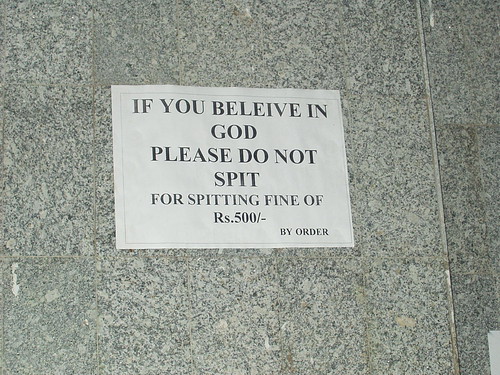
In Mecca, all street signs are in various languages. But there are certain signs you'll only find in Urdu, Bengali and Hindi. These signs simply state: "Spitting here is forbidden!". Or something like that.

Why? Across the Indian sub-Continent, people chew a special blend of nuts and paste wrapped in leaf known as paan which they chew and spit out into gutters or even against walls, leaving a nasty and distinct reddish-brown stain.

Turks travel in large groups and are extremely fussy about cleanliness. In one part of the Hajj, all pilgrims stay in tents on a plain called Mina for the night. The place becomes tent city for the night, with a range of facilities including toilets and kitchens. You know you're in the Turkish section because tents look shiny-new, the sand looks like someone has rubbed Mr Sheen into it, and the toilets are spotless to the extent you could make a sandwich on their floors.

Cronulla rioters will be pleased to learn that according to a reliable source (my mum), Lebanese pilgrims basically spend most of their Hajj sitting around cracking jokes and drinking coffee strong enough to keep you awake until the next Hajj.

Nigerians are tall and heavy-set. A major part of the pilgrimage is to circle the cubic temple seven times in an anti-clockwise direction, all the while shouting "Labayk! Allah humma Labbayk!" (roughly translated as "I'm here, Oh Lord, I'm here" though if you're on the receiving end of the rampage, you should read "My God! Here they come!!"). It's generally not advisable to slip if you find yourself in their path. When you see a group of them with arms clasped rushing toward you screaming the prayer, it's scarier than seeing 500 All-Blacks doing the Haka.

I have no idea what Kiwi pilgrims are like. I doubt they scream the Haka at any stage of the rituals. Plus people at Hajj tend to use sheep for slaughtering purposes.

And what the dinky-di Australian pilgrim do at Hajj? Maybe throw a halal shrimp on the bbq, have a game of sand cricket and sink down a few non-alcoholic VB's.

Hajj dress code

Despite the weird and wonderful characteristics of various cultural groups at Hajj, everyone dresses the same. Blokes wear a white-coloured two-piece towel thing, and ladies wear some additional stuff which is also white coloured. If you landed in Mecca at Hajj time and you didn't know where you were, you'd think it was a huge toga party. Except at this party, everyone is praying and no one gets pissed or stoned.

Despite this, Mecca does have some rather nasty features found in big secular cities. UK stand-up comic and columnist Shazia Mirza often talks about her Hajj during her routine. She was circling the Ka'aba when some dude pinched her behind. She turned around but couldn't recognise the culprit in a sea of sacred togas. She kept going when, within a moment or so, it happened again. She turned around, and again she couldn't locate the deviant.

Later, Shazia caught up with her sister, who also complained of being pinched. Shazia then relates to her audience: "We both concluded it was the Hand of God".

Boom boom!

(Don't panic. I didn't just let off a bomb.)

Meanwhile, back home...

Believe me, the party isn't just happening in Mecca. Across the world, Muslims celebrate their own party. In fact, it's the biggest feast of the year, and is known as Eid al-Adha (or Bayram for Turks, Hari Raya for Indonesians/Malays, Baqrah Eid for South Asians etc).

Thankfully, this year Eid and Christmas (or Hari Natal for all you Indonesians out there) are both happening around the same time. But for Aussie employers with Muslim employees, it's a huge pain in the butt. Here's why.

Aussie Lunar-tics

I'm sure all you (non-Orthodox) Christians find celebrating Christmas fairly straight forward. For a start, you at least know when it is. But spare a thought for us Muslims. The absence of any central priestly or scholarly authority in Aussie Islam means that we simply cannot agree on when the feast is to be celebrated.

Imagine being office manager in a medium-sized law firm in Sydney's CBD. It's Tuesday afternoon. Sekire (pronounced "Shakira"), a law clerk of Turkish ancestry, approaches you to confirm her leave on Wednesday to be at home helping mum with the cooking while her fiancé, brothers and dad go to the mosque for Bayram prayers. Her community's imams have settled religious festival dates until 2,987 A.D.

Then high-powered solicitor Suraina approaches you on Wednesday morning to take Thursday off for Hari Raya Haji. Her family and her metro-sexual husband (apparently the managing director of Petronas) are flying in from KL for the occasion. She only found out last night it was Hari Raya. She assures you a barrister had been briefed and will attend her hearing on Thursday.

Then on Friday morning, you get a call from the barrister's clerk. Thursday's hearing was adjourned to this morning, and the barrister Mr Yusuf can't make it as he heard last night that the Bakra Eid moon has been sighted.

But heck, don't blame us lay Muslims. Blame our lunar-tic mullahs, imams, sheiks, hojjahs, maulanas etc who can't seem to agree on how to calculate the beginning and end of lunar months!

The End

So that's the end of my slightly irreverent look at Hajj. For more information, go to your local mosque and convert. Then get on the first plane you can to Mecca, and you might arrive in time for the last rites.

First published in ABC Unleashed on 19 December 2007.

Words © 2007-8 Irfan Yusuf

Delicious
Bookmark this on Delicious

Digg!

Get Flocked

Stumble Upon Toolbar

Wednesday, December 10, 2008

UPDATE: From "qualified imam" in Sydney to "Islamic scholar" in Christchurch ...

"imam" Afroz Ali has joined the ranks of the big league, sharing a stage with actual former politicians (Bob Carr and Andrew Bartlett) and an actual sitting MP Pru Goward, as well as other actually qualified people. You can read their biographies here. Here is what "imam" sahib says about himself:

IMAM AFROZ ALI

Afroz Ali is the Founder and President of Al-Ghazzali Centre for Islamic Sciences & Human Development, based in Lakemba in south-western Sydney and a founding and executive member of the Australian Religious Response to Climate Change. Afroz is a qualified Imam in the Islamic Tradition. He has studied in Saudi Arabia, Yemen, the United States, Mauritania and Egypt and his worldwide work involves presenting workshops and training programs on Islamic Jurisprudence, Spirituality, Ecological Wellbeing, Ethical Rights and Responsibilities, and Personal and Corporate Citizenship. He mentors and trains community organisations in sustainability and personal development and advocates peace, acceptance, justice and interpersonal rights. Imam Afroz is the recipient of the International Ambassador for Peace award.
So Afroz founded this climate change group. That's a good thing. It's an issue that affects us all. Actual trained and qualified imams seem to be ignoring the issue. At least, we don't see actual imams involved in climate change activism.

But who gave him this Ambassador of Peace award? When did he start training people on "Islamic ... Spirituality" (i.e. irfan or tasawwuf)? Is he part of a tariqa (sufi order) and authorised by a murshid to do so? And what is this clumsy expression "interpersonal rights"? Is it the same as human rights? And who awarded Afroz the "International Ambassador for Peace" award? What is this award?

Afroz is no longer saying he has graduated or received degrees from Saudia, Yemen, the US, Mauritania or Egypt. Instead, he has merely studied in these countries. Afroz has learned to be relatively more honest in Australia, though such honesty doesn't extend to New Zealand.

In an upcoming session in Christchurch, hosted by the Nawawi Centre (and which I found on the University of Canterbury website), Afroz has this said about himself:

Islam and Muslim cultures: A primer for service providers
10am-4pm, 15 and 16 December — Refugee and Migrant Service Centre, 201 Peterborough St

Join Islamic scholar Imam Afroz Ali, from Sydney, for a two-day workshop seminar aimed at those in educational, health and legal sectors, as well as other service provider sectors, who work with Muslim clients. The workshop will provide a detailed workbook, and comprise of strategies, insights and effective tools to work with Muslims in light of their faith, Islam. The programme will highlight Muslim cultural matters that may affect your effectiveness as a service provider and how to develop a successful working relationship through sound knowledge of the practices.

Imam Afroz Ali provides such training to service and corporate sectors in Australia, and his insights and expertise will be highly valuable for your organization ...

Cost is $90 per person.
Islamic scholar? When did that happen? Is Afroz qualified as an Islamic acholar in the same manner as I am a qualified lawyer? Or as scholars like Bill Shepard or Anthony Johns are scholars of Arabic and Islamic studies?

So in Australia, Afroz is a mere "qualified imam", while in New Zealand (and at a cost of $90 a pop) he becomes an "Islamic scholar". Go figure.

Delicious
Bookmark this on Delicious

Digg!

Get Flocked

Stumble Upon Toolbar

Friday, August 08, 2008

EVENT: Islamic Awareness Week across the Tasman ...


While the Australian Federation of Islamic Councils has just about completed yet another round of expensive litigation, across the Tasman New Zealand's peak Muslim body is spending its money on organising a nationwide Islamic Awareness Week. The theme of the IAW 2008 is "Strong Families - Better Society", hardly the sort of theme which far-Right allegedly conservative fruitloops (such as the nutters that produce Investigate (or should that be Investi-hate?) magazine) could complain about.

Among the events being held are a women's fashion parade and a number of dinners for students and staff hosted by various Muslim Students Associations (MSA's). A number of prominent New Zealanders will also be awarded for their contributions to relations between Muslims and the broader community. For some reason, nobody thought of providing an award to someone in the NZ media.

And in case you wondered who were the first recorded Muslims in New Zealand, read this ...

The first identifiable Muslims resident in New Zealand are 15 Chinese gold diggers working in the South Island, recorded in the government census of April 1874. Little is known of them and it is assumed they either moved on to Australia or returned to China.

The Muslim Heritage part of the website includes biographies of prominent Muslims, among them Mazhar Krasniqi, a Kiwi of Albanian origin who (if I am not mistaken) has a very prominent son-in-law.

Well done, dear Kiwistanis!

Words © 2008 Irfan Yusuf


Join my Flock

Stumble Upon Toolbar

Sunday, May 04, 2008

COMMENT: New Zealand's Muslim heritage ...


Click here to discover New Zealand's Muslim heritage. You will find an article published in the NZ Listener on 21 April 1979 which discusses a mosque being established in Ponsonby, as well as some of the pioneers of Islam in New Zealand.

There's plenty of stuff here for Sheik Dicky Kerbaj to make an issue of. Even here, in New Zealand, the nasty Saudis had their tentacles. Too bad they invested more in Kerbaj's employers!

Words © 2008 Irfan Yusuf

Delicious
Bookmark this on Delicious

Digg!

Get Flocked

Stumble Upon Toolbar

Saturday, November 03, 2007

COMMENT: PM opens conference of Islamic scholars ...

Imagine if John Howard took time out from sucking upto Catch The Fire Ministries, the Exclusive Brethren and other fringe extremist groups. Imagine if he made time to open a national conference of Islamic scholars and theologians.

Then again, imagine if Australia has a properly functioning national conference or board of Islamic scholars. The so-called Australian National Imams' Council is in a mess, with mass-defections and resignations.

We in Australia don't have the luck of the Kiwis. Across the ditch, PM Helen Clark opened the New zealand Imams. Conference in Auckland on 27 October 2007. There was no media rucus. No shock jocks or tabloid columnists made an issue of her presence. In fact, the event received hardly any media attention at all (at least none that I could find on Google news).

Ms Clark no doubt is aware that imams are hardly in a position to deliver any votes. I'm not aware of a single imam on either side of the Tasman who has openly endorsed a political candidate. Well, apart from Sheik Hilaly endorsing Kerry Chikarovski's candidate in the 2001 Auburn by-election. And that didn't prove overly helpful to anyone (except perhaps ALP candidate Barbara Perry).

And the last time we heard about imams and politics was when The Australian allowed one of its cadet journalists to report on him attacking one of his internal community opponents over the issue of voting. I must say that I agree with Sheik Hilaly on this issue, but it was a bit silly for the newspaper to allow itself to be used as an instrument for intra-Muslim community politics.

(Sheik Hilaly's opponent, Dr Paul (Ali) White, was referred to in the article as "Mr White", despite it being well-known that he holds a PhD.)

In any event, it's great to see the Kiwis getting their political act together.

Words © 2007 Irfan Yusuf

Delicious
Bookmark this on Delicious

Digg!

Get Flocked

Stumble Upon Toolbar

Wednesday, August 17, 2005

OPINION: Protocols of the Learned Mullahs of Wellington

Winston Peters believes that there is a militant underbelly in all countries where large Muslim migrant communities exist. He made these comments in a speech on 10 August 2005.

His comments were almost immediately being discussed on the discussion forums of popular website islamicsydney-dot-com. They have been repeated by former Australian National Party Senator John Stone in a series of articles published in The Australian newspaper.

And what evidence does Peters produce? Peters claims to have sources amongst “moderate Muslims concerned about the impact of fundamentalism in their ranks”.

So? Many Maori friends of mine tell me of a militant underbelly in the Maori community. And who do they point to as a prime example?

Yep, you guessed it. Mr Peters.

Mr Peters’ claims are heavy on innuendo and anecdotes and light on facts. He has clearly not done his homework on what kind of speakers and media and magazines and sermons New Zealand Muslims are reading and watching and listening to.

Recently, the Federation of Islamic Associations of New Zealand (FIANZ) hosted Abdur Raheem Green to conduct a series of lectures as part of their Islamic Awareness Week. Mr Green does hold some extreme views on certain issues. I criticised some of these views in an opinion piece in the New Zealand Herald on 15 August 2005.

Despite the enormous controversy surrounding the proposed Green tour to Australia (which was organised by a fringe Salafi youth group in Sydney), the FIANZ tour went without incident. It appears Green has changed his views or at least toned them down.

But Peters’ claims that FIANZ are funding a Maori Muslim to spread radical Islamic views in NZ prisons is the stuff all good conspiracy theories are made of. It seems Peters is not satisfied with four mosques being vandalised following the London bombings.

In Australia, views such as those expressed by Peters were once fashionable. They were personified in one Pauline Hanson, founder of the virtually-defunct One Nation Party. Ms Hanson has moved on from her earlier xenophobic days to the real stage where she dances and sings quite well.

Hanson’s colleagues in New South Wales have been busy spreading all kinds of conspiracy theories about alleged radical Muslims trying to spread venom and hatred amongst Muslim youths.

Are there radicals amongst Muslims? Of course there are. Just as there are radical Jews opposed to the Israeli dismantling of settlements in the Gaza Strip. Just as there are radical Hindus who believe Muslims and Christians should be slaughtered in India. Just as there are radical Protestants and Orthodox Christians who believe in reviving the crusades and massacring Muslims and Catholics in the same manner as Bosnian Serbs did in Bosnia during the mid 1990’s.

And just as there is at least one radical Maori who believes Muslims are funding extremism.

But what really annoys me about Mr Peters’ comments is that he uses the alleged extremism as a means to claim that Muslim migration should be curtailed. He suggests that Muslim migrants hate New Zealand culture and values. Try telling that to Hazara Afghan refugees who risked life and limb to reach Australia and New Zealand, many (to use Neil Finn’s phrase) spending six months in a leaking boat.

And even worse is the fact that not only are Muslims demonised but even many people with some distant link to Islam. Muslims have been marrying non-Muslims for centuries. The children of these unions are being demonised. Persons with Arabic-sounding names are being castigated.

And all in the name of national security and social cohesion.

My law clerk was born in Canberra. She studies Nursing at a Catholic university. Her father is Anglo-Australian Catholic, her mother Indian Hindu. My clerk was born in Canberra. She speaks English with a posh private-school accent. Yet she keeps getting told that she should go back to where she came from. And she is now too scared to catch the train to my office in case someone thinks she is an Islamist terrorist.

One of our shared friends was born in Christchurch and never met her Muslim father. Her mum is a prominent lawyer and activist who agitates on behalf of Maori causes. Our friend has an abbreviated surname which, in Arabic, suggests her father was a descendant of the Prophet’s great-grandson. Yet she mixes champagne with orange juice and loves watching live bands at the local pub. She is the sort of girl Peters wants to see removed from New Zealand.

Both of these friends feel more demonised and fearful of anti-Muslim backlash than their activist Muslim lawyer-friend who sticks his neck out almost weekly publishing columns in newspapers in Australia and New Zealand.

When prominent political leaders attempt to marginalise an entire ethnic or ethno-religious group, it usually involves the making of gross generalisations and conspiracy theories. In times past, Jews were demonised in a forgery known as “The Protocols of the Learned Elders of Zion”.
Today, certain political leaders are re-writing that document. In the case of Mr Peters, the document should perhaps be entitled “Protocols of the Learned Mullahs of Wellington”. Yet it isn’t the learned mullahs who are being affected as much as ordinary Aussies and Kiwis deemed to be Muslim even if they have little if any link to Islam. Indeed, hatred thrives on ignorance and stereotypes.

Words © 2005 Irfan Yusuf

Delicious
Bookmark this on Delicious

Digg!

Get Flocked

Stumble Upon Toolbar

Tuesday, June 28, 2005

REFLECTION: From The Fringes of Ramadhan

(I wrote this piece in November 2004 (at least I think that's when it was) after visiting a friend who works behind a bar. I often used to visit her a work. When she is not serving beer and spirits to my mates and other customers, we would chat and listen and crack jokes and gas-bag like the 2 old men in the Muppet Show. Sometimes we would lose track of time, engrossed in conversation as we'd chat face-to-face with our chins resting on our hands and our elbows resting on some coasters, a bit like a scene from the British comedy duo Smith & Jones.

In those days, I felt so awful about not being able to fast. I told her as much, and she told me of her own frustration with knowing so little about her late father's heritage. It was then that I told her a few things about Ramadhan, about the Night of Power, about the significance of fasting and its spiritual aspect.

I had the feeling my words were getting through to her, but I had no idea to what extent. After that visit, I went home and penned this article for the MuslimWakeUp.com Ramadhan Diary section. It got published. I showed it to Jane a few days later but asked her not to read it until she finished work.

At 2am the next morning, I received the following text message on my mobile phone:

"Your story made of [me - she was using autotext] feel closer and included in a place I thought had died with my father Yet again you’ve made my reality a better one to exist in **Jane"

After receiving that text message, I could really feel the spirit of Ramadan. It was as if I could see the devils being chained before my very eyes.

Sometimes one can only appreciate spiritual life whilst standing on its fringe. Imam Hamza Yusuf Hansonn once quoted of friend of his as saying: "A religious person is someone who does not want to go to hell. A spiritual person is someone who has already been to hell and doesn't want to go back!")

______________________

This Ramadhan, I am happy and sad to announce that I will not be fasting. Yes, I know it is bad manners to make this public. After all, we are meant to be hiding our sins.

My failure to fast, however, is not a sin. In fact, for me to fast would be a virtual act of suicide. Now that’s what I call a sin!

Like many millions of Muslims out there, I have to take medication. So my announcement that I will not be fasting brings me mixed feelings.

I am happy because I will continue my successful management of a health condition that has plagued me big-time since February 2002. It was during one day of that month and year that I virtually collapsed. After numerous tests, it was discovered that my thyroid was not the best. The result was my having to take some 14 months off work.

I am sad because my health conditions and my need for medication at strictly appointed times result in my having to miss out on fasting. I feel like I am on the fringe of Ramadan.

Tonight I met up with a friend from New Zealand. Jane’s father was a Malay Muslim, though she never met him. When Jane’s mother was pregnant, the parents split up. Dad stayed in Malaysia and mum went to New Zealand. Jane knew about her father but never actually met him. Some 12 months after he passed away, Jane got a chance to visit Malaysia and meet her half-brothers and step mother who showed her the grave of her father.

For Jane, Ramadan is a distant yet important part of her life that always seemed to be missing and absent like her father. So when she asked me about Ramadan tonight, I felt embarrassed to tell her that I was not fasting. She found it hard to relate to my embarrassment.

I then explained to her that fasting is to Ramadan what Bethlehem and Jesus are to Christmas. I grew up with fasting during Ramadan. I can still remember the first time I fasted. I was some 6 years old, a rather chubby lad with long hair and big ears. And an even bigger stomach. I don’t think I had ever eaten so many ‘pakoras’ (deep-fried Indian potato cakes) as I did when breaking my fast on that day.

Jane could not help but compare Ramadan to the Christmas and Easter of her mild-Hispanic Catholic upbringing. She knew it was somehow related to visiting friends and family. She knew it lasted one month. She knew there were times when extra blessings were in store. She even had heard that people who died during this month were able to avoid hell (perhaps she confused this with typical hajj stories).

So here I was, trying to make Ramadan real for someone who loved it but had never seen it (much the same way as she had loved her father but never seen him). Even my half-hearted attempts at explaining the timings of fasting, the tarawih prayers and the significance of the Laylat al-Qadr and the last ten nights during which the search is on for this powerful night, seemed to captivate Jane’s attention.

Perhaps someone could convince Michael Wolfe to write a book on Ramadan in Morocco (or at least cut out the first half of his book on the Hadj and publish it separately) so I could give a copy to the Jane’s of this world. That way we could both feel a little less like Ramadan fringe-dwellers.
And so that the Irfan’s of this world could speak to them with greater conviction. Because moving onto my third Ramadan without fasting has made me feel a little bit rusty. I know I do not have to fast. But you don’t know what you’ve got until medication takes it away. I guess I will have to make-do with the spiritual burst of the super-fast turbo-charged tarawih at the local Turkish mosque. Speaking of which …

Words © 2005 Irfan Yusuf

Delicious
Bookmark this on Delicious

Digg!

Get Flocked

Stumble Upon Toolbar