Sunday, July 12, 2009

COMMENT: The honour killing they seem to have forgotten about ...

We've all heard of Amina Lawal, of Mukhtar Mai and of the various victims of honour killings over the years. But one woman's honour doesn't seem to figure very highly in European and Western media outlets. Indeed, in Australia, not a single News Limited newspaper has reported the murder of Marwa al-Sherbini. Not a single News Limited blogger has commented on the incident, including xenophobic bloggers like Andrew Bolt who frequently pluck poorly-reported stories of violence against women of nominally Muslim heritage.

Funny, that.

Marwa al-Sherbini is in her early thirties, smart and attractive. She comes from an educated middle class family, both her parents working as pharmacists. She grew up in the cosmopolitan Egyptian city of Alexandria. She now lives in Dresden, a city once famous for a severe allied bombardment at the end of the Second World War.

Every morning, Marwa readies herself for work. She puts on her pharmacy uniform and her headscarf. She stands in front of the mirror, check her makeup and smiles. But Marwa’s smile hides her secret dread. Each morning, Marwa’s honour is sullied and her security threatened by the violent and vicious taunts of a man.

“You slut!” he screams at her, “You whore!” The man doesn’t stop at mere words. He threatens her with violence. He even follows her to work, shouting taunts at her in the presence of horrified onlookers.

Marwa has had enough. She talks to her employers who put her onto local police. She brings an application to court. The man appears and is fined. She appeals. She knows the fine will not stop him. If anything, it will make him angrier and give him more reason to carry out his threats.

The date for appeal arrives, and Marwa attends accompanied by male relatives. The accused also attends. In the presence of the judge, the prosecutors and other persons present in court, the man screams out the same violent abuse. “You slut! You whore!” But this time he goes even further. He produces a knife and stabs her. Not once. Not twice. Marwa is stabbed at least 18 times.

It must have been a Herculean effort for the man to find the time and strength to stab Marwa 18 times. Readers might consider the effort involved by merely stabbing the air that many times.

Marwa is three months pregnant at the time. Her three year old son witnessed the whole incident.

Now let’s imagine for a moment that the man involved in the taunts and the stabbing was Marwa’s husband. Imagine if Marwa had applied to the court for an order restraining her husband from making violent threats toward her, stalking her and harassing her. Imagine if he had then stabbed her in court. No doubt this honour killing would have made a prominent story in your metropolitan daily newspaper. No doubt it would have been treated as yet another story of an honour killing. No doubt some columnists would have frothed at the pen about how Muslim migrants don’t integrate and are typically violent to women while good white-skinned European men (as if Muslims cannot be white or European!) never engage in domestic violence, let alone the kind of violence that led to the murder of Theo Van Gogh in the Netherlands.

But Marwa’s attacker was not her husband. Marwa’s husband, an academic working at the prestigious Max-Planck-Institut for pharmacology, was present in court. He tried to save his wife and was somehow confused by court security as the attacker. Perhaps they assumed that a Middle Eastern looking man was more likely to attack a woman than a German of Russian descent. Marwa’s husband was shot and at the time of writing was in a coma in hospital.

But then he also wasn’t a complete stranger but rather her neighbour. The stranger would taunt and threaten Marwa because she wore some cloth on her head and because she didn’t quite look like everyone else in Dresden.

It all started one day when she took her son to the local park. The man was seated on the swings, and Marwa politely asked if her son could use the swing for a short while. He responded with a continuous array of taunts and threats. He labelled her “terrorist”, “Muslim bitch”, “whore” and numerous other names. In court, he questioned what right she had to be in Germany. Before stabbing her, he declared:

Do you have a right to be in Germany at all? When the NPD comes to power, there'll be an end to that. I voted NPD.

Perhaps this is what’s worth contemplating. More and more European voters are turning to far-Right parties. Many of these parties have replaced virulent anti-Semitism with virulent anti-Muslim (and general anti-immigrant) sentiment. And mainstream European parties are meeting the far-Right challenge by co-opting far-Right rhetoric and attitudes, encouraging ugly sentiment.

What isn’t quite realised is that it isn’t just immigrants that suffer. Their children, their relatives, the descendants also suffer. When they marry Europeans and have children who don’t quite look European (whatever that means), the European spouses and their part-European children also suffer.

And inevitably it is women who suffer more than men. Women are easy targets for hate-filled men. When a man feels a woman has sullied his honour or the honour, he lashes out against her. She is the easy target. A harder target is the man’s own anger, his deeper issues.

Violence against women is violence against women. It is just as evil whether it is perpetrated by a particular kind of religious fanatic or by someone inspired by fanatical hatred of a particular religion. The result is the same. A woman is harmed. Her family mourns. Her community falls into a deep communal depression.

I could write more, but it's hard to keep up with the rage and anger I feel at those who only seem to care about a Muslim woman being killed when they can use it as an excuse to malign her culture and to make life difficult for her children and others she left behind.

Words © 2009 Irfan Yusuf

Delicious
Bookmark this on Delicious

Digg!

Get Flocked

Stumble Upon Toolbar

Thursday, June 18, 2009

COMMENT: Degrees of disappearance ...

It's amazing what can happen to one's education in a matter of years. My mother always warned me when I was young that I should never forget how to recite portions of the Qur'an previously memorised. "Forgetting Qur'an - it verry bad gunna," she would tell me.

["gunna" is an Urdu and Turkish word that means "sin]

But some people manage to lose entire university degrees. For instance, back in June 2005, the following appeared on the New Zealand Scoop news website:


Two eminent scholars on religion will be hosted in Auckland tomorrow (Friday) evening for public discussion on the topic of friendship between adherents of different faiths, specifically Islam and Christianity ...

... Mr. Afroz Ali of Sydney, also well versed in inter-religious matters, holding degrees in Islamic Studies and Shari'ah from Islamic University, Madina, Saudi Arabia, thereafter continuing through traditional Islamic learning styles under scholars such as Shaykh Hamza Yusuf of the United States, Shaykh Salik bin Siddina and Shaykh Murabtal Hajj of Mauritania.

And so this eminent scholar has not one but two degrees from the Islamic University in Madina.

But alas, after a mere 4 years, this eminent scholar seems to have lost his two university degrees. Hence the following profile appears on the website of an upcoming interfaith conference to be held in Perth ...


He is a qualified Imam in the Islamic Tradition, having studied under Traditional Islam and received licence to teach in various Islamic Sciences. His studies have taken him from university-based Islamic University- Madina, Saudi Arabia then moving towards Traditional Scholarship in Yemen, United States and Mauritania, where he has spent considerable time to learn from the most esteemed Rightly Guided Islamic Scholars of our time.

Er ... what happened to those university degrees? I thought he had degrees in both Islamic Studies and Shariah. Did these degrees go missing?

Anwar Ibrahim will also be speaking at this interfaith gathering in Perth. I wonder if any of his degrees have also mysteriously disappeared. Somehow I doubt it.

Words © 2009 Irfan Yusuf

Delicious
Bookmark this on Delicious

Digg!

Get Flocked

Stumble Upon Toolbar

Friday, June 12, 2009

VIDEO: BBC report on the Allah Made Me Funny tour ...

Here's a report from BBC about the UK tour of that awesome threesome known as Allah Made Me Funny from 17 April 2009.


Delicious
Bookmark this on Delicious

Digg!

Get Flocked

Stumble Upon Toolbar

Thursday, June 11, 2009

POLITICS: A liberal view of the Pan-Islamic Party of Malaysia ...

Keith Leong, an Associate at the Malaysia Think Tank, provides some interesting perspectives on PAS, a religious party that forms part of Malaysia's opposition.

As a young non-Muslim Malaysian with generally liberal leanings, I have always had mixed feelings about PAS. The party has been painted as the ultimate bogeyman by the establishment media and pundits to my demographic group, often with general success. Incidents like their periodic campaigns against alcohol consumption and teenybopper music only served to heighten my discontent towards the brand of politics that they practiced.

On the other hand, one cannot help but admire the dedication and perseverance that the PAS ranks have shown in their long, twilight struggle in Opposition. The high regard, even affection by which their leaders like Nik Abdul Aziz Nik Mat are accorded to, not only by Malaysian Muslims but their compatriots of other faiths as well suggest that there is more to PAS than what the powers-that-be would have us believe.

More importantly, however, is the small but growing number amongst them who realise, like their colleagues both in Pakatan Rakyat and Barisan Nasional that Malaysia can only be led effectively in a broad-based, inclusive manner. The politicians who realised this before and since the 8th of March 2008 have grown in stature, while those who have not or will not have only exacerbated the sectarian tensions that threaten to rend this country apart.

Malaysia may be a Muslim-majority country, but PAS cannot rely on Islam to gain anything even resembling an electoral majority. Religion and ethnicity are intertwined in Malaysian law and politics. If Malay nationalists worry non-Muslim minorities, imagine how they must feel about PAS.

... it seems many young leaders, regardless of their party, who want public life in Malaysia to be more than a zero-sum game dictated by archaic sectarian rivalries are being hounded into obscurity while the demagogues triumph.

The possibility of this happening in PAS is all the more sad because Malaysians have had, for the last couple of months the chance to see what the party could be like if it was led by moderates. The picture that that possibility presented was inspiring and promising.

MP for Shah Alam Khalid Samad visiting a Catholic Church (the construction of which had faced numerous bureaucratic obstacles) in his constituency and receiving rave reviews from the parishioners. Nik Abdul Aziz standing up for his fellow PKR and DAP leaders smeared by the reactionary press.

PAS has the ability to embrace a more pluralist approach that goes beyond pan-Islam and Malay chauvinism.

Words © 2009 Irfan Yusuf


Stumble Upon Toolbar

Wednesday, May 27, 2009

INDONESIA: Reflections from a recent dinner ...

Well, not that recent. The Australia Indonesia Institute held its 20th anniversary dinner in Sydney on Thursday 19 February 2009. I was there armed with a notepad and a cheap ball-point pen. I typed out some of the points made in a number of speeches which I thought were of interest (at least to me).

Geraldine Doogue, a prominent ABC personality, was MC at the event. Among the speeches was that of AII Chairman Professor Tim Lindsay. Professor Lindsay spoke in fluent Bahasa Indonesia, albeit with a slight Aussie accent. Lindsay said that without the foundation of people to people links, little chance of proper diplomatic relations. He noted there is a declining Indonesian language capacity in Australia.

Katika Kari, an Indonesian journalist, then spoke. She described relations between Canberra and Jakarta as being similar to those between Tom and Jerry. They fight sometimes, criticise each other sometimes but remain good friends. Kevin Rudd has already visited Indonesia 3 times. She made special mention made of the victims of the Victorian bushfire and their families, and remined us that Indonesia sent a forensic team to assist with the bushfire investigation.

Sarah Malik, an alumnus of the 2007 Muslim Leaders Exchange Program, spoke as a first time traveller. She said our views of Indonesia were mediated by the media. Yet this was a country of 17,000 islands and dozens of ethnic groups which recognised the need to balance everyone’s sentiments. Multiculturalism here is not just a luxury but a necessity.

In the tropics of Indonesia, in its sights and sounds, a piece of me still wonders.
Prime Minister Kevin Rudd gave an off-the-cuff speech with no speech notes whatsoever! Here is a summary of his speech in numbered paragraphs:

[01] In 2008, Rudd and SBY met 7 times. This in itself shows just how vital the relationship is to Australia. Indonesian government and people showed enormous generosity to Australia during the recent bushfires. Indonesians proved they wanted to be not just good neighbours but also good friends. The brutal power of nature affects both nations, and both came to each other’s help.

[02] In 1947, Australia declared that it would stand with Indonesia in seeking independence from the Dutch. This was very unusual for a Western country.

[03] Indonesia is a country of 230 million people spread across 17,000 islands. It’s an extraordinary nation building achievement. One can see the extreme diversity in Indonesia just after spending a few weeks or months. To build a nation out of such diversity is an extraordinary achievement.

[04] Indonesians have had to work and struggle hard to build and maintain their democracy.

[05] For the past 60 years, a major foreign policy preoccupation of leaders of both Indonesia and Australia has been how to manage relations with each other.

[06] Australia, a nation with a Christian heritage, works closely with the largest Muslim country on earth in a seamless fashion. Surely this must send a strong message to the world.

[07] We have embarked on the century of the Asia-Pacific.

[08] Australians need to do more to understand the complexities of Indonesian Islam. Australia needs to be the most Asia-literate country in the West. We need to regard the languages, cultures and religions of our region as familiar and not foreign.

[09] Australia and Indonesia will host a large conference on interfaith dialogue. Rudd and SBY have agreed that Australia and Indonesia must play a key role in the dialogue between Christianity and Islam.

[10] The prepared speech is on the internet in case anyone is interested!

More to follow.

Words © 2009 Irfan Yusuf

Delicious
Bookmark this on Delicious

Digg!

Get Flocked

Stumble Upon Toolbar

Friday, May 22, 2009

ADDRESS: A Common Word ...


Before I start, I’d like to pay my respects to the indigenous owners, the Gadigal people of the Eora nation, of this land.

Thank you for inviting me to join with you to celebrate the document entitled “A Common Word” (ACW). The document was prepared by some 138 Muslim scholars and intellectuals across the world and from every denomination, and was addressed to Christians of every denomination. The document sought a basis for discussion and cooperation between Christians and Muslims, whose combined population made up well over half the world’s population.

“Without peace and justice between these two religious communities,” reads the Summary and Abridgement, “there can be no meaningful peace in the world”. The document further stated that the “basis for this peace and understanding already exists ... [in] … the very foundational principles of both faiths: love of the One God, and love of the neighbour”.

The document then provides in detail the textual evidence for both these foundational principles in the Old and New Testaments as well as in the Qur’an and Ahadith literature.


Educating Theology

It’s all wonderfully esoteric and theological, but as many of you know, I am no theologian. Religious texts matter to me to the extent that I see them acted out by those around me.

We are very close to the grounds of a school managed by the Melkite Catholic Church. Each of the children attending that school will learn about their Christian faith and heritage from their teachers and school elders. They will learn this from studying the Bible and other religious works. But more importantly, they will learn this from their exposure to their Christian teachers and elders and community leaders and (hopefully) from their own families acting out the teachings of the Bible. They will learn how to be what Jesus Christ (p.b.u.h.) described as “the salt of the earth”. They will not only learn the words of the Ten Commandments, the Lords Prayer, the Sermon of the Mount and of Paul’s wonderful description of love and charity in I Corinthians 13.

Up the road from here is a Muslim independent school. Each child attending that school will learn about their Islamic faith and heritage from their teachers and elders. They will study the Qur’an, the Ahadith and other religious works. But more importantly, they will learn from their exposure to their Muslim teachers and elders and community leaders and (hopefully) from their own families acting out the teachings of the Qur’an and the Sunna. They will learn how to be what Muhammad (p.b.u.h.) described as people of “ihsan” who “worship God as if they see Him, and if not then they are at least conscious that He is seeing them”. They will learn the words of the Ayat al-Kursi, Surat al-Fatiha and the Prophet’s extraordinary communion with God after being pushed out of the city of Taif.

But like most Muslim kids brought up in Australia, I never attended a Muslim independent school. Instead, mine was a rather confusing and confused upbringing, a mish-mash of Urdu linguistic fascism, ecumenical north Indian Bollywood culture and very spicy food. So what I wanted to share with you today is how I learned my lessons in loving God and loving my neighbour. I learned these lessons from my parents, my (largely Christian) teachers at my Christian school and the few decent imams I was exposed to during my youth.


Common Values

For my middle class North Indian parents, the idea of a “Common Word” seemed almost superfluous. They took it for granted that Christianity and Islam taught the same values. But then, so did Hinduism, Sikhism, Judaism, Buddhism and other major religions. Mum taught me that the best people were generally the most religious, and that all religions taught you to be good to people.

At primary school, Thursday afternoon was devoted to what was called “scripture”. Volunteers were sent by various churches to take children whose families belonged to their denominations. Mum left it to me to attend whichever denomination I wished, and I’d flirt between Catholic and Anglican. Much of our time was spent studying Bible stories, and my favourite was the dramatic story of Joseph. It was a full-scale Biblical blockbuster in which the good guy came out on top in the end and showed extraordinary magnanimity to his foes who ironically were his own brothers.

I also enjoyed the nativity plays we’d perform during Christmas time. For some reason, I was always assigned the role of one of the three wise men from a strange country called “The East”. The other two wise men were a boy from New Guinea and Chinese girl dressed up as a boy. The baby Jesus was played by a white skinned doll, while our teacher insisted that Mary and Joseph be played by blond-headed children. Perhaps she thought Bethlehem was somewhere north of Scandinavia and that Mary and Joseph lived next door to Santa.

Later my parents wanted to extend my religious and secular education. Like many migrant parents, they wanted their children to have the best education money could buy, even if they could barely afford this amount of money. They ended up sending me to St Andrews Cathedral School, a very Protestant low church Anglican.School located in Sydney’s CBD. It was here that Christianity was less about culture and skin colour and more about values. My first school captain was the son of a Pakistani Anglican priest. I repeatedly learned, almost memorised, the beautiful words of Paul in 1 Corinthians 13 about the primacy of love.

Christianity was less about culture and more about values. It was about God loving us so much that he was even prepared to sacrifice a part of Himself, and about how we must show love to those around us. But the Islam I learned was in a strictly Indo-Pakistani cultural zone which I never quite understood. We didn’t have many Islamic books in English, and mum would read to me from books in Urdu.


Culture and Tribalism

When we associate religion and religiosity with culture, we turn it into a closed chop, into a club. We tribalise religion. The kids at my primary school could perhaps never imagine the existence of a Pakistani Anglican priest, let alone elect his son as school captain. But then, many Pakistani Muslims I grew up with also probably couldn’t imagine a Pakistani Anglican priest.

When people use religion and religious identity to serve tribal causes, the results are not only deadly but also highly irrational and involve a complete misreading of theology, history and reality – not just that of the “other” but also of our own. For instance, Christianity (or the so-called “Judeo-Christian” tradition) is often cited in support of prejudice against persons from the Middle East, forgetting that Christ himself wasn’t exactly Caucasian.

Conclusion

ACW reminds both Christians and Muslims that they can only find commonality by becoming (in a sense) fundamentalists, by returning to the fundamental themes of their faith. Tribalised religion is about turning people away, while Islam and Christianity are missionary faiths that seek to attract people.

The basic principles of loving God and loving one’s neighbour negate religious tribalism. Or as my mother taught me as a child, the best people are those most true to their religion.

(Irfan Yusuf is a Sydney-based lawyer, author and columnist. His first book Once Were Radicals: My years as a teenage Islamo-fascist has just been published by Allen & Unwin. The above address was delivered to a conference on the Common Word document organised by the Australian Muslim-Christin Friendship Society and the Melkite Welfare Association on Friday 15 May 2009.)

Words © 2009 Irfan Yusuf

Delicious
Bookmark this on Delicious
Digg!

Get Flocked

Stumble Upon Toolbar

Thursday, May 07, 2009

VIDEO: The brutal practice of daughter exchange ...

Normally we should take for granted that people will mix religion and culture. The idea that religious practice can only exist in a cultural vacuum is absurd. But what happens when those cultural influence leads to the exploitation of women?

The following video from Al-Jazeera English shows the tragic results of certain cultural practices being enforced by religious leaders among Kurdish Muslims in Iraq. The text accompanying the video is as follows:

In the tribal areas of Kurdistan in northern Iraq, arranged marriages have been a way of life for centuries.

But society is changing. Families who engaged their daughters when they were still children are now renegotiating old contracts.

Nicole Johnston reports from Rania district, where some girls are choosing death over an arranged marriage.


Words © 2009 Irfan Yusuf


Delicious
Bookmark this on Delicious

Digg!

Get Flocked

Stumble Upon Toolbar

Sunday, May 03, 2009

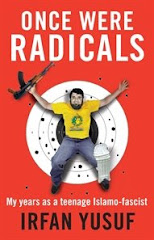
BOOK: Bollywood exegesis of Once Were Radicals - Part I

Well my book Once Were Radicals: My years as a teenage Islamo-fascist has finally been released. You can buy it at most shops for $27, or you can save $2 and buy it from me direct. However, if you do that, then chances are that I will have to charge you at least $2 just to post it to you! Unless of course if you are prepared to meet me in an agreed-upon location. Preferably something very tasteful such as ElSweetie Cafe in Granville, though I'll happily settle for places like the Auburn Soccer Club, Ryde/Eastwood Leagues Club or the Pymble Hotel.

Anyway, from time to time, I will share with you some tafsir (a technical term in Islamic sciences meaning exegesis) of the text with reference to a cultural institution I spent much of my growing years being tortured by - Bollywood. So here goes ...

My parents resumed their fascistic language regime which involved us not being allowed to speak English at home ... My linguistic education included a regular regime of Bollywood movies.
(from Once Were Radicals: My years as a teenage Islamo-fascist)

Bollywood movies like Namak Halal, starring Amitabh Bachchan. Here is the big man playing the character of Arjun Singh, a villager who has just arrived in the city for a job interview.

Words © 2009 Irfan Yusuf


Stumble Upon Toolbar