Before I start, I’d like to pay my respects to the indigenous owners, the Gadigal people of the Eora nation, of this land.
Thank you for inviting me to join with you to celebrate the document entitled “A Common Word” (ACW). The document was prepared by some 138 Muslim scholars and intellectuals across the world and from every denomination, and was addressed to Christians of every denomination. The document sought a basis for discussion and cooperation between Christians and Muslims, whose combined population made up well over half the world’s population.
“Without peace and justice between these two religious communities,” reads the Summary and Abridgement, “there can be no meaningful peace in the world”. The document further stated that the “basis for this peace and understanding already exists ... [in] … the very foundational principles of both faiths: love of the One God, and love of the neighbour”.
The document then provides in detail the textual evidence for both these foundational principles in the Old and New Testaments as well as in the Qur’an and Ahadith literature.
Educating Theology
It’s all wonderfully esoteric and theological, but as many of you know, I am no theologian. Religious texts matter to me to the extent that I see them acted out by those around me.
We are very close to the grounds of a school managed by the Melkite Catholic Church. Each of the children attending that school will learn about their Christian faith and heritage from their teachers and school elders. They will learn this from studying the Bible and other religious works. But more importantly, they will learn this from their exposure to their Christian teachers and elders and community leaders and (hopefully) from their own families acting out the teachings of the Bible. They will learn how to be what Jesus Christ (p.b.u.h.) described as “the salt of the earth”. They will not only learn the words of the Ten Commandments, the Lords Prayer, the Sermon of the Mount and of Paul’s wonderful description of love and charity in I Corinthians 13.
Up the road from here is a Muslim independent school. Each child attending that school will learn about their Islamic faith and heritage from their teachers and elders. They will study the Qur’an, the Ahadith and other religious works. But more importantly, they will learn from their exposure to their Muslim teachers and elders and community leaders and (hopefully) from their own families acting out the teachings of the Qur’an and the Sunna. They will learn how to be what Muhammad (p.b.u.h.) described as people of “ihsan” who “worship God as if they see Him, and if not then they are at least conscious that He is seeing them”. They will learn the words of the Ayat al-Kursi, Surat al-Fatiha and the Prophet’s extraordinary communion with God after being pushed out of the city of Taif.
But like most Muslim kids brought up in Australia, I never attended a Muslim independent school. Instead, mine was a rather confusing and confused upbringing, a mish-mash of Urdu linguistic fascism, ecumenical north Indian Bollywood culture and very spicy food. So what I wanted to share with you today is how I learned my lessons in loving God and loving my neighbour. I learned these lessons from my parents, my (largely Christian) teachers at my Christian school and the few decent imams I was exposed to during my youth.
Common Values
For my middle class North Indian parents, the idea of a “Common Word” seemed almost superfluous. They took it for granted that Christianity and Islam taught the same values. But then, so did Hinduism, Sikhism, Judaism, Buddhism and other major religions. Mum taught me that the best people were generally the most religious, and that all religions taught you to be good to people.
At primary school, Thursday afternoon was devoted to what was called “scripture”. Volunteers were sent by various churches to take children whose families belonged to their denominations. Mum left it to me to attend whichever denomination I wished, and I’d flirt between Catholic and Anglican. Much of our time was spent studying Bible stories, and my favourite was the dramatic story of Joseph. It was a full-scale Biblical blockbuster in which the good guy came out on top in the end and showed extraordinary magnanimity to his foes who ironically were his own brothers.
I also enjoyed the nativity plays we’d perform during Christmas time. For some reason, I was always assigned the role of one of the three wise men from a strange country called “The East”. The other two wise men were a boy from New Guinea and Chinese girl dressed up as a boy. The baby Jesus was played by a white skinned doll, while our teacher insisted that Mary and Joseph be played by blond-headed children. Perhaps she thought Bethlehem was somewhere north of Scandinavia and that Mary and Joseph lived next door to Santa.
Later my parents wanted to extend my religious and secular education. Like many migrant parents, they wanted their children to have the best education money could buy, even if they could barely afford this amount of money. They ended up sending me to St Andrews Cathedral School, a very Protestant low church Anglican.School located in Sydney’s CBD. It was here that Christianity was less about culture and skin colour and more about values. My first school captain was the son of a Pakistani Anglican priest. I repeatedly learned, almost memorised, the beautiful words of Paul in 1 Corinthians 13 about the primacy of love.
Christianity was less about culture and more about values. It was about God loving us so much that he was even prepared to sacrifice a part of Himself, and about how we must show love to those around us. But the Islam I learned was in a strictly Indo-Pakistani cultural zone which I never quite understood. We didn’t have many Islamic books in English, and mum would read to me from books in Urdu.
Culture and Tribalism
When we associate religion and religiosity with culture, we turn it into a closed chop, into a club. We tribalise religion. The kids at my primary school could perhaps never imagine the existence of a Pakistani Anglican priest, let alone elect his son as school captain. But then, many Pakistani Muslims I grew up with also probably couldn’t imagine a Pakistani Anglican priest.
When people use religion and religious identity to serve tribal causes, the results are not only deadly but also highly irrational and involve a complete misreading of theology, history and reality – not just that of the “other” but also of our own. For instance, Christianity (or the so-called “Judeo-Christian” tradition) is often cited in support of prejudice against persons from the Middle East, forgetting that Christ himself wasn’t exactly Caucasian.
Conclusion
ACW reminds both Christians and Muslims that they can only find commonality by becoming (in a sense) fundamentalists, by returning to the fundamental themes of their faith. Tribalised religion is about turning people away, while Islam and Christianity are missionary faiths that seek to attract people.
The basic principles of loving God and loving one’s neighbour negate religious tribalism. Or as my mother taught me as a child, the best people are those most true to their religion.
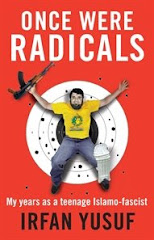
(Irfan Yusuf is a Sydney-based lawyer, author and columnist. His first book Once Were Radicals: My years as a teenage Islamo-fascist has just been published by Allen & Unwin. The above address was delivered to a conference on the Common Word document organised by the Australian Muslim-Christin Friendship Society and the Melkite Welfare Association on Friday 15 May 2009.)
Words © 2009 Irfan Yusuf
Bookmark this on Delicious