Bookmark this on Delicious


Flippant Thoughts on this Friday's Youth Summit
This Friday, young Muslims from across Australia will be gathering in Sydney for the inaugural National Muslim Youth Summit. They will discuss a range of issues affecting young Aussie Muslims. These issues include drug & alcohol addiction, family crises, the Anti-Terrorism Bill and Muslim coverage in the media.
You’d think such a summit would be organised by a peak Muslim body such as the Australian Federation of Islamic Councils. Think again. This talkfest is being financed by the Department of Immigration Multicultural & Indigenous Affairs (DIMIA). It is being organised by a non-Muslim NGO called the Australian Multicultural Foundation.
Around two-thirds of Australian Muslims are aged under 40 and were born in Australia. Many Muslim communities – Turks, Bosnians, Albanians, Afghans and Lebanese – are into their 3rd and 4th generation. They have high levels of education and employment and integrate well in mainstream Australian society.
Yet the very fact that AFIC and other Muslim bodies have never organised a Muslim youth summit is indicative of how out-of-touch these migrant-dominated peak bodies are. It also explains why they find it so hard to send the right signals to the broader community understandably seeking some kind of reassurance that the London bombings will not be replicated in Australia.
When asked if any single event changed his perceptions toward national security, Prime Minister John Howard spoke of the London terrorist attacks of 7 July 2005. What made the London attacks so different was that the alleged perpetrators were not foreign terrorists but local boys. The phrase “home grown terror” became part of our vocabulary.
And it wasn’t just in Australia that the shockwaves were felt. Across the Tasman, at least 4 mosques were vandalised in different parts of New Zealand.
Within hours, a small group of grassroots Muslim organisations led by the Islamic Council of Victoria condemned the attacks unconditionally. These organisations had one thing in common – they were managed by Australian-born Muslims who knew how to engage with the Australian mainstream and could address the legitimate concerns Australians of all faiths and no faith in particular held on national security issues.
However, other Muslim peak bodies were much slower in their condemnation. It took the Australian Federation of Islamic Councils around 3 weeks to issue an open letter signed by its president and its mufti (chief imam) to various Muslim groups and associations. The letter made mention not just of the terror attacks but also of the alleged grievances of those carrying out many attacks. A similar letter and with similar timing was issued by the Islamic Council of NSW.
The conditional nature of the condemnations and their delayed release led to suggestions that Australian Muslims would only condemn terrorism when embarrassed into doing so, and only on a conditional basis. The suggestions were, of course, unfair but understandable. What Muslim bodies did not realise was that their management of Muslim affairs was now regarded as a national security issue.
The most recent raids and arrests conducted by ASIO and police raised even more questions about Muslim community management. The majority of those arrested were young men born and brought up in Australia. A number of these men were known to attend youth groups managed by imams and volunteers deemed to be more “radical”.
This naturally led many commentators to ask certain questions. What attracts many local Muslim youth to attend such classes and become part of such groups? Why aren’t mainstream mosques attracting more young people? What facilities and programs are being run by mainstream imams? Are mainstream imams equipped to provide programs to younger home-grown Muslims?
One troubling aspect of Muslim community leadership is that it has not yet figured out exactly who or what it represents. Both AFIC and its New Zealand equivalent (the Federation of Islamic Associations of NZ or FIANZ) are umbrella bodies representing mainly societies responsible for the management of mosques.
At least in Australia, the majority of mosques are divided along ethnic and linguistic lines, and leadership is dominated firmly by first generation middle-aged migrant men with an interest in maintaining the ethnic divisions. The leadership tends to regard mosques and religious activities as cultural artefacts which run parallel to their cultural perception of Islam.
The mosque associations tend to employ imams who fulfil a cultural role. As such, the imams of different mosques will perform different cultural roles depending on the dominant cultural group of the association. Most Friday sermons and other lectures are given in Arabic and another language (usually not English).
Indeed, most sermons being given this Friday will also tend to be in a language most young Muslims will not understand. The inability of mainstream Muslim institutions will be just one of the topics to be addressed this Friday at the National Muslim Youth Summit in Sydney.
Delegates will be divided into 6 subgroups and will brainstorm a number of the issues selected. The summit is perhaps the first time young people across the ethnic and linguistic spectrum of Muslim Australia will be able to discuss and pass on their concerns to the Australian Government.
One would have expected the topics discussed at the summit would form part and parcel of the deliberations and decision making of these bodies. The inability of peak Muslim bodies to involve and engage the youthful Muslim majority will ensure these institutions will become irrelevant in the Australian Muslim landscape. The fact that a government agency and a non-Muslim NGO are taking this initiative is yet another indication of how hopelessly out-of-touch the migrant and middle aged male dominated Muslim leadership is with the community it claims to represent.
Bookmark this on Delicious

A Message To Imams Across Australia, New Zealand & The WorldWords © 2005-11 Irfan Yusuf
25 November 2005 falls on a Friday, the day regarded as sacred to Muslims. On this day, Muslims gather at the mosque to pray in congregation. Part of that process includes the delivery of a sermon or “khutbah”.
The Prophet Muhammad has provided guidelines for the delivery of sermons. One od these guidelines is that the khatib (the one who delivers the sermon) is to deal with current issues facing the Muslim community.
Although I am no scholar, I have a humble suggestion for our imams and khatibs for a topic which affects all Muslims, especially Muslim men. I also have a humble request for our imams and khatibs to wear a certain item with their clothing.
The United Nations has designated 25 November to be the International Day for the Elimination of Violence Against Women. As part of this day, men wear white ribbons on their chests as a symbol that they will not commit, condone or tolerate any forms of violence against women carried out by other men.
I urge our imams and khatibs to wear a white ribbon on that day, and to encourage the male members of their congregation to also wear the white ribbon.
Islam gave dignity to women. It gave women rights and liberties. But some men, Muslim and non-Muslim, choose to take those rights away. Moreover, some men choose to act violently toward women.
Our greatest exemplar in conduct was the Prophet Muhammad. There is no instance of him ever behaving violently toward a woman. He never engaged in physical or sexual violence toward any women, be they his wives, his daughters or women outside his family.
The Prophet Muhammad brought a scripture which states that husbands and wives are like “garments unto each other”. Which man would rip up or punch or kick his garments?
The Prophet is reported to have said: “The best of you is he who is best to his wife. And I am the best amongst you because of my behaviour with my wife.”
The measure of a man is how he treats his wife. Yet we all know that Muslim men do exist who beat and act violently toward their wives. Often such violence is carried out in the presence of children, or at least comes to the knowledge of the children.
When violence against women is perpetrated in the home, it isn’t just the women victims who suffer. The children are traumatised, and this can last even after they reach maturity. Other men who care for the woman victim – fathers, brothers etc – also suffer.
Indeed, even the perpetrator of the violence suffers. He loses respect of his children. He is increasingly unable to control the anger or other causes of the violence. Most importantly, he eventually loses the woman who could have offered him unconditional love.
Society as a whole loses. And we are losing. Our women are suffering physical and sexual violence at the hands of their husbands and other men. We know it is happening. But many of us come from cultures where domestic violence is hidden.
In Australia and other Western countries, there are laws which forbid domestic violence and which provide women with remedies against the perpetrators. Similar laws exist in Muslim countries.
Yet it troubles me that when I visit a court located in an area of Sydney with a substantial Muslim community, I see names like “Ali” and “Muhammad” and “Umar” and “Abdullah” figuring prominently on the court list as perpetrators of violence toward their female partners.
It also troubles me that I see so many women with names like “Aisha” and “Khadija” and “Yasmin” and “Fatima” as victims.
Women make up at least 50% of the Muslim population, and at least 50% of the human race. Violence against women is condemned across all faiths and schools of thought. So why is it on the increase?
This is not just an issue for Muslims. It is eating at the soul of mankind. We know that God is “ar-Rahman” (absolutely gracious) and “ar-Rahim” (absolutely merciful). We know that these two primary attributes of God come from the root word “Rahm” which means “the womb”.
God uses the example of the female womb to describe His own absolutely mercy. Yet instead of respecting the wombs that carried us, we see women being subject to the worst forms of physical, mental, sexual and emotional violence in our communities. We even see fathers and brothers perpetrating violence for the sake of protecting family honour.
Yet the most honourable and best of men is the one who is best to his wife. This is the standard set for us by our Prophet. It is the standard we have failed.
The Prophet said: “Help your brother, both when he is oppressed and when he oppresses.” Those hearing asked: “How do we help someone when he oppresses?” The Prophet responded: “By stopping him from his oppression.”
Muslim men need to stop their Muslim brothers who deem it acceptable to oppress their wives and other women. The violence against women will only stop when men take a stand. If Muslim men sit by and not stop the evil from occurring, we might as well be lending a hand to the violence.
I humbly call upon all imams and khatibs to deliver this message to the men in their congregations on 25 November 2005.
Bookmark this on Delicious
Here we go again. The integration mass debate has been started by politicians too gutless and/or stupid to deal with harder questions of economics. Pointing fingers at others without realising three fingers are pointing back at them.
Once again the pseudo-intellectual monoculturalists are coming out of the closet, dusting off the attitudes that have been used for over two centuries in Australia. One of my recent favourites has been a line from an editorial published by that American-owned newspaper the calls itself The Australian.
How wonderful it would be if the next generation of [Muslim] Lebanese-Australian kids held as their models the successful chief executives and footballers from their communities, rather than drug barons and night club owners.
Bookmark this on Delicious
 Bookmark this on Delicious

On 7 January 2011, I received the following e-mail from some dude calling himself "Jaaved":Dear irfan,
Assalaamu Alaykum and Peace Be Upon You!
The Forum Guidelines for Muslim Village have been updated today, Friday 7 January 2011. It is your responsibility to read through and understand the rules as a whole and to ensure you comply with them.
For your convenience, you may access the Forum Guidelines here: http://muslimvillage.com/forums/index.php?app=forums&module=extras§ion=boardrules
If you have any questions about these new Forum Guidelines, you may do the following:
1. Contact Jaaved, the admin (http://muslimvillage.com/forums/user/1831-jaaved/)
2. Post in the relevant thread about the new Guidelines (http://muslimvillage.com/forums/topic/62569-updated-forum-guidelines/)
3. Contact any of our fantastic Moderators (http://muslimvillage.com/forums/index.php?app=forums&module=extras§ion=stats&do=leaders)
Thank you for your co-operation and thanks for your support thus far.
Wasalaam,
With Peace,
Jaaved and the rest of the Muslim Village Team
What a lovely surprise! A personal invitation!! I'd already been banned from the MV forums over the past 5 years for any number of reasons including:
1. Twice for criticising Shaykh Hilaly for his imbecilic comments, including his infamous catmeat remarks.
2. Thrice for questioning the dubious academic credentials of pseudo-imam Afroz Ali.
3. At least once for questioning the arguments of Hizb ut-Tahrir.
So anyway, I decided to join. Heck, why not?
Within 30 minutes, I was banned again. I was curious as to why. So I penned this e-mail:
To:webmaster@muslimvillage.netAA.Thanks for inviting and then uninviting me.Just out of curiosity, I'm wondering what reasoning was used to ban me.Ma salamehirfan
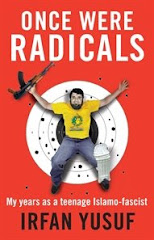
You are merly using Islam to peddel your books, why don't you advertise your books elsewhere, we the Muslims here are not stupid to believe your lies.
So Irfan was once a radical "Islamo-fascist", yeah right, it shows how much credibility you've got by using a bull **** word once used by Mr. Bush our biggest enemy. He used that word when he made a speech after the attempted bombing of US and British airplanes by using chemicals stored in cans.
What is an "islamo-facist" anyway? It's a kind of oxymoron don't you think, becuase Islam and fascism are totally different and opposite.
the collective IQ of that place can be measured in terms of average rainfall in Canarvon. Occassionally Irfan arrives and it floods
From the Aussie Mossie blog first published 05 December 2005.
Christmas is hardly a fortnight away, and already some people feel affronted. What puzzles me is that some of these people claim to feel this way because of their Muslim faith.Words © 2005-11 Irfan Yusuf
Yet anyone who understands what Christmas is about will see nothing in it offensive to Muslim sensibilities.
Muslims believe the Jesus Christ is the Messiah. They believe his birth occurred by immaculate conception to the Virgin Mary, an miraculous act of direct Divine intervention. Muslims do not dispute that Jesus was born in Bethlehem, presently a Palestinian town in the West Bank.
You cannot be regarded as a Muslim if you do not believe in these key events of Christmas. The nativity scene is as much part of the Qur’an (the Muslim scripture) as it is of the New Testament.
I have the benefit of being exposed to both Christian and Muslim religious traditions. I attended Sydney’s only Anglican Cathedral School. I studied the New Testament in Divinity classes and attended weekly chapel services. My Indian Muslim parents insisted I be part of all Christian activities of the school.
At the same time, as a child, I grew up with the Qur’an. I learnt about the chapter of the Qur’an named after Mary which describes the nativity scene in great detail. In that chapter, it states that Mary chosen above the women of all nations and ages for the sacred task of giving birth to God’s Messiah.Today, Bethlehem is a city where Muslims and Christians celebrate Christ’s birth together. It is not uncommon to see Muslims seated in the pews of the Church of the Nativity. During the most recent Israeli incursion into Bethlehem, both Muslims and Christians sought refuge in the Church.
Both ancient and modern realities of Bethlehem bring the two communities of Christ together. It makes no sense for Muslims to oppose the celebration of Christmas. In this regard, comments attributed to the Forum of Australia’s Islamic Relations (FAIR) in the Sunday Mail on 4 December are cause for concern.
In a press release dated 5 September 2005, FAIR director Kuranda Seyit denied suggesting that Christmas should be phased out of Australian life. The comments attributed to FAIR are certainly not echoed by Muslim leaders in other parts of Australia.
Of course, some will argue against Christmas being used to sell products. Even some Christians feel that Christmas is becoming too commercial, with more emphasis being placed on storewide sales than church services.
I personally feel that the sales themselves are a reflection of a broader Christmas spirit. Christmas is about celebrating Christ’s mass, the birth of Christ. It is a time when God showed His divine generosity by sending His Messiah to spread a message of love and compassion.
The New Testament Christ is a man who made time for the most marginalised members of society – tax collectors, sex workers and lepers. The Christ of the Qur’an was a man who brought the message of God’s mercy and love. Both versions involve celebrating a man whose life was itself a celebration of human kindness and generosity.
It therefore makes sense that people exchange gifts during this time. Retailers who choose to cash in on people’s generosity by offering incentives and sales for people are hardly doing society a disservice.
Islamic teachings state that money should continue to circulate through the economy. Money grows when it is in motion. Like still water stagnates, hoarded wealth is a source of many diseases of the heart. The cure for such diseases is generosity.
So this year, as in every other year, I will be sending Christmas cards to all my clients, Muslim and non-Muslim. I will also be sending a package to a close Muslim female friend for Christmas consisting of books of poems by the Muslim mystic Rumi.
The message of the Muslim saint Rumi, like that of the Muslim Messiah Jesus, was one of Divine love. I hope my fellow Aussie Muslims show traces of that love to their fellow countrymen and women of all faiths and of no faith in particular.
Bookmark this on Delicious