Showing posts with label partition. Show all posts

Monday, August 20, 2007

REFLECTION: The pain of partition caused by some lines drawn on a map


MY FAMILY sits on the partition fence. Dad and Mum were born in the same year in the same neighbourhood in Old Delhi, in the shadow of the Red Fort. In 1947, Dad's family managed to fly over the border to Sialkot, thus avoiding the slaughter in Punjab between Hindus, Muslims and Sikhs.

At this time, Mum's family were living a comfortable middle-class existence in the university town of Aligarh. Mum's father taught undergraduate philosophy, geography and a few other subjects.

So Dad is Pakistani and Mum is Indian, despite both being born in the same year in the same neighbourhood.

Now for a really tough question — what on earth am I? Perhaps this week, marking the 60th anniversary of the partition of India, would be a good time to revisit this question.

I've been thinking about this for some time now. I was born in Karachi, but was bundled onto a cruise liner bound for Sydney after barely five weeks. Growing up in John Howard's electorate, I was surrounded by family friends, virtually all of whom were South Asian — Hindus, Sikhs, Catholics, Jews, Muslims, even a Pakistani Anglican priest.

Mum and all the "aunties" wore saris or shalwar kameez (baggy pants with a long loose shirt hanging outside). They always wore red to weddings and had henna art painted on their hands. The men — especially the medical doctors — wore flared pants or safari suits and showed off their flash cars.

At age six, I spent seven months in Pakistan and forgot English. I relearnt it after spending six months at school in New Jersey. Then I returned to Howard's electorate and was teased for my brown skin, my strange name and my New Jersey accent.

It wasn't until I reached double figures that the difference between a Sikh and a Muslim became apparent to me. One day I was at one of those South Asian Sunday lunches where everyone rocks up at 4pm ("Indian standard time") for what turns into dinner. Our host, a Sikh doctor-uncle, offered me a glass of Coke. I refused.

"Why don't you want Coke? You always used to like it," he asked. "I'm sick, uncle," I said. "No, you're not, son. You're Muslim!" Dr Uncle replied, setting all the other uncles and my Dad into fits of laughter. I thought they were laughing at me and walked away in tears.

Dad could tell I didn't get the joke. He then explained to me in simple language how Sikhs and Muslims differed. Sikh religious uncles grow beards and wear turbans like religious Muslim uncles. Sikh aunties wear the same loose clothes as my Mum did. Sikhs worship the same God, speak the same language and eat the same food. Sikh religious songs sound like Sufi Muslim qawwali songs.

After saying all this, Dad expected me to believe Sikhs and Muslims are different. I had good reason to be sceptical.

Guru Nanak (the founder of the Sikh faith, although regarded by many Indian Muslims as a Sufi saint) performed the Muslim pilgrimage to Mecca at least once.

Sadly Sikhs often suffer abuse due to misdeeds of fanatics claiming to act in the name of Islam. Following the September 11 attacks, the first victim of a reprisal hate-crime was Balbir Singh Sodhi, an American Sikh who was planting flowers at the family-owned petrol station in Arizona. The killer told police he thought Balbir was a Muslim.

Sixty years ago Sikhs and Muslims massacred each other in the months leading up to and following partition. My uncles, both Indian and Pakistani, tell stories of trains arriving at Lahore and Amritsar filling the air with the stench of death, carriages turned into communal coffins filled with innocent Muslims, Hindus and Sikhs massacred by religious militants.

But were all these deaths caused by militants? Or were they caused by innocent people manipulated by militants spreading rumours? Or by survivors of massacres who saw family members massacred and raped and burnt alive before their eyes? Who knows? My uncles certainly had no idea who started all the madness. But they did want me to know that it happened. And that members of all communities suffered.

Pakistan was a nation carved out on the basis of ethno-religious identity. Its founder and first governor-general, Mohammad Ali Jinnah — known as Quaid-i-Azam, or "Great Leader" — was an irreligious Bombay barrister who made his fortune representing the wealthy in London.

India's founders were no less elite. Professor Raj Mohan Gandhi has just released a biography of his saintly grandfather, known to us as the Mahatma (or "great soul"), detailing among other things his troubled family life and sexual indiscretions.

Pakistan was established to protect Muslims from being an oppressed minority. Muslims were told by Pakistan's founders that they were a nation separate to the rest of India. I never saw much evidence of that growing up.

Dad still talks about how his father dreamed of returning to Delhi. I'm sure he wasn't the only one whose memories transcended politics.

This week, the near-futility of partition was on display in the Bombay High Court, where lawyers for the daughter of Pakistan's founder argued for her father's palatial Bombay residence (now Indian state property) to be returned to the family. Among the evidence presented will no doubt be a statement Jinnah made to the Indian high commissioner in 1948:

Tell your prime minister not to break my heart by taking over my Bombay residence. You know well how much I love Bombay. I hope to return there some day.
Even after achieving partition, Jinnah could not erase his very human emotions by referring to lines he insisted be drawn on a map.

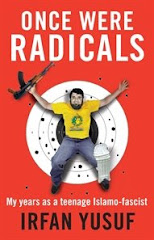
Irfan Yusuf is a lawyer and associate editor of AltMuslim.com. This article was first published in The Age on 15 August 2007 and then on AltMuslim.com on the same day.

Words © 2007 Irfan Yusuf

Delicious
Bookmark this on Delicious

Digg!

Get Flocked

Stumble Upon Toolbar

Saturday, August 11, 2007

Paragraphs on Partition

As we lead up ro the 60th anniversary of the Partition of India, I will be expressing my own personal thoughts and reflections on the re-emergence of post-colonial India and the creation of what would become the Islamic Republic of Pakistan. Perhaps a good place to start is to build upon what I’ve written already on the subject.

A year ago, I wrote the following lines in an article for NewMatilda.com …

My family sits on the Partition fence.

My paternal grandfather was a Crown Prosecutor based in the outer-Delhi neighbourhood of Gurgaon. When the communal riots started in Delhi in 1947, he and his family were moved to the border town of Sialkot in Punjab. His family never managed to get back, and they ended up as accidental Pakistanis.

My maternal grandfather taught philosophy at the Aligarh Muslim University. He had no plans of leaving behind a cushy job and a nice home provided by the university. He remained in India with his family following Partition.

I grew up in Sydney, the son of mixed Indian and Pakistani parents. Most of our family friends were from the sub-Continent: Hindus, Sikhs, Muslims, Parsis, Catholics and even a Pakistani Anglican priest. We spoke the same language, listened to the same music, watched the same movies and ate the same food. We celebrated each other’s religious festivals.

I also grew up with harrowing stories told by my Hindu, Muslim and Sikh uncles of the communal bloodbath that claimed over 1 million lives during the 1947 Partition that created two independent States of India and Pakistan.

One image features prominently in these tales; trains arriving at Lahore and Amritsar filling the air with the stench of death, carriages turned into communal coffins filled with innocent Muslims, Hindus and Sikhs massacred by religious militants.

But were all these deaths caused by militants? Or were they caused by innocent people manipulated by militants spreading rumours? Or by survivors of massacres who saw family members massacred and raped and burnt alive before their eyes?

Who knows? My uncles certainly had no idea who started all the madness. But they did want me to know that it happened. And that members of all communities suffered.

The memory of ‘carriages of death’ runs deep in the sub-Continental psyche ...

As is often the case in the sub-Continent, the real terror begins when the shock of the initial terror subsides. Terror breeds a worse terror, out of all proportion with the initial terror. When religion is hijacked by terror, essential religious values are thrown with the enemy into the furnace of hatred.


Then in late July this year, I wrote these words about Indian communal violence in the Canberra Times ...

Communalist violence in the Indian subcontinent is a reality of which many Australians are unaware. Historically, the general rule is and always has been one of followers of different faiths living side by side peacefully. India is a religious country where believers often display their religious symbols. This generally doesn't hinder respect for each other and even taking part in each other's religious festivals.

Sadly, South Asia has also been the scene of ethno-religious intolerance which has led to organised and violent attacks on one group by the other, violence that makes our 2005 riots at Cronulla look relatively tame. The 1947 partition of the subcontinent saw about onemillion people massacred.

The conventional view is that the attacks were largely orchestrated by religious fanatics on all sides. But how many were the work of militants? And how many were caused by otherwise innocent people manipulated by militants spreading rumours? Or by survivors of massacres who saw family members massacred and raped and burnt alive before their eyes?

India's 20th century political saint Mahatma Gandhi was himself assassinated. His killers emerged not from a disgruntled extremist element from a religious minority but from a movement wishing to establish a Hindutva nation, a Hindu theocratic state in which non-Hindus would become second-class citizens. Just as extremists have hijacked Islam for their own ends, similarly the peaceful and tolerant theology of Hinduism has been held hostage by an array of extremist groups misusing Hindu symbols to rape, pillage and murder.

India has its own groups of religious extremists, many of which are not afraid of using both electoral politics and communal violence to achieve their goals. Indeed, voters in this largest democracy in the world have been known to elect religious fanatics at both state and federal level.

Before the May 2004 elections, India's Federal Government (and many of its state governments) was ruled by the Bharatiya Janata Party, a Hindu nationalist coalition that was arguably dominated by religious fanatics who inherited the militant ideology of Gandhi's assassins. In India's commercial hub of Mumbai, former leader Bal Thackeray openly expressed his admiration for Adolf Hitler.

Some Indian commentators make much of Pakistan's previous support for the Taliban (and indirectly for al-Qaeda). The al-Qaeda attacks on September 11, 2001 resulted in some 3000 deaths. Human Rights groups estimate that a similar number of members of India's Muslim and other minority communities were massacred during the riots in Gujrat in February and March 2002.

What made the Gujrat massacres even more disturbing was the involvement of governments. Human Rights Watch reports that some rioters were guided by voter lists and printouts of addresses of Muslim-owned properties and businesses obtained from local municipal administration. Police and soldiers stood idly and in some cases participated in the carnage.

Yet religious fanaticism is generally the exception and not the rule. Indian voters showed this in March 2004 when they elected a government led by India's first prime minister from a religious minority. The significance of this event cannot be underestimated.

Some 23 years ago, the holiest shrine of Sikhism was stormed by Indian troops. Within five months, prime minister Indira Gandhi was gunned down by her Sikh bodyguard. Thousands of innocent Sikhs in Delhi and across the country were massacred in reprisal attacks. Now, 23 years later, Mrs Gandhi's own party is led by a member of this faith minority.


So what does Partition mean to an Aussie kid who hardly stayed in Pakistan for 5 weeks before being whisked away on a cruise ship bound for Circular Quay? I have spent some considerable time in Pakistan. Well, that's if you call a combined period of 9 months (consisting of 7 months when I was 6 years old plus 2 or 3 holidays, each of 3-6 weeks duration) to be significant. I've hardly spent a week in Bombay.

Yet I still have this enormous sense of nostalgia for South Asia. If someone asked me what my religion was, it would be insufficient to describe it as "Muslim". Really, I am a "Mussalman" (an Urdu word for "Muslim" but perhaps the best word to use to denote that unique kind of Muslim from South Asia).

When wanting to define what kind of Muslim I am, in my mind I don't go for the usual divisions of Sunni or Salafi or Shi'i as many Western Muslim kids do. Rather, I think in terms of South Asian maslaq differences - Deobandi, Barelwi, etc.

Yet somehow, I don't quite feel Indian or Pakistani. If I feel anything South Asian, I feel somehow in between the two.

But who gives a stuff about what I think? After all, at best I have an emotional attachment to South Asian culture, music and language. And food, of course. But it wasn't until recently that I discovered things about my own ancestral heritage. And the sources I used were hardly the sort of stuff Pakistani and Indian kids would study at school.

The first book I read about the Partition was Freedom At Midnight. It was a rivetting read, though I couldn't help but wonder while I was reading the book at why the authors always presumed communal riots could only be initiated by Muslims.

The first book I read about Delhi was William Dalrymple's terrific City of Djinns. In fact, much of my understanding of Indian history comes from Dalrymple. In a later instalment, I might share some of what Dalrymple told an audience at Macquarie University when he was here for the Sydney Writers' Festival.

Perhaps the most important book I read on Indian Muslims was a set of biographies entitled Eight Lives by an Indian journalist who also happened to be Mahatma Gandhi's grandson. It was the first time I had read a coherent biography of Pakistan's founder, Muhammad Ali Jinnah (rahimahullah - God have mercy on him).

So for the next week or so, this blog will focus on South Asia, its history, religions, cultures and politics. Hopefully by the end of this, I'll be able to make some sense of the South Asian part of my jumbled-up identity!

© Irfan Yusuf 2007

Stumble Upon Toolbar