It was a financially satisfying Saturday night. We had been treated to presentations by two of the world’s foremost experts on mortgages and managed funds and insurance and all that other boring stuff that I failed at university. For me it was financially satisfying because I had been given a free dinner.
The night was organised by the Muslim Community Co-Operative (Australia) Limited, Australia’s first institution set up to develop financial products that complied with the tried and tested principles of sharia.
No, that doesn’t mean they involve stoning adulterers or chopping the hands of thieves (or, if you will, bankers) or even burning embassies. Rather, in the case of tonight’s dinner, it meant launching a new kind of ethical investment that enabled investors to play the stock market without getting their hands dirty on companies that traded in arms or pornography or similar nasties.
By the end of both presentations, I was thoroughly bamboozled and ready to hit the dessert and gobble down a few more glasses of complimentary coke. It was then that one of MCCA’s sharia advisers, an Egyptian chap named Dr Ibrahim Abu Muhammnad, decided to hit the stage.
Dr Abu Muhammad graduated from Al-Azhar University in Cairo, and lived for many years somewhere in the Middle East before settling in Australia. He runs his own radio station known as Radio Qur’an-Kareem or simply Q-K Radio. It broadcasts using narrow-casting short-wave frequency or something like that. The point is that you have to buy a special radio that costs around $40.
I purchased one of these radio sets for my mum. She started using it, and found that each time she turned on the radio she couldn’t understand a word being said. Like the other two Muslim radio stations in Sydney, Q-K Radio broadcasts all its programs in what is obviously the most relevant language for Australian conditions – Arabic.
Yep, we all know that every single Muslim in Australia instinctively knows how to speak Arabic. It’s just one of those things you naturally pick up after living in Sydney’s south-west – together with an aversion to paying tax and a mysterious attraction to Centrelink officers.
Dr Abu Muhammad decided he would continue with this tradition of exceptional relevance by speaking in Egyptian dialect of Arabic. I’m not sure exactly what he said, but it sounded really grouse. I started catching up on some gossip from a lady involved in one of Sydney’s “united” Muslim women’s associations.
The audience were overwhelmed by the speech. Some 30% of the audience got up and left. Virtually all of these were non-Arabic speakers. The rest of us just kept chatting away.
Dr Abu Muhammad finally pinned his gaze on me. He gave me one of those nasty looks, as if to say: “Look, I know what I am saying is in a language that hardly 0.5% of Australia can understand, but you must listen hard because I am shouting my head off!”
I, of course, looked back at the revered doctor. I gave him a look, as if to say: “Dude, you’ve lived in this country for over a decade now. Isn’t it time you got out of the ghetto and learnt some English?”
Of course, Dr Abu Muhammad did have something very important to say. In fact, so do most other Islamic religious scholars in Australia. But like Dr Abu Muhammad, most of them simply cannot express themselves in a language most of us can understand.
Later, MCCA Director Muhammad Abu Shaban stood up and gave an impressive summarised translation of Dr Abu Muhammad’s speech in English. It was truly awesome stuff.
Dr Abu Muhammad made the following points in relation to the Danish cartoons:
a. The fatwas (non-binding rulings) apparently made by various Middle Eastern scholars such as Dr Yusuf Qaradawi calling for boycotts of the goods of countries whose newspapers published the cartoons cannot and do not apply to Australia. We have no reason to boycott the goods of any European country.
b. Following the establishment of the Truce of Hudaybiyya between the Prophet and his foes from the city of Mecca, the Meccans began to suffer a famine. In previous years, these same people had fought 3 battles to annihilate the Prophet and his community. They had also sent assassins to kill him. What was his response to their famine? Did he trash their embassies? No. He followed the Qur'anic dictate of repelling evil with good. He sent them food aid.
c. We should give Europeans the benefit of the doubt. Perhaps they are lampooning the Prophet in frustration at the bad behaviour of some Muslims.
d. Whilst Muslims may be mistreated in Europe, Muslims in Australia have little reason to complain. Their rights are adequately protected and guaranteed under Australian law. Australian Muslims realise this, which explains why Muslims here have not made any substantial protest to the publication of the cartoons here.
What absolute gems of wisdom can be found in these words. But unless you go out and do a crash course in classical Arabic, good luck if you can understand them.
The Australian Federation of Islamic Councils (AFIC), the peak Muslim body in Australia, is meant to be having a national summit of imams on 25-26 February 2006. The Federal Government is worried about imams preaching radical stuff that could lead to some Muslim kids blowing themselves up. That summit has now been postponed as Muslim women’s groups are pushing for female scholars to be represented at the summit.
But there’s just one problem. Most Muslim female scholars can speak fluent English. Most male scholars cannot. Perhaps they need simultaneous translations. Or maybe AFIC will need to hire out the SBS subtitling machine.
Australia has some really fantastic Muslim religious scholars with bright ideas and amazing minds. Dr Abu Muhammad is one such scholar. His message is sober, thoughtful and sensible. But unless he can learn to speak English, his sensible message will go over the heads of people who need to hear the message. People like me.
© Irfan Yusuf 2006
Monday, February 13, 2006
Nice words, shame about the lingo ...
Sunday, February 05, 2006
Some Thoughts on Danish cartoons and Danish pastries
It’s difficult to know what to make of the controversy surrounding the publication of twelve cartoons depicting the Prophet Muhammad as a violent terrorist. On the surface, it appears to be a battle between the medieval and modern, between Abrahamic religion and freedom of speech.
The cartoons were first published in the obscure neo-Conservative newspaper Morgenavisen Jyllands-Posten in September last year. They have now been reproduced in newspapers across Europe. A number of major American networks, including CNN, have refused to allow the cartoons to grace their websites.
Across the Tasman, the New Zealand Herald editorialised on February 4 why it refuses to publish the cartoons. Its competitor, the Fairfax-owned Dominion Post, has reproduced the cartoons in full and explained their significance.
Muslim haters have had a field day over images of violent protests in various Muslim-majority countries. Neo-Conservative publications known for their venom toward all things Islamic have been at the forefront of using more extreme Muslim responses as an indication of what broader Muslim opinion on the issue is.
The reality is that Muslim opinion has been divided. If anything, the entire fiasco has prompted a mood of soul-searching amongst educated Muslims, especially those living as minorities in Western countries.
Canadian writer Safiyya Ally, writing for popular Muslim website altmuslim.com, hasn’t held back in referring to the entire issue in her headline: “Stupid Cartoons, Even Stupider Reaction”.
Egyptian commentator Mona Eltahawy, writing in the Beirut Daily Star, argues that the issue exposes the inconsistencies of some despotic Muslim leaders. “Danish Prime Minister Anders Fogh Rasmussen was right not to intervene, insisting the government has no say over media - the argument used by Arab leaders when they are asked about anti-Semitism in their media, by the way.”
She goes onto state that the Danish cartoonist may have offended Muslims but certainly did not call for violence against Muslims. Indeed, in August 2005 Danish authorities suspended the broadcasting license of a radio station calling for the extermination of Muslims.
Jyllands-Posten has since apologised for the publication of the cartoons. It claimed the cartoons were published in an attempt to test the limits of freedom of speech. Maybe. But why did the newspaper really publish the cartoons, knowing as it did that these would cause offence to millions of Muslims?
One needs to understand the political background of Denmark, in particular the ongoing claims of Danish neo-Cons that Muslims are not welcome in the country. The prejudice and hatred toward Muslims by some sectors of Danish society is reflected in an article entitled “Something Rotten in Denmark?” and published in Danish and American newspapers in August 2002. That article was written in the aftermath of the defeat of social democratic and leftist parties in Denmark’s elections.
In that article, veteran Islamophobe Daniel Pipes joined forces with Lars Hedegaard to claim that Muslim migrants “show little desire to fit into their adopted country.” Mr Pipes’ own Jewish background does not stop him from blaming Muslims for a host of Denmark’s social ills in a manner reminiscent of Nazi propaganda concerning European Jews.
American Muslim writer Svend White writes on his blog that too many commentators have ignored the role played by the offending newspaper in an ongoing debate about immigration. When one understands this context, it is clear that the Danish newspaper’s intentions were not as noble as first seems.
White, whose mother is Danish, claims that politics in Norway has made a sudden turn to the hard-right since the Conservative Party formed a government following the 2001 election. Despite an election win for a centre-left coalition in 2005, many politicians and media outlets on the conservative side continue to blame Muslim migrants (who hardly make up 4% of the Danish population) for all Denmark’s ills.
Even in Denmark itself, Jyllands-Posten has been criticised. One prominent Danish commentator, Rune Engelbreth Larsen, speaks of the cartoons and the paper in the context of “over 15 years of progressively humiliating rhetoric and propaganda attacks” suffered by Danish Muslims.
Larsen further comments on the complete futility of the exercise as a means to campaign for freedom of speech and other liberal democratic values. He says that if the paper was really concerned about freedom of speech, it would caricature the despotic emirs, kings, generals and presidents-for-life that currently rule the roost in most Muslim countries. Instead, publication of the cartoons has enabled despotic rulers of Muslim lands to shore up more support by fuelling popular Muslim sentiments.
Some 3 years ago, the UK-based Independent newspaper published a cartoon depicting Ariel Sharon as a cannibal eating the head of a Palestinian child. Jews across the world protested, some arguing that the cartoon reminded them of medieval Christian myths of Jews eating children. Today, the modern myths of Muslims as all being terrorists has been depicted in the name of freedom of speech. Surely European newspapers publishing the cartoons should understand that the Prophet Muhammad means more to Muslims than Ariel Sharon does to Jews.
At the same time, Muslims need to ask themselves how their Prophet would have liked his honour to be defended. The earliest Muslims were not known for holding violent protests, holding hostages or storming buildings. In their present response to the cartoons, many Muslims are displaying the sort of love and affection their own Prophet, had he been with us, would have condemned.
The author is a Sydney lawyer. iyusuf@sydneylawyers.com.au
© Irfan Yusuf 2006
Wednesday, January 25, 2006
Lebanese Leaders should move beyond tolerance
As we are in the Australia Day season, we should ponder over where our nation is heading. In this respect, I want to make some general comments about tolerance.
Basically, I hate tolerance. Call me intolerant if you like. I believe that you only tolerate something or someone reluctantly. You tolerate because you have to, not because you want to.
If you are somewhat different to the majority, would you rather be tolerated? Or would you rather want to be understood and accepted?
I think it was JFK who once said: “Ask not what your country can do for you. Instead, ask what you can do for your country.” Another way to earn acceptance and respect is to contribute and to be seen to be contributing to the nation.
Many Lebanese Australian community leaders have entered the debate about ethnic crime using the politically correct catch cry of tolerance. They say it is wrong for a senior police officer or an Opposition Leader to talk about race in the context of crime. It is intolerant.
But I can't help asking how many Lebanese Australian leaders have learned to move beyond politically correct slogans. I also wonder what example some Lebanese leaders have set in relation to tolerance.
To this day, the Lebanese Muslim Association claims that it represents Sydney's Muslims. Its senior imam, Sheik Hilali, is meant to be the spiritual leader of Muslims in Australia and New Zealand. Yet the LMA continues to refuse membership to Muslims who are not Lebanese.
The LMA leaders and their predecessors (including Keysar Trad) have little moral authority to talk about racism when their own membership structure is based on a kind of apartheid within the Muslim community. If the LMA cannot even show racial tolerance toward non-Lebanese Muslims (including Aussie Muslim converts), what right do its leaders have to cry racism?
But it isn't just the LMA that discriminates against Muslims. To this day, the majority of programs on the Voice of Islam radio are broadcast in Arabic. Go to their website, and you will see the Arabic programming schedule full and the English broadcasting schedule empty. Even SBS Radio broadcasts more English language programs than the allegedly multilingual Islamic radio station.
If we look at the Lebanese community, we find a well-heeled and vibrant community that has contributed to all areas of Australian life for decades. Lebanese Australia has produced a NSW Governor, a Victorian Premier and numerous state and federal MP's.
Lebanese Australians can be found on the boards of major Australian companies, in government departments, in academia and in sport. We've all heard of Hazem el-Masri, one of Australia's top Rugby League players. Then there is National Australia Bank Chief Executive Ahmed Fahour, an avid fan of Aussie Rules. And which Aussie hasn't heard and seen the smiling face of John Symond telling us about how we can save thousands of our home loans?
I could list many more. The reality of the Lebanese community is well-known to people in the know. Sadly, Lebanese community leaders find themselves unable to communicate this reality to the broader Australian community. For this, they only have themselves to blame. Sadly, the rest of us have to suffer.
Wednesday, January 11, 2006
Sinking the Boot
Now that the Christmas and New Year's Eve parties are over and most of us are back at work, I thought it might be a good idea to sit down and write something completely original. Something unexpected, that no one would ever expect me to write at a time like this.
Then I thought to myself: stuff it! So here, before your eyes, is perhaps the 50,000th survey of the highlights of the 2005th year since three oriental-looking dudes followed a star to the House of Lamb (the literal translation of Beyt Lahm, or Bethlehem).
For Kiwistani readers, the big news in 2005 was that you now have a Foreign Minister even more embarrassing than ours. And that powerhouse known as the New Zealand film industry has produced a movie about a rather large gorilla.
For us Aussies, two events from 2005 stand out in my mind. The first was the Socceroos' entry into the World Cup finals. The second was the Cronulla riots. Both were triumphs of sorts. Both represent two competing strands of thinking in Australia. In my opinion, only one strand is truly Australian.
According to some, the Cronulla riots prove that multiculturalism doesn't work. Immediately following the riots, that allegedly conservative American newspaper calling itself The Australian devoted substantial op-ed space to articles supporting monoculturalism. The underlying sentiment of some of these articles was simple - persons of Middle Eastern appearance (and anyone else for that matter) looking, dressing, speaking or worshipping differently to 'us' had better learn to fit in, or watch out!
Not all the opinion writers had this kind of feral wind blowing out of their shuttles. But few had anything nice to say about what they saw as 'politically correct multiculturalism' or its alleged institutional offspring: the Special Broadcasting Service (SBS), anti-discrimination bodies, and Fairfax newspapers.
Even mosques were included, this despite the fact that most Aussie mosques outside Canberra operate along strict ethnic lines, so it beats me how they could be seen as examples of 'multiculturalism.' I also can't see how anti-discrimination laws implementing over three decades of legislative consensus could be seen as shallow 'political correctness.'
And what did Australia gain from the Cronulla riots? What is the legacy we are left with? Perhaps the best people to ask are the local shopkeepers and business people who rely on local and visiting beach-lovers.
Many Cronulla shopkeepers will have signed up to long-term leases, and have to pay wages to their (usually young, local) workers. Reduced sales means staff will have to be laid off. More locals will be unemployed, leading to further reduced sales.
You don't need a Nobel Prize in economics to figure out that the insistence of some people to attack others (whether those attacked be Anglo surf lifesavers or visitors resembling Jesus and Mary) in the name of intolerance and monocultural stupidity, brings more loss than gain.
But try telling that to some of the lunatic fringe that congregate around some News Limited newspapers. They might claim to be conservative (despite the fact that many are little more than senile ex-communists). But their idea of conservatism is to reject anything supported by anyone they think is left-of-centre. Even when the Left gets it right!
Then there are the ex-National Party luminaries like a certain John (who feels he is without cultural sin and ever ready to cast the first) Stone. In one of his more outrageous pieces, published in The Australian on 18 November 2005 (and republished on Online Opinion here), Stone even called for the formation of the Queen Isabella Society in Australia. (For those who don't know, Queen Isabella of Castile not only expelled the Moors and Jews from Spain in 1492 but also considerably nourished the Inquisition's programs of ethnic cleansing. It is provocative for Stone, who is clearly uncomfortable with continuing Muslim immigration to Australia, to celebrate such a figure.)
Now let's turn to the soccer. Like their Kiwi cousins, Australians love sport. Some readers will be disturbed to learn that I wore my Wallabies jersey with pride during my visit to New Zealand some two weeks ago. I was in Napier at the time, and almost caused a race riot. (In New Zealand these days, a race riot means a few Maoris smiling at me and laughing as one points his finger at my chest and declares: 'Wot are yoh dowung wierung thet jerzay ovah heyaar?')
But after the Socceroos' performance on 16 November last year, both Wallabies and All Blacks supporters must now admit a painful truth: in the eyes of the world, REAL football is that game we used to refer to as 'pansy ball' or 'wog ball' or even 'soccer' at school.
Following its defeat of Uruguay, Australia became a World Cup Football Nation. We will now be playing the World Game. In Germany. On the World Stage.
Real football requires the deft use of feet, knees and head. Real football penalises you for using your fists or any other part of your hands, whether on the ball or on other players. In real football, you win if you pass the ball around and play as a team.
Now we have re-entered the international scene of real football, we can strengthen the real multicultural Australian community that made all this possible.
Australian football could never have reached these heights without a healthy respect for our multicultural status quo. (Are you reading this, feral conservatives? Multiculturalism is our STATUS QUO. And no, I'm not referring to the 1970s pop band.)
Like New Zealand, Australia has a tradition of welcoming migrants and respecting different cultures. Unlike New Zealand, we still haven't learnt to respect our Indigenous people. (But then again, Indigenous rights is one of those nasty Fairfax-SBS-Left conspiracies that we shouldn't blacken our conservative White faces with!)
Even during the White Australia Policy era, the rules were bent to allow Cypriot, Turkish and Middle Eastern migrants. Virtually all were from football-mad nations.
Hardly four decades after General Mustafa Kemal led Turkish troops against the ANZACs at Gallipoli, Turkish migrants commenced working alongside Australians of other ethnicities in the factories of BHP and other Australian companies. Today, their descendants in Sydney and Melbourne compete in a competition named after the Gallipoli General, the Ataturk Cup. Many worship in Sydney's Gallipoli Mosque.
The world game is an English invention. But in Australia it was largely European, South American and Middle Eastern migrants who popularised the game.
The prevalence of non-Anglos in real football has been the target of comedians. Billy Birmingham's spoof The Wired World of Sports includes a skit in which Australian soccer players have surnames like 'Lostthehousekey' and 'Sonofabitch'. At one stage, a substitute named Smith comes onto the field. The commentator remarks: 'I hope I pronounced his name correctly'.
It was and is SBS, that favourite punching bag for Australian monoculturalists, that keeps supporting, sponsoring and broadcasting soccer games from around the world, from local clubs' games to World Cup finals.
SBS remains a major sponsor of the Football Federation Australia, together with Westfield and the National Australia Bank. The head of the FFA, Frank Lowy, is a Czechoslovakian migrant of Jewish faith who began his working life as a construction labourer. The CEO of the National Australia Bank's Australian operations, Ahmed Fahour, is the son of working-class Lebanese Muslim migrants. Apart from real football, Fahour has a well-known passion for Aussie Rules.
The rise and rise of real football in Australia is a direct result of mass immigration and multiculturalism. Australia's presence in the World Cup will yield economic and other benefits for decades to come.
As for the frenzy and paranoia underpinning the beachside rioters and their pseudo-intellectual pseudo-conservative supporters, I doubt its monocultural ideology will be kicking too many goals for Cronulla or Australia.
(First published in New Matilda on Wednesday 11 January 2005)
Friday, January 06, 2006
Some thoughts on the Hadj
Muslims take their internationalism very seriously. And perhaps no more seriously than at the time for the annual Hadj, the name given to the pilgrimage to Mecca, an ancient city located in the central-west of Saudi Arabia near the Red Sea coast.
The Hadj is considered one of the 5 pillars of Islamic practice, and is compulsory for all able-bodied Muslims who can afford the trip. It commences this weekend and lasts for around 5 days.
This year, an estimated 2.5 million pilgrims from across the globe will be attending. A number of delegations from Australia and New Zealand will also be present. They will participate in an international gathering of worship, the theme of which is the struggle of Abraham and members of his family.
The three universal monotheistic faiths (Judaism, Christianity and Islam) respect and honour Abraham as the patriarch of ethical monotheism. Where today some speak of “Judeo-Christian” values, it would perhaps be more accurate to speak of “Abrahamic” values which the three faiths share.
The Qur’anic account of Abraham is similar to the Biblical one. Abraham was born in a region roughly coinciding with modern Iraq. His father sculptured idols which were worshipped in the temples of his region. Abraham’s insistence on worshipping a single invisible God was a threat to his father’s livelihood, and Abraham was forced to leave his home town.
Islamic tradition states that Abraham had two wives. His Egyptian wife Hagar bore him a son Ishmael. Both mother and child were left in a desert wilderness known as “Bakkah”. Hagar is believed to have run between two hills in a desperate search for water for her toddler.
After her seventh sprint, Hagar found her son had uncovered a spring of fresh water. She quickly built a well, known as “Zam Zam”. That well continues to quench the thirsts of the millions of pilgrims visiting “Bakkah” (now known as Mecca).
Today, most pilgrims travel in comfort. But that hasn’t always been the case. Indeed, as one Australian pilgrim’s account of the Hadj some 80 years ago shows, pilgrims faced constant danger in what were then the lawless environs of the Arabian peninsula. The journey often took years. The relatively short trip from Jeddah to Mecca to Stegar’s caravan some 10 days.
Winifred Stegar was born in London in 1882. She and her father migrated to South Australia, and married at 17 years to one Charles Stegar, a marriage that proved miserable. Some seven years after separating and leaving her four children behind, she married the love of her life, an Indian hawker (travelling salesman) named Ali Ackba Nuby. In 1927, they both set off for pilgrimage.
Stegar’s account of her Hadj journey was published in 1969 under the title “Always Bells”, and has now been republished in an anthology of Hadj writings collected and edited by American Muslim writer Michael Wolfe and entitled “A Thousand Roads To Mecca”.
Most of Stegar’s travelling companions were from the Indian sub-Continent, many of them cameleers and hawkers that made up the majority of Australia’s largely outback Muslim community at the time. Her group travelled the last leg of the journey, from the Red Sea port of Jeddah to Mecca, in a caravan of camels. The illness of many pilgrims was compounded by their insistence on fasting during the last leg of the trip.
“Most of our Indian pilgrims were very old; some even tottered on crutches and sticks. We all knew that hundreds of our company would not return again to their homeland, and many of them did not even wish to, for they deemed themselves doubly fortunate if their weary bodies could lie down in eternal rest in this, their Holy of Holies.
“So very many were weak and ill, coughing their lungs away, but still deep in the rheumy old eyes was the glint of a peace their souls longed for, a gleam of joy at something at last attempted but yet by no means done.”
For many pilgrims, th Hadj represented their only opportunity to set their affairs right with God. In many Muslim cultures, Hadj is one of the last acts of devotion a person will fulfil. For Muslims from the Indian sub-Continent, who make up around a quarter of all Muslims, the Hadj is generally not performed until children have grown up and married.
Muslims believe that the reward for a Hadj accepted by God is nothing short of Paradise. The Hadj and its hardships represent a person’s personal sacrifice to achieve salvation. All sins are washed away. This fact has generated numerous jokes and sarcastic remarks, such as the Urdu saying: “After eating several thousand mice, the cat finally decides to set off for Hadj!”
On the other hand, a precondition for going on Hadj is that a person has paid off all their debts. With this in mind, Malay and Indonesian pilgrims tend to be young adults and couples who perform the Hadj before taking on major financial commitments.
Muslims also travel to the Prophet’s grave, located in the chamber of his wife Aishah and located in the city of Medina (some 200 km north of Mecca). The grave is today contained in his mosque, and is covered by a green dome. Pilgrims experience first-hand the aura and spiritual presence of the man they regard as God’s final messenger to humanity. It is not uncommon to see pilgrims break into tears of love and longing upon setting sight on the green dome.
Much more can be said on the subject. Entire volumes have been devoted just to commentaries on the Qur’anic verses dealing with the Hadj. For anyone seeking personal accounts, perhaps the best and most moving is contained toward the end of the Autobiography of Malcolm X. There is also Michael Wolfe’s own personal account which is well worth reading and readily available in most libraries.
© Irfan Yusuf 2005
Wednesday, January 04, 2006
Usama's Real Jihad - Part 1
The image of Usama bin Ladin (UBL) is one that strikes fear into the hearts of Americans and other Westerners.
UBL and his organisation were responsible for carrying out some of the most daring and destructive attacks on the United States. UBL represents the symbol of terror, a symbol so powerful that the very mention of the name “Usama” sebds shivers down the spine of Muslims and non-Muslims alike.
Yet the name “Usama” has not always been synonymous with terrorism, just as names like “Ariel” and “Adolf” haven’t always been synonymous with genocide.
And whilst UBL may claim his type of unconventional warfare is a form of “jihad”, this term has traditionally not been associated with terror.
Who was Usama?
Usama is the name of a child, one of the favourite children of the Prophet Muhammad. To understand the historical Usama, we must understand his parents and their role in early Islamic history.
The Prophet lived some 63 years. His entire life was witnessed by an anonymous slave woman named Barakah (literally “blessing”).
The Prophet’s Mother, Amina, inherited Barakah and appointed her to be her personal assistant. Barakah was fortunate to be a servant to the most noble and kind of Arab aristocratic families. The Banu Hashim were from the purest of Arab stock and direct descendants of the Prophet Abraham and his son Ishmael.
Amina was a woman of noble lineage from one of the ruling families of Yathrib. She married into the Banu Hashim family, and her husband was the noble and handsome Abdullah. Some 2 weeks into the marriage, after falling pregnant, Amina was forced to undergo the trauma of seeing her husband undertake a risky trade journey to Syria. He was never to return, and was buried in Yathrib.
Amina gave birth to a baby boy who was named Muhammad. Barakah acted as mid-wife and helped nurse the young boy. She was with the boy throughout his life.
At age 7, the boy accompanied his mother and Barakah to Yathrib where she was to visit her family and complete her grieving process. Each day, Barakah would look after the boy while her mistress Amina would weep at the grave of her husband.
On the return journey, Amina succumbed to a fever. She died on the outskirts of a small village. Her last words to Barakah were:
“O Barakah, I shall depart from this world shortly. I leave behind my son Muhammad in your care. He lost his father while he was in my abdomen. Here he is now, losing his mother under his very eyes. Be a mother to him, Barakah. And don’t ever leave him.”
Barakah and the young Muhammad buried Amina in the sands of Arabia. Barakah never left Muhammad’s side. She later told Muhammad’s first wife Khadija: “I never left him and he never left me.”
When the young Muhammad grew up, he was gifted by his wife with a slave named Zayd. He was a young Arab boy was captured in a tribal war and sold in the slave market at Makkah. Zayd was adopted by Muhammad.
There is a famous story of Zayd’s father who searches across Arabia to find his kidnapped son. He finally hears of Zayd living in captivity and under the care of Muhammad.
The father approached his son. It was an emotional reunion. He had not seen his son for over 2 decades. The father offered Muhammad a handsome sum to buy his son’s freedom. Muhammad refused to accept a sum and left the choice to Zayd.
Islamic history reports Zayd’s response to his father’s offer as follows:
“I shall never leave this man. He treated me nobly, as a father would treat his son. Not a single day have I felt that I am a slave. He looked after me. How can I leave him and go with you? I will never leave him!”
Thereupon Muhammad publicly declared Zayd to be a free man and adopted him as a son. Zayd became known as Zayd bin Muhammad.
Both Barakah and Zayd were part of the household of Muhammad. Zayd was a handsome man in his 20’s. Barakah was an elderly sickly woman in her 50’s. Under the blessing of Muhammad, they married and had a son named Usama. This young child was a favourite of Muhammad. He was often found jumping on the back of the Prophet who was prostrating in prayer. Usama often played with the other young boys of the Prophet’s household, Hasan and Husayn.
Because of Muhammad’s love for the young Usama, the more senior disciples of Muhammad often referred to Usama as “the beloved son of the beloved”.
Usama was the product of a union between 2 people whose lives were transformed by the kindness and mercy of Muhammad. Usama eventually echoed that kindness and mercy of his spiritual preceptor and was known for his tender-heartedness and compassion toward the poor and destitute.
What is Jihad?
In the aftermath of the London bombings on 7/7, both the Prime Minister and Treasurer were reported as saying that jihad has no place in Australian society. Both can be forgiven for making such statements given the gross misunderstanding of the term in the broader community.
Jihad is a term frequently misused and abused by persons from all different faiths. Before his arrest, the Algerian man from Melbourne named “Abu Bakr” praised UBL and supporting a form of jihad which some of us might regard as terrorism.
So what is jihad? Is it war? Does it refer to killing civilians? Is it suicide bombing?
The term “jihad” is an Arabic word which literally means to struggle or strive. It is related to the term “ijtihad”, a legislative process which Canadian Irshad Manji claims to have revived, if not invented.
Both ijtihad and jihad are forms of struggle. Ijtihad refers to a struggle for finding solutions to new problems using existing sources of Islamic law. It is a process which guarantees the dynamism of the development of Islamic law. Notwithstanding Ms Manji’s claims, she is not the first writer to discuss the process of ijtihad. Indeed, it has been a common theme of Islamic legal scholarship for the past 14 centuries.
Indeed, it is by a process of warped ijtihad that UBL has claimed that the classical rules of armed jihad can be changed. The classical scholars are agreed on certain pre-conditions for an armed jihad. These include:
1. The existence of an Islamic state ruled by a properly constituted caliphate.
2. A formal declaration of war by the caliph.
3. An act of aggression on the Islamic state.
4. No women, children or other non-combatants are to be targeted.
The last of these rules is particularly regarded as being non-negotiable. As such, the September 11 attacks as well as suicide attacks targeted at individuals would be regarded as not falling within the boundaries of jihad as agreed to by Islamic jurists.
It is only by a process of what one may call “creative ijtihad”, common to both Irshad Manji and UBL, that one could argue jihad incorporates terrorism and attacks on civilian targets.
© Irfan Yusuf 2005
Sunday, December 25, 2005
Piers’ Christmas gift for Aussie Mossies
It’s easy to dismiss Piers Akerman’s writings as just another example of tabloid rant. Yes, it’s true that much of his writing on “Muslim” issues is inspired by (or, at best, laced with) ignorance. He clearly has little understanding of the variety of Muslim cultures that exist in Australia. His simplistic analysis and neo-Conservative politics don’t help.
I could spend many a paragraph hacking into the simplistic and spurious analysis of Mr Ackerman. In fact, I’ve done so on numerous e-mail groups over the past 2 years or so. But then, the fact is that we still read what he has to say. So do hundreds of thousands of others.
We have to keep in mind what is Ackerman’s role in writing his pieces - to express an opinion, to generate a response and to give his readers something to think about. The fact that so many people spend so much time criticising him means that Ackerman has achieved his goals.
And amongst all the invective, some real home truths emerge. His Christmas day article is an example of this.
As is his usual practise, Piers has a go at the real enemy – those he describes as the feel-good left-wing media mainstream. Piers’ usual targets are the ABC and “its print arm, the Fairfax press”.
He claims this sector has engaged in hypocrisy in its reporting of both the Nguyen execution in Singapore and the Cronulla riots. He commences his Cronulla analysis as follows:
Similarly, the usual suspects determined to paint Australia as a nation of knuckle-headed racists were quick to slander fellow citizens when a drunken mob turned on young Lebanese Muslims at Cronulla.
On the surface, Piers distinguishes between “fellow citizens” and “young Lebanese Muslims”. For some of us regular Piers critics, that would be a tempting analysis. Except that the point Piers is perhaps trying to make is that all Australians are demonised as racist by certain sectors of the media. Further, he acknowledges that the attackers were a “drunken mob”.
What Piers should know is that in most people, an excess of alcohol generally removes inhibitions and enables people to speak more freely and honestly. One wonders if the same crowd would have pulled off the same violent riots without alcohol.
Piers also ignores police and intelligence reports of white supremacist groups’ involvement in organising and directing the riots. Perhaps his response would be that white supremacists do not represent all Anglo-Australians.
But then, what’s good for the goose is also good for the gander. One hopes that Piers will one day recognise that a handful of lawless young Muslims do not represent the attitudes of 300,000-plus Aussie Muslims.
Piers then makes mention of certain manifestations of “the troubled minds of younger members of the Arabic-speaking Muslim community”. These include gang rapes, drive-by shootings and convoys smashing cars and destroying property. Piers also implies that Lebanese Muslim youth are behind a recent attack on a church in Auburn, though at the time of writing his piece police had laid no charges on that ugly incident.
The meat of Piers’ argument can be found in the next few paragraphs.
Decades of politically correct policing have failed lawless young Muslims, and their self-appointed leaders have done nothing to assist their entry to Australian society. The very notion of multiculturalism giving all cultures equal standing is fundamentally flawed.
Piers is far more honest than some of the op-ed writers at that most tabloid of broadsheets, The Australian. He at least is honest enough to state that he doesn’t regard all cultures as equal, thus implying a belief that Anglo-Australian culture in inherently superior. Piers attacks the heart of multicultural policy, unlike many op-ed contributors to The Australian who pretend to attack only one or two symptoms.
Yet the concept of cultural eugenics should really be left to WWII Germany where it belongs. What Piers should be talking about is the cultural irrelevance of those Piers rightly describes as “self-appointed leaders” of Muslims.
Piers displays an advanced degree of ignorance in the following sentence.
There is no way the misogynistic values of Sharia law can be equated with the values of equality embedded in Australian law.
Whether Piers likes it or not, there are many values of sharia (the Arabic name given to the broad corpus of Islamic legal traditions) which are in fact embedded in Australian law. For instance, the emphasis of our commercial law on mediation and arbitration is (according to at least one Australian judge and jurist) directly borrowed from classical sharia.
Piers should also consider exactly what are the values of sharia. He might, for instance, consider reading the transcript of a lecture given by a senior lawyer and representative of the largest Islamic organisation on earth, the Nahdlatul Ulama of Indonesia.
Muhammad Fajrul Falaakh told a packed audience at the Centre for Independent Studies that in the world’s largest Islamic nation, sharia law is associated more with the gender-neutral areas of banking and finance than with criminalising sexual behaviour.
Mr Falaakh made these comments in 2002. The most recent Indonesian election results show that not much has changed. As SBY knows full well, running on an election platform of fighting religious extremism and terrorism gains you plenty of votes.
But that’s Indonesia, our closest neighbour. At home, I am not aware of a single Muslim group that calls for the introduction of sharia into Australia. Even the fringe Hizbut Tahrir group have ruled out any attempt to campaign for an Aussie version of sharia.
Australia should promote itself as cosmopolitan, reflecting the contributions of migrants who have achieved their dreams here, not laud those who proclaim their allegiance to failed Middle Eastern states.
And who does that, Piers? Which Middle Eastern state do I proclaim my allegiance to?
The only Muslims I know who keep swearing allegiance to foreign governments are the very self-appointed leaders Piers criticises. Even the Lebanese thugs who attack surf lifesavers don’t do so in the name of a Middle Eastern government.
Perhaps Piers should be asking John Howard why he keeps giving legitimacy to these self-appointed leaders. Why does he and his Attorney-General keep visiting the institutions managed by the Saudi Government’s paymaster in Sydney, to the exclusion of other schools and institutions? And why does Piers' favoured government insist on inviting these self-appointed leaders to reference groups and summits?
Piers is right about the self-appointed leaders. Yet these same leaders sit in their positions and take funding for projects they never implement beyond employing their otherwise unemployable relatives.
Piers knows as well as I do that the government wants these sources of idiocy to rule the halal roost in Australia. Why? Because these fools cannot engage the government on equal terms in policy, media or law reform. The government would rather have compliant peak body leaders who will suck upto John Howard in the same manner as they have sucked upto King Fahd and Colonel Gaddafi for all these years.
Piers' favoured conservative government prefers to deal with the mafia of middle aged migrant men. It wants to promote organisations that don’t involve women and young people. Because such bodies will not challenge the government’s agenda.
Muslim communities should look hard at those who claim to represent them and ask whether they are genuinely attempting to promote integration into our society.
Actually, the allegedly conservative government should look hard at who it chooses to promote as so-called “moderate” leaders. The government should ask itself what scandals will erupt when it turns out the organisations it sponsors and funds have been involved in a range of financial and other improprieties.
Perhaps, Piers, you should have a chat to one of your colleagues at The Australian (the news section, not the fringe op-ed section) who is busy collecting a range of material on a variety of individuals and organisations associated with the Muslim Community Reference Group and its sub-committees.
Then again, much of the reason these people are in their positions is because ordinary Muslims are too busy with their jobs and businesses to deal with the problem. Aussie Muslims are too busy being Australian to worry about communal issues. They are too concerned with the same mainstream issues and struggles facing their fellow countrymen and women of other faiths and no faith in particular.
Young Muslims who proclaim they are Australian might, for example, explore the anathematisation of co-operation with non-Muslims preached by many imams.
Again, which imams preach this? One could accuse local imams of many things. One could accuse them of not being able to speak English. Or of being too busy fulfilling irrelevant cultural roles imposed on them by the management committees of mosques. Or of only working as hard as their measly salaries can justify.
Maybe Piers should sit down with imams and find out what they preach. But that would mean having to learn Arabic and perhaps half a dozen other languages – Bahasa Indonesia, Arabic, Farsi, Urdu, Bangla, Bosnian, Turkish and Albanian.
Young Muslims should ask questions about why their mosques are divided along ethnic lines. They should also be asking what sort of education their imams have and whether an accreditation system can be established so that imams fulfil genuine pastoral roles of relevance to English-speaking Muslims in a Western country.
They might ask why their so-called leaders leave them feeling alienated, why their communities place so little emphasis on education, and why unemployment is endemic among Muslims.
Excuse me, Piers. Which Muslim community are you talking about? Are you talking about the Indians and Pakistanis and Bangladeshis who all want to send their kids to Sydney Grammar or Wesley College? Or the Egyptians and Palestinians who want their kids to become doctors and lawyers and bankers?
Are you talking about the new and growing Islamic independent school sector that has produced some of the most outstanding academic results in New South Wales and Victoria?
Perhaps Piers should visit Friday prayers at a university and speak to some of the young people there. He’ll find a range of students at undergraduate and post graduate level.
Perhaps most importantly, Piers might ask himself why the Australian Bureau of Statistics does not report unemployment figures according to religious affiliation.
There is no underlying racism preventing Lebanese, or anyone else, from participating positively in our society.
I have no complaint with this phrase, beyond saying that a lot has to do with which area of work or activity a person chooses to involve him or herself in. And at the end of the day, being visibly Muslim may be tough, but it is a breeze compared to being visibly Aboriginal or Torres Strait Islander.
Lebanese Christians have been central to the mercantile life of this nation for more than a century; Lebanese Muslims should ask themselves why they have marginalised themselves.
I can only presume Piers doesn’t bank with the National Australia Bank, and doesn’t read the Australian Financial Review magazine. I also presume Piers doesn’t follow Australian Rugby League football, nor had he ever been represented by some of Australia’s top commercial law firms.
Australians of Lebanese Muslim background can be found in all fields of endeavour. Indeed, Mr Ackerman’s own newspaper recently engaged a student of Lebanese Muslim background from the University of Western Sydney as a cadet journalist.
The October 2005 edition of the Australian Financial Review magazine was devoted to power and who wields it in Australia. In the area of financial services, the AFR named Ahmed Fahour (head of the NAB’s Australian and Asian banking division) as being in the top 5. His influence, both as a former player in the New York office of Citigroup and in his current role at the NAB, gives him “the power to redraw the battlelines in Australia” in the finance industry.
Finally, there is nothing inherently conservative about creating demons out of ethno-religious communities. Conservatives love to speak of their loyalty to their “Judeo-Christian” heritage, all the while forgetting that both Moses and Jesus taught a message based on love for all peoples.
British conservatives such as William Wilberforce were at the forefront of agitating for the elimination of slavery from the British Empire. Conservatives have a proud tradition of recognising the inherent virtues of all peoples regardless of race, religion or colour. Those conservatives who seek to marginalise and demonise people on the basis of their ethno-religious heritage are showing complete disdain toward the essence of Western conservative traditions.
Just as those who wish to impose their alien and irrelevant values and administrative practices on a largely locally-born community are going against the grain of Islamic values and heritage.
© Irfan Yusuf 2005
Friday, December 23, 2005
Family, friends and a sense of real unity
Church of the Nativity, Bethlehem
Christmas is traditionally a time for family and friends getting together and for exchanging gifts. Among my extended family and close friends, Muslim and non-Muslim, both will be done. And both sides of the Tasman are involved.
An uncle from Los Angeles visited Australia for the first time and his wife convinced me to take both of them to New Zealand. Our trip coincided with the Sydney beach riots which made my relatives particularly desperate to leave Sydney although I joked: "Hey, you guys must be used to that sort of thing, coming from LA".

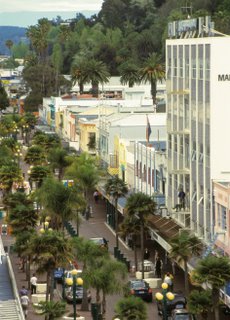
Napier, New Zealand
We were in New Zealand for five days, only enough time to drive a circle around the North Island. Despite our requests, my mother and aunt refused to remove their headscarves. As if the rioters were crossing the Tasman to cause more trouble. The closest we did come to cultural conflict was walking down the main street of Napier in search of breakfast. I noticed the locals staring. Naturally, I presumed the ladies' defiance over their headscarves was disturbing.
Then one of the locals shouted the real cultural reason for the stares. "Why are you wearing that damned Wallabies' jersey in New Zealand?"
Before leaving for New Zealand, I decided to deliver my Christmas gifts early. One recipient of this clean-shaven Islamic Santa's largesse was a Kiwi friend of mine who never met her Muslim dad. This year she will receive a package of three books, including a selection of Rumi poems and the latest Deepak Chopra offering.
As usual, I will spend Christmas Day having lunch with my best mate. We both attended Sydney's only Anglican Cathedral School. Some years back, I introduced him to a Japanese friend. They instantly clicked. I was best man at their wedding.
It was a truly Australian event - an Anglican boy marrying a Buddhist girl with a Muslim best man, all taking place at St Andrews Cathedral.
At age 14, I was given my first translation of the Koran in English, a very old version first published in Lahore during the 1930s and made by a high-ranking Indian civil service named Abdullah Yusuf Ali. The Jesus story can be found in a chapter of the Koran named "Maryam" (Arabic for Mary).
It begins with the usual supplication that commences all but one chapter: "In the name of God, Most Gracious and Most Merciful".
This supplication is used not only when commencing a reading of the Koran, but precedes virtually all the daily actions of a Muslim, both mundane and devotional.
The chapter describes how John the Baptist appeared on the scene. John (named Yahiya in classical Arabic) was born to Zachariah, and both father and son are revered as prophets. Once John has been mentioned, Mary is introduced. She is described as withdrawing from her family "to a place in the East". A messenger from God appears in her private chamber announcing she shall have the gift of a holy son.
Mary: How shall I have a son, seeing that no man has touched me, and I am not unchaste?
Angel: So it will be: Thy Lord saith: "That is easy for Me: and We wish to appoint him as a sign unto men and as a Mercy from Us". It is a matter so decreed.
Following the birth, Mary took her son back to her family. Her father was a respected rabbi and Mary was always known for her modesty and chastity. When she was first publicly accused of sexual impropriety, she pointed to the baby Jesus.
The Koran describes the first miracle of Christ - his speaking from the cradle in defence of his mother.
His exact words were:
"I am indeed a servant of God: He hath given me revelation and made me a prophet. And he hath made me blessed wheresoever I be, and hath enjoined on me prayer and charity as long as I live.
"He hath made me kind to my mother, and not overbearing or miserable. So peace is on me the day I was born, and the day I die, and the day I shall be raised up to life again."
A number of Jesus' other miracles are mentioned in the Koran, as is Christ's ascension. It is not surprising then that in the place where it all happened, the Palestinian town of Beit Lahm (Bethlehem), Muslims and Christians both celebrate Christmas.
In many Muslim countries, Christmas is a public holiday. And when Christian leaders remind us that "Jesus is the reason for the season", our Muslim brethren should find nothing objectionable in this.
Christmas should remind us that, despite cultural and theological differences, the things that unite us are greater and more important than those which divide us.
(First published in the New Zealand Herald on December 22, 2005.)